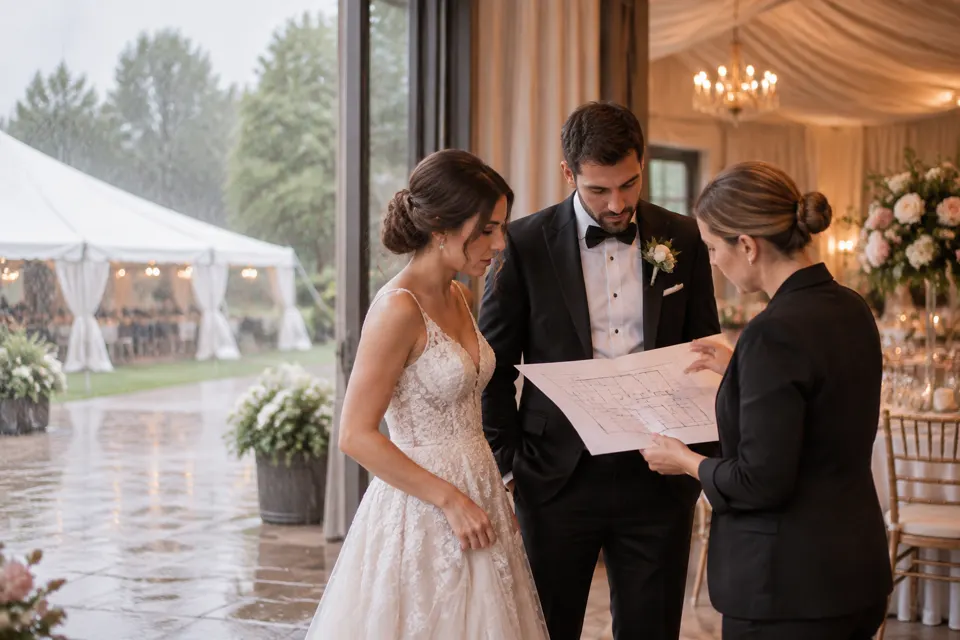
Defining Your Weather Thresholds
Creating a wedding weather backup plan requires moving beyond a simple 'rain or shine' mentality to establish precise, data-driven thresholds for your celebration. By defining specific atmospheric limits now, you remove emotional volatility from the final countdown to your wedding day.
The foundation of a successful backup strategy is identifying the exact moment a outdoor setting becomes a liability. Many couples, like Sarah and David, mistake a light drizzle for the only reason to move inside. However, environmental factors like soil saturation and wind gusts can be just as disruptive. While a global average wedding cost might reach approximately $33,000 (The Knot Real Weddings Study 2025), a significant portion of that investment is tied to guest comfort and floral aesthetics. Establishing hard metrics ensures that you are not making a high-stakes decision based on adrenaline or optimism during the rehearsal dinner.
Quantifying Your Atmospheric Limits
To build your decision matrix, you must analyze three primary categories: precipitation probability, thermal comfort, and wind velocity. For example, a 40 percent chance of rain might be acceptable for a ceremony under a heavy canopy, but the same percentage is a dealbreaker for an open-air cliffside vow exchange. Similarly, wind speeds exceeding 25 kilometers per hour can topple unsecured floral pillars or extinguish hurricane candles. You should sit down with your partner to discuss these numbers. If you are planning in Australia, where the average wedding cost is A$35,315 (Easy Weddings 2025), protecting your photography and decor investment requires these firm boundaries.
| Metric | Level: Yellow (Monitor) | Level: Red (Trigger Plan B) | Impact to Guest Experience |
|---|---|---|---|
| Precipitation | 20 to 40 percent probability | Over 50 percent or any active rain | Ruined attire and slippery surfaces |
| Wind Speed | 15 to 24 km/h | Above 32 km/h | Toppled decor and hair disruption |
| Heat Index | 27 to 31 degrees Celsius | Above 32 degrees Celsius | Dehydration and makeup melting |
| Wind Chill | 13 to 15 degrees Celsius | Below 12 degrees Celsius | Guest shivering and early departures |
Consider the specific needs of your guest list when setting these limits. If your attendees include elderly relatives or infants, your tolerance for extreme temperatures should be much lower. A wedding in Canada, with an average cost of C$30,000 (RBC), often involves unpredictable shoulder seasons where cold snaps are common. In such cases, the threshold for moving indoors might be a temperature drop below 15 degrees Celsius. Discuss these scenarios using a script like: If the forecast shows a 50 percent chance of rain two hours before the ceremony, we will commit to the ballroom to ensure our guests remain dry and comfortable.
Finally, synchronize these thresholds with your venue coordinator and lead planner. In the UK, where weddings average between £20,600 (Bridebook 2024) and £23,000 (Which? 2024), many historic venues have strict rules about when a flip must occur to protect their interiors. Aligning your personal comfort levels with the venue operational requirements prevents friction. By documentating these limits in a shared digital folder, you create a clear roadmap that eliminates second-guessing when the weather app starts showing unfavorable icons. This clarity allows you to focus on the celebration rather than the clouds.
Establishing Your Threshold Checklist
- Determine the maximum wind speed your floral installations can withstand.
- Identify the 'point of no return' time for the venue setup team.
- Assess the shade availability for high-temperature scenarios.
- Check the drainage capability of your outdoor ceremony site.
- Agree on a specific weather app or service to use as the primary source.
- Define the minimum temperature required for an outdoor seated meal.
- Confirm if the backup space requires additional lighting or climate control.
- Consult with your photographer on light requirements for the indoor alternative.
Budgeting for the Invisible Venue
Developing a wedding weather backup plan requires more than just a tent: it demands a strategic financial reserve known as the Plan B Tax. By treating weather readiness as a necessary line item rather than an afterthought, you ensure your celebration remains elegant regardless of the forecast.
Every outdoor event carries a hidden cost structure often referred to as the Plan B Tax. This is the financial commitment required to replicate your primary venue vision in a protected environment. For many couples, the shock of a last minute tent rental price can derail the entire weekend budget. To avoid this, financial planners recommend keeping 10 to 15 percent of your total wedding funds liquid for weather contingencies. This liquidity ensures that if the skies darken, you can authorize immediate logistical changes without compromising other vendor payments or dipping into personal savings meant for your future together.
Calculating Your Contingency Reserve
To determine your specific reserve, look at your region's average costs. The Knot Real Weddings Study 2025 reports the US average is about $33,000, while RBC notes Canada averages C$30,000. In Australia, Easy Weddings 2025 finds the average is A$35,315. For those in the UK, Bridebook 2024 cites £20,600 and Which? 2024 estimates £23,000. If a couple in Sydney, for example, follows the 15 percent rule, they should hold approximately A$5,300 in a dedicated weather fund. This fund acts as a safety net, allowing for high quality flooring or side walls that cheaper alternatives often lack.
| Expense Category | Typical Allocation | Reason for Cost |
|---|---|---|
| Tent Structure | 50 to 60 percent | Rental, delivery, and labor fees |
| Flooring and Subflooring | 20 to 30 percent | Preventing mud and high heel sinkage |
| Climate Control | 10 percent | Industrial fans or space heaters |
| Lighting Upgrades | 5 percent | Replacing natural light under canvas |
| Permits and Insurance | 5 percent | Local safety and fire regulations |
Consider the scenario of Sarah and Mateo. They planned a garden ceremony and only budgeted for the primary venue fee. When a storm was forecast 72 hours out, they discovered that a high quality marquee with a wooden subfloor would cost an additional 20 percent of their total budget. Because they had not set aside a weather reserve, they had to choose between a muddy lawn or canceling their late night catering. A smarter approach is to book your tent deposit early. Most rental companies require a 25 to 50 percent non refundable deposit to hold the inventory, which should be paid during your initial booking phase.
Hidden Expenses Often Overlooked
- Weighting fees for tents on hard surfaces where stakes are not allowed
- Delivery surcharges for holiday weekends or remote locations
- Late night labor fees for breakdown during rain
- Additional generator power for heated lamps or cooling units
- Protective walkway matting for guest transit between the tent and restrooms
- Temporary cloakroom facilities for wet umbrellas and coats
The psychological benefit of this budget cannot be overstated. When you have the funds allocated, a rain forecast becomes a logistical shift rather than a financial crisis. Ensure your contracts with rental companies specify the latest possible date to confirm the full installation. Usually, this is 48 to 72 hours before the event. If the weather is clear, that 10 to 15 percent reserve can be redirected toward a post wedding brunch or a surprise upgrade for the honeymoon. This creates a win win situation where your budget remains intact regardless of the environmental conditions.
Financial Readiness Checklist
- Calculate 15 percent of your total budget for a weather fund
- Confirm tent rental deposit terms and refund deadlines
- Obtain a quote for professional flooring to prevent mud issues
- Verify if your wedding insurance covers weather related cancellations
- Set aside specific funds for heavy duty umbrella purchases
- Check for hidden delivery fees in your rental contracts
- Account for extra lighting needs if the sky is overcast
- Review generator capacity for additional heaters or fans
Mapping the Interior Pivot
Successfully executing a wedding weather backup plan requires more than just moving indoors. It demands a technical understanding of spatial dynamics and time management to ensure the transition feels like a design choice rather than an emergency measure.
The technical core of a wedding weather backup plan involves the Room Flip. This is the orchestrated process of converting a ceremony space into a reception hall while guests are distracted elsewhere. When your outdoor options vanish due to rain, your indoor square footage must perform double duty. A successful flip relies on a detailed furniture map that accounts for every inch of floor space. You must identify where the altar will sit, where the dining tables will be staged during the ceremony, and exactly how the catering staff will navigate the room without causing a bottleneck. Spatial efficiency is the difference between a seamless transition and a cluttered chaos.
Case Study: The Sixty Minute Tropical Shift
Elena and Kofi planned an expansive lawn ceremony in a coastal region known for sudden weather shifts. When a tropical storm forced their wedding weather backup plan into action, they faced the challenge of converting their single 250 square meter ballroom from a seated ceremony for 150 guests into a full banquet layout. Their secret weapon was a pre-planned furniture map color coded by phase. Because they had pre-set the dining tables behind a heavy velvet drape at the rear of the hall, the crew only needed to move the chairs and roll the tables forward. This preparation allowed them to complete the entire turnover in exactly 60 minutes while guests enjoyed cocktails in a sheltered veranda.
To replicate this success, couples should utilize a staging ratio. Aim for at least 1.5 square meters per guest for a seated ceremony and 2.5 square meters for a reception with a dance floor. If your indoor space falls below these metrics, you must prioritize multifunctional furniture. For example, use the ceremony chairs for the dining tables rather than renting two separate sets. This reduces the number of items that need to be moved or stored during the transition. Every piece of decor should have a designated home for both Phase A and Phase B to prevent the venue from feeling like a storage unit during the flip.
| Function | Space Per Guest | Required for 100 Guests | Buffer Goal |
|---|---|---|---|
| Theater Ceremony | 1.0 - 1.2 sqm | 120 sqm | 10 percent |
| Seated Banquet | 1.8 - 2.2 sqm | 200 sqm | 15 percent |
| Cocktail Staging | 0.7 - 0.9 sqm | 80 sqm | 5 percent |
| Dance Floor Area | 0.3 - 0.5 sqm | 40 sqm | 20 percent |
A common mistake is forgetting the transition of the floral installations. If your wedding weather backup plan involves moving a heavy floral arch from the garden to the indoor stage, you must account for the manpower and time required. Large installations often require two to three people to move safely. Without a specific plan for these focal points, the indoor space can feel sparse. By mapping out the weight and dimensions of these pieces in advance, you ensure that the aesthetic quality of your wedding remains high despite the change in location. Planning for these logistics allows the couple to focus on the celebration rather than the mechanics of the room.
The Technical Interior Pivot Checklist
- Create two distinct floor plans for the indoor space: Ceremony and Reception.
- Designate a hidden staging area for tables and bulky decor items.
- Confirm the number of staff members available for the 60 minute flip.
- Verify that all floral installations are mobile or have an indoor equivalent.
- Measure all doorways to ensure pre-assembled tables can pass through.
- Identify the specific location for the sound system and DJ during the flip.
- Plan a guest flow route that avoids the main room during the transition.
- Allocate a 15 percent time buffer for unexpected logistical delays.
- Confirm that the venue HVAC system can handle a full room of guests for eight hours.
Ultimately, the interior pivot is a test of logistical foresight. While the average cost of a wedding reaches about $33,000 in the US (The Knot Real Weddings Study 2025) or approximately A$35,315 in Australia (Easy Weddings 2025), none of that investment matters if the guests are standing in the rain. By treating the indoor space with the same design rigor as the outdoor original, you protect your financial and emotional investment. The transition should be practiced with your coordinator at the final walk through to ensure every vendor knows their specific role in the choreography of the room flip.
Synchronizing Your Vendor Team
A successful wedding weather backup plan relies on a unified front of professionals who know exactly when to shift from the sunshine scenario to the sheltered alternative. Clear communication and ironclad contract clauses ensure your team acts as one cohesive unit when the clouds roll in.
The foundation of vendor synchronization is the 'Final Call' clause. Many couples mistakenly assume they hold the power to delay until the last second. However, professional contracts often stipulate that the venue manager or lead planner makes the ultimate decision based on safety and logistics. For example, if Sarah and Mark are planning a cliffside ceremony, their florist may have a clause stating that installations cannot proceed if winds exceed 30 kilometers per hour. Review your contracts to see if the decision maker is you, the planner, or the venue. Clarity here prevents mid morning arguments while the rain begins to fall.
Vetting Talent for Adverse Conditions
When interviewing photographers, do not just look at their golden hour highlights. Request a rainy day portfolio or a full gallery from a wedding with poor weather. A photographer like Chloe, who thrives in natural light, might struggle if forced into a dark ballroom. Use this script: We love your style, but could you share a full gallery from a wedding where the ceremony was moved indoors due to rain? We want to see how you handle artificial lighting and tight indoor spaces. This ensures your investment, which contributes to global averages like the UK 20,600 pound figure reported by Bridebook 2024, is protected regardless of the sky.
Catering and Floral Adjustment Scripts
- To the Caterer: If the ceremony is delayed by 30 minutes due to a weather transition, what is the latest possible time we can push back the main course service without compromising food quality?
- To the Florist: If we pivot to the indoor Plan B, which specific floral elements from the outdoor arch can be repurposed for the indoor mantle or aisle entrance?
- To the DJ or Band: Do you have specialized covers for your electronic equipment, and what is the minimum distance you require from an open window or tent edge?
- To the Rental Company: In the event of rain, will your team stay on site to move chairs between the ceremony and reception spaces, or is that a separate labor fee?
Logistics for catering require precise timing because food safety and temperature are non negotiable. If a ceremony is delayed to wait out a passing cell, the kitchen must be notified immediately to pause preparations. For instance, if an Australian couple, aiming for the A$35,315 average wedding cost cited by Easy Weddings 2025, experiences a 45 minute delay, their catering lead should have the authority to extend the cocktail hour. This prevents the primary meal from sitting under heat lamps while guests are still finding their seats in the backup indoor space.
Finally, synchronize your florist with your venue staff regarding the physical movement of decor. Rain often means high humidity, which can cause certain blooms to wilt faster or petals to stain indoor carpets. Ask your florist: What is the plan for drying off the bridal arch before it is moved inside? You do not want soaked floral foam dripping onto the indoor dance floor. By addressing these granular details during the planning phase, you ensure that the transition to your indoor space feels like a deliberate choice rather than a chaotic compromise.
The 48-Hour Communication Window
When your weather threshold is crossed, the 48-hour window marks the transition from hopeful observation to decisive action. This period requires a systematic approach to wedding weather backup plan execution to ensure your guests arrive prepared and your logistics remain seamless.
Effective communication begins the moment the decision to move indoors or under a tent is finalized. For a couple like Sarah and David, who planned an outdoor ceremony in a public park, the 48-hour mark was the point where they ceased checking the forecast every hour and committed to their Plan B. At this stage, the priority shifts from aesthetic perfection to guest comfort. You must notify all attendees of the specific changes to the arrival time, parking instructions, or venue entrance. Clarity prevents confusion, ensuring that your investment, which reflects global averages like A$35,315 according to Easy Weddings 2025, is protected through organized logistics.
The primary method for notification should be a multi-channel approach. Start with a clear update on your wedding website homepage, followed by an email blast to your guest list. For time-sensitive changes, such as a shift in location or a 30-minute delay to allow a storm cell to pass, SMS alerts are most effective. Use a tone that is helpful and proactive rather than apologetic. If you are moving a ceremony due to extreme heat, frame the message around the luxury of climate control and chilled refreshments rather than the loss of the outdoor vista. This framing keeps the celebratory energy high.
Drafting Your Weather Update Messages
Essential Scripts for Guest Notifications
- Email Subject: Important Update: New Location for the [Name] Wedding Ceremony
- Email Body: We are so excited to celebrate with you! To ensure everyone stays dry and comfortable, we have moved our ceremony to [New Room/Location Name]. Please arrive at [Time] at the [Specific Entrance].
- SMS Script 1 (Rain): Weather Update: We are moving the party indoors! Join us at [New Location] at [Time]. Please use the valet entrance for easy access to the coat check.
- SMS Script 2 (Heat): It is going to be a scorcher! We have moved our ceremony to the air-conditioned [Location] so we can celebrate in comfort. See you at [Time].
- Website Banner: Plan B is in motion! Ceremony now at [Location]. Free shuttle starts at [Time] from the hotel lobby.
Logistical adjustments within the venue are just as critical as the messages themselves. If rain is the culprit, your 48-hour checklist must include a designated coat check or umbrella station. Guests arriving in wet outerwear need a place to store these items so they do not clutter the reception space or dampen seating. If the pivot is due to extreme heat, this is the time to confirm with your caterer that cooling stations with infused water or handheld fans are ready for the interior arrival. These small touches show guests that their experience was prioritized despite the change in scenery.
| Timeframe | Action Item | Primary Contact | Logistical Focus |
|---|---|---|---|
| T-Minus 48 Hours | Final Weather Decision | Couple and Planner | Confirm Plan B Layout |
| T-Minus 47 Hours | Digital Updates | Designated Bridesmaid | Website and Email Blast |
| T-Minus 24 Hours | Vendor Re-Confirmation | Wedding Planner | Delivery of Rentals |
| T-Minus 12 Hours | SMS Alert | Best Man or Maid of Honor | Arrival Instructions |
| T-Minus 2 Hours | Station Setup | Venue Manager | Coat Check and Cooling |
Mistakes often occur when couples rely on word of mouth or social media posts that get lost in algorithms. Avoid the trap of assuming everyone will check the wedding website on the morning of the event. A direct text message is the only way to ensure 90 percent or more of your guests receive the update in real time. Remember that your wedding weather backup plan is not just about the rain plan, it is about managing the flow of people. By providing clear directions, you prevent a bottleneck at the new entrance and keep the timeline on track for your celebration.
The 48-Hour Logistics Checklist
- Confirm the number of attendants needed for the coat check station.
- Verify that all signage for the new location is printed and visible.
- Update the Google Maps link on the wedding website if the address changed.
- Assign one person to answer phone calls from lost guests on the day.
- Ensure the venue has extra floor mats at the entrance to prevent slipping.
- Check that the backup space temperature is adjusted 3 hours before arrival.
- Test the microphone system in the new indoor ceremony space.
- Distribute the updated floor plan to the catering and photography teams.
Finally, consider the psychological impact of the 48-hour window on your own wellbeing. Once the notifications are sent, the decision is out of your hands. This allows you to stop mourning the outdoor vision and start embracing the new atmosphere. Whether your wedding reflects the UK average of £20,600 per Bridebook 2024 or a different regional benchmark, the success of the day depends on your presence. Guests will take their cues from you. If you are radiant and relaxed in the indoor ballroom, they will focus on the joy of the occasion rather than the clouds outside the window.
Beyond Rain: Managing Heat and Wind
While most couples focus exclusively on precipitation, extreme temperatures and high winds often present more significant structural and physical risks to a wedding weather backup plan.
Heat and wind require a different logistical approach than rain because they affect guest health and structural integrity directly. In a 2025 study by The Knot, the US average wedding cost reached $33,000, yet many couples neglect the 'comfort costs' of outdoor summer celebrations. For example, Sarah and Mark planned a beach ceremony where 35 degree Celsius heat led to two guests fainting. High temperatures necessitate a proactive hydration formula to prevent medical emergencies. You should provide 0.5 liters of water per guest for every hour spent outdoors in heat exceeding 27 degrees Celsius. This volume is separate from bar service and should be distributed immediately upon arrival to ensure guest safety before the ceremony begins.
The Invisible Threat: Understanding Wind Loads
Wind is frequently more dangerous for decor and structures than light rain. While a drizzle might ruin linens, a strong gust can transform a floral arch or a marquee into a projectile. Professionals use the Beaufort Scale to determine safety thresholds. If you observe twigs breaking off trees or feel difficulty walking against the wind, you have reached Beaufort 6, which is roughly 40 to 50 kilometers per hour. At this stage, most temporary structures like pop up gazebos must be dismantled. A wedding weather backup plan must include a specific wind speed trigger where all tall decor, including candelabras and unstable backdrops, is moved indoors to prevent injury.
| Beaufort Number | Wind Speed (km/h) | Visual Cues | Action Required |
|---|---|---|---|
| 3 | 12 to 19 | Leaves and small twigs move | Secure light linens and menus |
| 4 | 20 to 28 | Dust and loose paper raised | Weight all floral pillars |
| 5 | 29 to 38 | Small trees begin to sway | Lower umbrellas and sails |
| 6 | 39 to 49 | Large branches in motion | Evacuate tents and marquees |
Managing high heat involves more than just shade. It requires a fundamental shift in the event timeline. If the forecast predicts record highs, consider delaying the ceremony by 30 minutes to allow the sun to drop lower. This reduces the UV index and cooling costs. In Australia, where the average wedding cost is A$35,315 according to Easy Weddings 2025, couples often invest 5 percent of their budget into professional grade misting fans or portable air conditioning units. These mechanical interventions are vital when the humidity index makes the perceived temperature feel significantly higher than the actual reading, as stagnant air can lead to heat exhaustion even in shaded areas.
Structural failures due to wind are often the result of the 'sail effect'. Large flat surfaces like signage or fabric backdrops catch the wind and exert massive pressure on their supports. During a garden wedding in Canada, where the average cost is C$30,000 per RBC, a couple lost their entire reception backdrop because it was not vented. To mitigate this, ensure all outdoor signage is heavy or includes wind slits. Use sandbags or water weights for all tripod stands. If your venue is in a high wind corridor, prioritize low profile centerpieces and heavy glassware that cannot be easily displaced by a sudden gust.
Heat and Wind Mitigation Checklist
- Calculate water needs using the 0.5 liter per guest per hour formula.
- Verify tent ballast weights meet the manufacturer wind rating.
- Identify a shaded cool down zone with seating for elderly guests.
- Replace tall tapered candles with glass encased hurricane lamps.
- Secure all outdoor linens with heavy duty clips or hidden weights.
- Assign a bridesmaid or groomsman to monitor local wind speed apps.
- Provide electrolyte packets at the welcome beverage station.
- Ensure the sound system has wind muffs for all outdoor microphones.
- Confirm the florist has anchored all tall installations to fixed structures.
Finally, remember that the psychological impact of heat can be as draining as rain. Guests who are sweating or battling wind gusts will likely leave the dance floor earlier. By integrating cooling stations and wind breaks into your wedding weather backup plan, you maintain the energy of the celebration. In the UK, where Bridebook 2024 notes an average cost of £20,600, indoor pivots for the reception are common when heatwaves strike. Always prioritize the physical comfort of the collective over the aesthetic vision of an outdoor setting if the temperature exceeds your pre-determined safety threshold.
The Psychological Pivot
The final stage of a wedding weather backup plan is not logistical but emotional, requiring a shift from the dream of an outdoor landscape to the intimacy of an interior space. Mastering this psychological transition ensures that a change in atmospheric conditions does not overshadow the commitment being celebrated.
The transition from an expansive outdoor vision to a confined indoor setting often triggers a sense of loss for couples who have spent months visualizing a specific horizon. This emotional friction is natural. When Chloe and Marcus realized their mountain ceremony would move to a hotel ballroom due to gale force winds, they felt an immediate wave of disappointment. To manage this, couples should implement the Five Minute Mourning rule. This technique allows both partners exactly five minutes to express their frustrations, sadness, or anger about the weather. Once the timer stops, the focus must shift entirely to the functional reality of the indoor celebration.
Refocusing on Purpose Over Aesthetic
Aesthetic backdrops are secondary to the legal and spiritual union taking place. While an outdoor setting provides a canvas, the couple provides the art. When the weather forces a move, the physical proximity of guests in an indoor space often creates an unintended benefit of heightened intimacy. Instead of looking at a distant horizon, the couple is forced to look at their guests and each other. This shift in perspective helps prioritize the exchange of vows over the perfection of the photos. By acknowledging that the ceremony is an action rather than a photoshoot, couples can reclaim their joy regardless of the ceiling height.
| Feature | Outdoor Vision | Indoor Reality | Emotional Benefit |
|---|---|---|---|
| Acoustics | Wind and ambient noise | Clear and resonant | Vows are heard clearly by all |
| Proximity | Spaced out seating | Close and cozy | Greater sense of community |
| Visuals | Natural landscape | Decor and lighting | Focused attention on the couple |
| Comfort | Variable temperatures | Climate controlled | Relaxed and happy guests |
| Photography | Natural light | Studio style lighting | Consistent and flattering shots |
The psychological pivot also requires a shift in how you communicate with your bridal party. If the couple appears devastated by the rain, the guests will mirror that discomfort. If the couple embraces the change with humor and grace, the atmosphere becomes one of adventure. For instance, if the plan pivots, use a script like: We are so excited to bring everyone closer together in this beautiful room to keep the focus on our promises. This framing signals to the room that the weather is a minor footnote in a much larger story. It transforms the backup plan from a failure into a deliberate choice.
Ultimately, the wedding weather backup plan is a tool for peace of mind. While the average wedding costs are significant, such as A$35,315 in Australia (Easy Weddings 2025) or C$30,000 in Canada (RBC), the value of the day is not tied to the location. In the UK, where costs range from £20,600 (Bridebook 2024) to £23,000 (Which? 2024), and in the US, where the average is about $33,000 (The Knot Real Weddings Study 2025), the investment is in the marriage itself. By accepting the pivot, you ensure that the memory of the day is defined by love rather than a meteorology report.
Steps for Emotional Readiness
- Set a five minute timer to vent all weather related frustrations.
- Identify three specific indoor features you love about the backup space.
- Brief the wedding party on maintaining a positive attitude for the guests.
- Practice your vows in the indoor space to build comfort with the acoustics.
- Choose a high energy song for the indoor processional to lift the mood.
- Verify that the indoor lighting plan highlights the altar area.
- Update your inner monologue from 'we have to' to 'we get to' be indoors.
- Focus on the faces of your guests rather than the windows.
- Trust your professional team to execute the aesthetic transition.