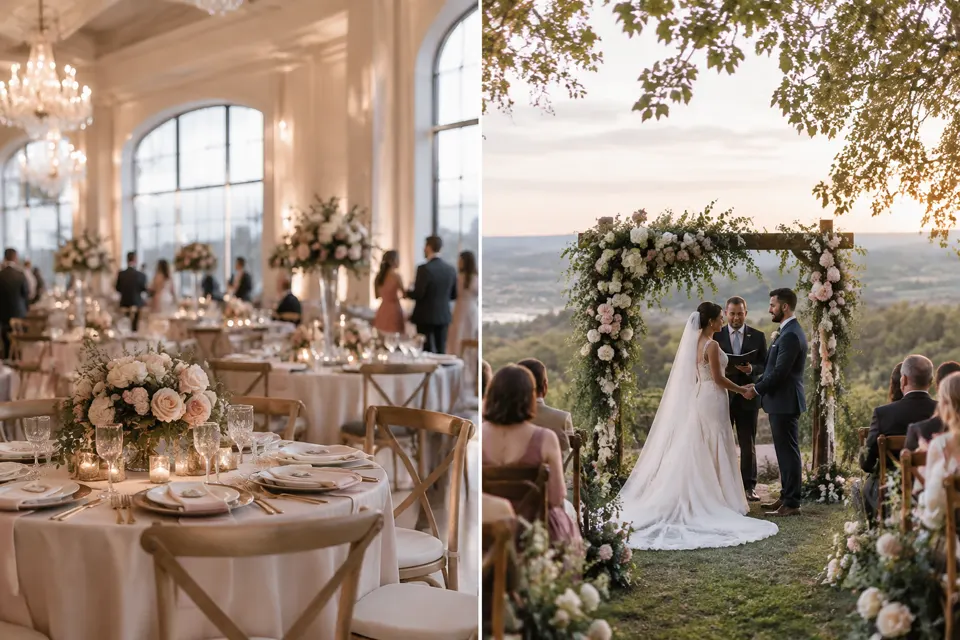
Financial Realities: Hidden Costs of Each Setting
Deciding between indoor versus outdoor wedding venues requires a deep dive into the logistical infrastructure that impacts your bottom line. While a natural landscape may seem budget friendly, the hidden costs of building a venue from scratch often exceed the price of a traditional ballroom.
When couples begin their planning journey, the sticker price of a venue often dictates their initial direction. According to The Knot Real Weddings Study 2025, the US average for a wedding is about $33,000, while Bridebook 2024 reports the UK average at about £20,600. In Australia, Easy Weddings 2025 places the average at A$35,315. These figures provide a baseline, but the allocation of these funds shifts dramatically depending on whether you choose a four walled space or an open field. Indoor venues typically provide a turnkey solution where the base price covers the essential bones of the event, allowing couples to focus their remaining budget on personalization rather than basic necessities.
The Savings Hidden Within Four Walls
Indoor venues, such as hotels or dedicated event spaces, often include hard goods like banquet chairs, dining tables, and basic linens in their rental fee. Incorporating these items can represent a 10 to 15 percent savings on the total decor and rental budget. Beyond furniture, indoor settings provide built in climate control and lighting systems. For couples like Chloe and Sam, choosing a ballroom meant they avoided the expense of hiring an electrician to ensure the power grid could handle a live band and professional catering equipment. This structural readiness allows the couple to allocate funds toward premium food or photography rather than utility logistics.
To illustrate the financial contrast, consider a sample scenario where Chloe and Sam compare a city ballroom to a secluded meadow. The ballroom quote was all inclusive, covering the kitchen use, staff, and furniture. In the meadow, they discovered that to achieve the same level of guest comfort, they needed to rent a high quality marquee for weather protection. This addition alone, combined with the necessity of a satellite kitchen for their caterers, added significant weight to their expenses. While the meadow had no 'venue fee,' the logistical rentals effectively surpassed the ballroom's flat rental rate by several thousand units of currency.
| Expense Category | Ballroom (Indoor) | Meadow (Outdoor) |
|---|---|---|
| Furniture Rentals | Included in fee | 10-15% of budget |
| Power & Lighting | Included in fee | Extra generators required |
| Sanitation | On-site restrooms | Portable luxury units |
| Weather Protection | Permanent roof | Tenting (20% increase) |
| Kitchen Access | Full commercial site | Satellite setup fee |
International couples must also consider regional averages such as Canada's C$30,000 baseline cited by RBC or the UK's £23,000 average from Which? 2024. Regardless of the country, the financial rule remains the same: indoor venues offer predictable costs, while outdoor venues offer a blank canvas with a variable price tag. If you choose the outdoors, you must be prepared for the 'bring-in' costs that ensure the event functions smoothly. For Chloe and Sam, the peace of mind offered by the ballroom's inclusive package outweighed the rustic charm of the meadow, primarily because their budget could not absorb the 20 percent infrastructure surge.
Hidden Cost Audit for Outdoor Venues
- Confirm if the site has sufficient power for a DJ and catering ovens.
- Check for accessible, high quality restrooms within walking distance.
- Calculate the cost of a 'Plan B' tent including delivery and setup.
- Assess if the ground requires professional leveling or flooring.
- Budget for lighting to ensure guest safety in parking areas.
- Inquire about water access for the catering team's cleanup.
- Account for additional labor hours for off-site rental delivery.
- Verify if trash removal and site cleanup are included in the rental.
The Environment Impact Framework
When comparing indoor versus outdoor wedding venues, couples must evaluate how the physical environment dictates the sensory experience of their guests. This section introduces a rigorous assessment model to move past aesthetic preferences and into functional venue logistics.
The first step in selecting a location is applying a standardized metrics system to remove emotional bias. Consider a couple like Sarah and David, who fell in love with a clifftop view but failed to account for the acoustic interference of wind. By using a five point scoring system, you can rank lighting, sound control, accessibility, and temperature from one, which indicates poor or unreliable conditions, to five, which represents total environmental mastery. This framework forces you to quantify the comfort of your elderly relatives and the quality of your wedding speeches before signing a contract. A high aesthetic score cannot compensate for a low functional score.
Climate Control and the Plan B Dilemma
Indoor venues offer the distinct advantage of 100 percent climate control, allowing for precise temperature regulation regardless of external heatwaves or cold snaps. This stability eliminates the need for expensive cooling or heating rentals. Conversely, outdoor venues necessitate a Plan B rental deposit, which is often a non refundable fee to hold a tent or marquee. While the average wedding cost in the UK is around £20,600 according to Bridebook 2024, an unplanned tent rental can increase that budget by 15 percent overnight. You must decide if the natural backdrop justifies the financial risk of paying for a space you hope never to use.
| Feature | Indoor Venue (1 to 5) | Outdoor Venue (1 to 5) | Primary Risk Factor |
|---|---|---|---|
| Lighting Control | 5 (Full dimming) | 2 (Solar dependent) | Golden hour timing |
| Acoustic Clarity | 4 (Echo possible) | 1 (Wind/Wildlife) | Microphone feedback |
| Thermal Comfort | 5 (HVAC systems) | 2 (Peak sun exposure) | Guest dehydration |
| Power Access | 5 (Built in outlets) | 3 (Generator reliant) | Circuit overload |
| Accessibility | 4 (ADA compliance) | 2 (Uneven terrain) | Mobility limitations |
Power grid capacity is a frequent oversight for outdoor celebrations. When Chloe and Marcus planned their forest reception, they assumed the single outlet on the property shed could power their DJ, fairy lights, and catering warmers. They experienced a total blackout during the first dance. Indoor venues typically have industrial grade electrical infrastructure designed for high wattage. For outdoor sites, you must verify if the site can handle your specific lighting rig without blowing a fuse. This requires a direct technical conversation with the venue manager to confirm if you need to budget for a whisper quiet tow behind generator.
Script for Venue Managers Regarding Power Infrastructure
- What is the total amperage available at the outdoor ceremony site specifically for lighting and audio?
- Are the outdoor circuits dedicated to event production, or do they share a load with catering appliances?
- Do you have a map of all outdoor power drops and their proximity to the main stage area?
- In the event of a circuit failure, is there an on site technician available to reset the breakers immediately?
- If we bring in a generator, where is the designated parking spot that minimizes engine noise for the guests?
Finalizing your decision requires looking at the global financial context of wedding planning. With the US average at about $33,000 per The Knot Real Weddings Study 2025, and Australia seeing costs around A$35,315 according to Easy Weddings 2025, every environmental variable carries a price tag. In Canada, where the average is C$30,000 per RBC, the cost of heating an outdoor tent in the autumn can be prohibitive. Use the Environmental Impact Framework to ensure that your venue choice aligns with both your vision and the reality of your guests physical needs. Avoid the mistake of choosing a view over basic human comfort.
Environmental Assessment Checklist
- Verify the distance to the nearest indoor restroom for outdoor setups.
- Test the acoustic levels during peak traffic or wind hours.
- Check for overhead flight paths that may disrupt the ceremony audio.
- Confirm the availability of shade for guests during the warmest part of the day.
- Evaluate the flooring surface for guests using heels or mobility aids.
- Identify the specific 'trigger time' for moving to the Plan B location.
- Audit the venue for existing lighting fixtures and dark spots.
- Ask for the maximum wattage capacity of the outdoor electrical panel.
Weather Proofing: Beyond the Rain Plan
When comparing indoor versus outdoor wedding venues, weather proofing requires a strategic shift from simply avoiding rain to actively managing temperature and air movement. This section provides a logistical framework for maintaining guest safety and aesthetic integrity regardless of the forecast.
The primary mistake couples make with outdoor settings is viewing the rain plan as a binary choice. Effective weather proofing involves tiered responses to thermal discomfort and wind speed. For extreme heat, the strategy focuses on thermodynamic cooling. This includes high velocity fans placed at floor level to move air without disrupting table settings and hydration stations that provide electrolyte infused water rather than just iced tea. When temperatures exceed 32 degrees Celsius, planners must account for the melting point of floral arrangements and the structural integrity of tiered cakes. Transitioning to an indoor space should occur if the heat index creates a risk of heat exhaustion for elderly guests.
The Three Hour Rule for Venue Transitions
Decision paralysis often leads to logistical chaos during unpredictable weather. To avoid this, utilize the Three Hour Rule. This framework mandates that a final, irreversible decision on the ceremony location must be made exactly 180 minutes before the first guest arrives. This window provides the catering team, florists, and audiovisual technicians enough time to strike the outdoor set and calibrate the indoor environment. If the chance of precipitation is above 40 percent or if wind gusts are projected to exceed 30 kilometers per hour at the three hour mark, the ceremony must move inside to ensure the safety of the decor and the comfort of the attendees.
Wind is an often overlooked factor in the indoor versus outdoor wedding venues debate. During their outdoor ceremony, Amara and Leo faced a sudden windstorm that threatened their high profile floral pillars. Their team successfully managed the crisis by utilizing weighted steel plates hidden within the floral installations and deploying heavy duty tent anchors rated for high tension. They also pre-emptively swapped light silk table runners for weighted linens to prevent table settings from blowing away. This scenario highlights that outdoor success depends on structural reinforcement. Using museum wax to secure centerpieces and opting for heavier seating materials like wrought iron or solid wood can prevent wind related damage.
| Environmental Factor | Threshold Level | Immediate Action Step |
|---|---|---|
| Ambient Temperature | Above 32°C / 90°F | Deploy cooling fans and cooling towels |
| Wind Speed Gusts | Over 30 km/h / 18 mph | Remove tall florals and secure umbrellas |
| Humidity Levels | Above 80 Percent | Activate indoor dehumidifiers for hair/makeup |
| Rain Probability | Above 40 Percent | Initiate the Three Hour Rule move |
| Night Temperature | Below 15°C / 59°F | Distribute blankets and activate heaters |
Beyond the physical structures, weather proofing extends to the sensory experience of the guests. If choosing an outdoor path, the budget must accommodate mechanical interventions. While the US average cost for a wedding is about $33,000 according to The Knot Real Weddings Study 2025, those opting for outdoor venues often spend an additional 10 to 15 percent on climate control rentals. In Australia, where the average is about A$35,315 per Easy Weddings 2025, sun protection becomes a major cost. Proper weather proofing means ensuring that the transition from a hot exterior to a cooled interior does not result in condensation issues for photography equipment or guest discomfort due to extreme temperature swings.
Essential Weather Proofing Logistics
- Verify tent ballast weight requirements with the rental company.
- Confirm the location of secondary power generators for cooling systems.
- Secure tall floral installations with floor plates or hidden sandbags.
- Prepare a backup kit containing static spray and hair pins for wind.
- Assign a specific person to monitor the local radar every 30 minutes.
- Draft a guest communication template for last minute location changes.
- Ensure all outdoor electrical connections are elevated and waterproofed.
- Check that indoor backup spaces have functioning climate control systems.
- Stock sunscreens and insect repellents in discreet guest baskets.
Ultimately, the choice between indoor versus outdoor wedding venues relies on your risk tolerance. An indoor venue offers a controlled environment where the design remains static regardless of the elements. However, an outdoor venue provides a unique atmosphere that can be successfully managed with the right infrastructure. By implementing heavy duty anchoring systems like Amara and Leo and adhering to strict decision timelines, couples can mitigate the risks associated with Mother Nature. A successful plan is one that recognizes the limits of the environment and prioritizes the structural safety of the event over the initial aesthetic vision if conditions become hazardous.
Capturing the Moment: Lighting Challenges
Photographic success when comparing indoor versus outdoor wedding venues hinges on a couple's ability to master the behavior of natural and artificial light sources.
The primary draw of an open air celebration is the Golden Hour, that fleeting window shortly before sunset when the sun sits low on the horizon. This period provides a soft, warm glow that eliminates harsh shadows and creates a romantic haze. However, relying on this window is a calculated risk. For instance, a couple named Sarah and David planned their ceremony at 5:00 PM to hit the peak light, but a sudden cloud cover shifted the color temperature from warm amber to a cool blue. Outdoor photography demands constant recalibration of camera settings to manage the high contrast between bright skies and shaded faces.
The Thirty Percent Buffer Rule
Couples must account for the fact that outdoor weddings require thirty percent more flexibility in their photography timeline compared to indoor settings. This buffer is necessary because shadows move rapidly as the earth rotates. A perfect portrait spot at 2:00 PM might be bisected by a sharp, unflattering shadow from a tree branch by 2:45 PM. Unlike indoor venues where light is static, outdoor photographers must constantly scout the grounds to find even lighting. If the ceremony runs fifteen minutes late, the sun may dip behind a hill, forcing a total relocation of the family portrait session to find usable light.
Indoor venues offer a controlled flash environment where the photographer acts as the master of light. In a banquet hall or historic manor, professionals use external flashes to bounce light off surfaces, creating a consistent look regardless of the time of day. Consider a couple like Elena and Marcus who chose a windowless ballroom. While they lost the sunset view, they gained total consistency. Their photos taken at noon looked identical in quality to those taken at midnight. The challenge here is not the sun, but the architecture itself, specifically the color and height of the surfaces the light must bounce off.
While indoor lighting is predictable, it can become flat or yellow if the venue uses low quality LED bulbs or mixed light sources. A common mistake is assuming that a room with many windows is always better. During a midday indoor ceremony, large windows can create a backlighting nightmare where the subjects appear as dark silhouettes against a blown out white background. To avoid this, couples should look for venues with neutral wall colors. Dark wood paneling or deep red carpets will absorb light and reflect those specific hues onto the skin tones of the wedding party, making post production editing much more difficult.
Indoor Venue Lighting Evaluation Checklist
- Measure the ceiling height: ceilings over four meters make bouncing flash difficult.
- Check ceiling color: white or light cream is ideal for clean light reflection.
- Locate all windows and identify which direction they face (North, South, East, West).
- Test for mixed lighting: turn on the house lights to see if they clash with natural daylight.
- Identify 'dead zones' where no overhead lighting or windows reach.
- Ask if the venue allows the use of off-camera light stands in the corners of the room.
- Evaluate the intensity of exit signs or emergency lights that cannot be dimmed.
- Check for sheer curtains that can be used to diffuse harsh direct sunlight.
- Confirm if the venue uses dimmable tungsten bulbs or non-dimmable fluorescent tubes.
Ultimately, the choice between indoor versus outdoor wedding venues is a trade off between the ethereal beauty of nature and the technical reliability of a hall. While the average cost of a wedding in Australia is about A$35,315 according to Easy Weddings 2025, a significant portion of that investment goes toward capturing memories. If your budget is tight, an indoor venue may save money on specialized lighting equipment rentals. However, if you prioritize the natural aesthetic, ensure your photographer has a proven portfolio of handling shifting shadows and the high dynamic range found in the great outdoors.
Prioritizing Guest Experience and Comfort
When debating indoor versus outdoor wedding venues, the deciding factor often rests on how well the environment serves your guests' physical comfort throughout the celebration. A beautiful backdrop loses its charm if attendees are shivering or struggling to hear the vows over echoing acoustics.
For outdoor weddings, guest comfort requires a proactive strategy rather than a reactive one. A 'Comfort Station' serves as a centralized hub to mitigate environmental stressors before they become distractions. If hosting a summer ceremony in Italy, Sarah and Marco might stock their station with high SPF sunblock, eucalyptus infused cooling towels, and battery operated fans. Conversely, for a late autumn wedding in the Canadian Rockies, the same station would feature wool blankets, hand warmers, and pashminas. These details ensure that guests focus on the ceremony rather than their own physical discomfort, preventing early departures and enhancing the overall mood of the event.
Managing Environmental Stressors and Soundscapes
Indoor venues present a different set of challenges, primarily centered on acoustics and noise levels. Hard surfaces like marble floors, high vaulted ceilings, and glass walls can create an echo chamber that makes conversation difficult and distorts music. To manage this, couples like Liam and Chloe should prioritize spaces with soft furnishings or request the installation of pipe and drape to absorb sound. During the site visit, test the acoustics by having one person speak at the altar while the other stands at the back of the room. If the sound bounces excessively, you must factor in the cost of high quality audio reinforcement to ensure every guest hears the vows clearly.
| Feature | Outdoor Requirement | Indoor Requirement | Guest Impact |
|---|---|---|---|
| Restrooms | 2 units per 50 guests | Internal plumbing access | Prevents long queues |
| Temperature Control | Misting fans or heaters | HVAC monitoring | Prevents heat stroke or chills |
| Acoustics | Wind resistant microphones | Sound absorbing decor | Ensures clear communication |
| Hydration | Iced water stations | Constant water service | Maintains guest energy |
| Lighting | Pathway safety lights | Dimmable overheads | Ensures safe navigation |
Logistical planning for remote outdoor locations must account for basic biological needs, specifically restroom access. A common mistake is underestimating the quantity of facilities needed for a crowd. Use this specific formula for remote sites: Total Guests divided by 50, then multiplied by 2, equals the required number of individual restroom units. For a 150 person wedding in a remote field, you should provide at least 6 units. While the US average wedding cost is about $33,000 according to The Knot Real Weddings Study 2025, and Canada is about C$30,000 per RBC, failing to budget for luxury portable toilets in remote areas can severely degrade the guest experience regardless of total spend.
Ultimately, the choice between indoor versus outdoor wedding venues depends on your willingness to manage these variables. An indoor venue in the UK, where the average cost is between £20,600 (Bridebook 2024) and £23,000 (Which? 2024), offers a controlled environment where you can regulate the thermostat and lighting precisely. In Australia, where the average is A$35,315 per Easy Weddings 2025, many couples opt for outdoor settings but must invest in high quality infrastructure to combat the heat. Whether you choose a ballroom or a beach, the goal is to remove every possible barrier to guest enjoyment through meticulous site preparation and thoughtful amenities.
Guest Comfort Essential Tasks
- Conduct a sound check in the empty indoor hall to identify echo spots.
- Calculate restroom needs using the 2 per 50 guests formula for fields.
- Order custom signage for the outdoor Comfort Station.
- Verify the HVAC capacity of indoor venues for peak summer dates.
- Purchase bulk quantities of umbrellas for unexpected sun or rain.
- Identify accessible pathways for guests with mobility aids.
- Arrange for a dedicated water station near the outdoor ceremony site.
- Schedule a walkthrough to check for evening lighting gaps outdoors.
Design Flexibility and Decor Restrictions
When weighing indoor versus outdoor wedding venues, the ability to realize a specific aesthetic vision depends heavily on the structural limitations and site rules governing the space.
Indoor venues frequently impose strict safety regulations that can stifle ambitious design concepts. For example, historic estates or modern hotels often enforce no open flame policies, banning wax candles to protect heritage interiors or comply with fire codes. Additionally, many ballrooms prohibit adhesives or hardware on walls, which effectively eliminates floor to ceiling floral installations or custom drapery. While these spaces provide a climate controlled foundation, the existing architecture, such as patterned carpets or ornate wallpaper, dictates the design. Couples must decide if they are willing to work within these boundaries or pay extra for freestanding rigging to bypass hanging restrictions.
The Blank Canvas Versus The Natural Backdrop
Outdoor venues offer a literal blank canvas, yet this freedom introduces unique logistical burdens. Without the built in infrastructure of a hall, every design element must be self supporting. Consider the scenario of Sarah and Liam, who envisioned a romantic forest wedding. They quickly discovered that hanging a crystal chandelier required hiring a specialized rigging team to build a freestanding truss, as the local trees were too fragile to support the weight. While outdoor spaces allow for grander scale, every item brought in must be heavy enough to withstand wind gusts, adding specialized weights or staking costs that indoor weddings simply avoid.
The financial investment required to transform a venue varies significantly between settings. To turn a plain community hall into a luxury space, couples might spend 40% of their total decor budget on draping and lighting to hide unsightly features. Conversely, enhancing a natural landscape typically requires less mask and hide spending, allowing funds to go toward high quality florals. However, according to The Knot Real Weddings Study 2025, the US average cost for a wedding is about $33,000, and outdoor couples often find their budget stretched by the hidden expense of heavy duty rentals that can survive the elements.
Color Palette Selection Strategies
- Avoid competing with green: In lush outdoor settings, skip heavy green foliage in centerpieces. Opt for high contrast whites, creams, or soft blushes to ensure arrangements stand out.
- Combat ballroom busy-ness: If a carpet features bold reds or busy patterns, stick to a monochromatic palette of metallic gold, black, or white to prevent visual clutter.
- Assess lighting warmth: Indoor spaces with warm tungsten bulbs require warmer toned flowers. Cool white outdoor sunlight favors vibrant blues, purples, and deep magentas.
- Ground the design: Use dark wood or stone textures outdoors to provide a visual anchor against the vastness of an open field or beach.
| Design Element | Indoor Restriction Level | Outdoor Requirement | Budget Impact |
|---|---|---|---|
| Lighting | High: Fixed points only | High: Generators needed | Outdoor is 20% more |
| Floral Installations | Medium: Weight limits | Low: Open space | Indoor needs rigging |
| Signage | Low: Easels allowed | High: Wind proofing | Similar costs |
| Flooring | Low: Pre-installed | High: Leveling required | Outdoor is 30% more |
| Candles | High: LED only often | Medium: Hurricane glass | Indoor is cheaper |
Budgeting for these differences requires a global perspective on total wedding spend. In the UK, where the average cost is about £20,600 (Bridebook 2024) to £23,000 (Which? 2024), couples often allocate more to marquee structures when choosing outdoor sites. In Australia, where the average is A$35,315 (Easy Weddings 2025), or Canada at C$30,000 (RBC), the cost of rentals like flooring and lighting for outdoor spaces can fluctuate based on seasonal demand. Ultimately, a couple must choose between the convenience of an indoor shell or the creative freedom, and logistical complexity, of the great outdoors.
Decor Feasibility Audit
- Verify if the venue allows real wax candles or requires flameless LED alternatives.
- Ask for a written policy on hanging items from ceiling beams or light fixtures.
- Measure the width of entrances to ensure large rentals or floral arches can fit.
- Check for existing decor like paintings or furniture that cannot be moved.
- Inquire about the maximum wind speed rating for outdoor tents and tall decor.
- Confirm if the venue provides a ladder or lift for setup or if you must rent one.
- Evaluate the floor surface to see if it requires specialized tape or protection.
- Test the cell signal or Wi-Fi if using tech based decor like digital guestbooks.
- Identify the proximity of power outlets for lighted decor and sound systems.
The Final Verdict: A Step by Step Checklist
The final stage of evaluating indoor versus outdoor wedding venues requires moving past aesthetics to verify technical feasibility and operational flow. This checklist ensures that your preferred setting can actually support the complex logistics of a large scale celebration.
Before signing a contract, couples must conduct a final site visit focused on the invisible infrastructure that makes or breaks an event. For remote outdoor settings, cell service is a safety priority rather than just a social media convenience. If the signal is weak, you must account for the cost of satellite Wi-Fi or local radio rentals for your coordination team. Conversely, for indoor venues, the distance between the industrial kitchen and the guest tables is the primary factor in meal quality. A long transit through service corridors often leads to lukewarm entrees, so time the walk yourself to ensure food arrives at the proper temperature.
The Final Site Visit Inspection
- Test mobile signal strength at the specific ceremony spot and the parking area.
- Measure the walk time from the kitchen to the furthest reception table.
- Identify the exact location of the nearest grounded power outlets for vendors.
- Check for overhead flight paths or nearby construction that creates noise pollution.
- Confirm the availability and cleanliness of restroom facilities for the total guest count.
- Verify the accessibility of paths for guests with limited mobility or strollers.
- Inspect the lighting in transition zones like hallways or garden paths at dusk.
- Request a demonstration of the climate control systems or outdoor heating units.
Consider the scenario of Leo and Sofia, who were torn between a botanical garden and a historic ballroom. While the garden offered stunning natural beauty, their site visit revealed that the nearest power source was 200 feet away, requiring expensive cable rentals and trip hazard covers. In the ballroom, they noticed the air conditioning unit was remarkably loud during speeches. By identifying these specific mechanical hurdles early, they were able to negotiate sound system upgrades and power solutions into their final contract, avoiding the stress of last minute technical failures on the wedding day itself.
The Head Versus Heart Decision Matrix
To finalize your choice, use a weighted scoring system that balances practicalities with your personal vision. Assign a value from one to five for each category, then multiply by the weight to see which venue truly meets your needs. Many couples find that a venue that scores a four in every category is a safer and more enjoyable choice than one that scores a five in beauty but a one in guest comfort. This objective approach strips away the emotional fog of touring beautiful spaces and highlights the venue that offers the best value for your specific guest list and budget.
| Criteria | Weight | Venue A (Outdoor) | Venue B (Indoor) |
|---|---|---|---|
| Guest Comfort | 30% | Score 1 to 5 | Score 1 to 5 |
| Logistical Ease | 25% | Score 1 to 5 | Score 1 to 5 |
| Visual Appeal | 20% | Score 1 to 5 | Score 1 to 5 |
| Plan B Security | 15% | Score 1 to 5 | Score 1 to 5 |
| Acoustic Quality | 10% | Score 1 to 5 | Score 1 to 5 |
Ultimately, the best venue is the one where you feel most confident in the face of uncertainty. If the idea of a 40 percent chance of rain makes you lose sleep, the indoor ballroom provides the peace of mind you need. If you cannot imagine your day without a sunset backdrop and are willing to pay for the necessary rentals to ensure guest comfort, the outdoor site is your winner. Use this checklist and matrix to confirm your intuition with data, ensuring your celebration is as functional as it is beautiful for every guest in attendance.