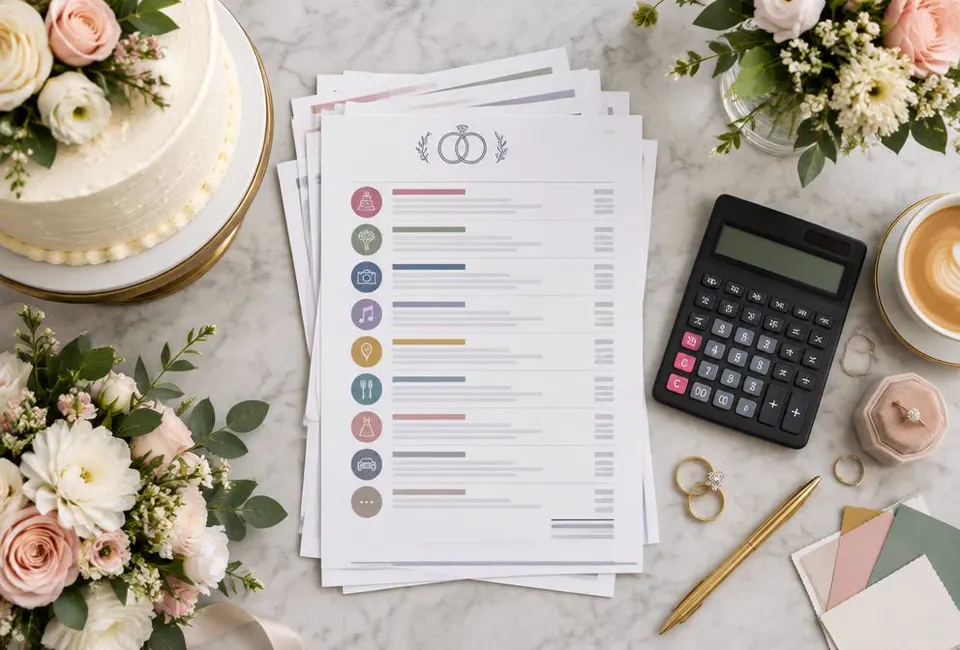
The Foundational Percentage Formula
Determining a wedding budget breakdown by category requires a balance of mathematical discipline and personal priority. This section establishes a universal percentage model that helps couples worldwide translate their total savings into a functional spending plan.
The core of a successful financial plan is the percentage formula. Rather than guessing individual costs, couples should start with a total sum and apply established ratios. According to The Knot Real Weddings Study 2025, the US average is about $33,000. In Australia, the average reaches A$35,315 according to Easy Weddings 2025, while UK figures range from £20,600 per Bridebook 2024 to £23,000 per Which? 2024. Canadian couples average C$30,000 based on data from RBC. Regardless of the local currency or total amount, the relative weight of each category remains remarkably consistent across global markets.
Defining the Standard Spending Ratios
The 50 percent rule serves as the anchor for most wedding budgets. This half of your total funds typically covers the venue rental and all catering services. Photography and videography generally require a 10 percent allocation to ensure high quality documentation of the event. Another 10 percent often goes toward attire and beauty, while flowers and decor claim another 10 percent. The remaining 20 percent is split between entertainment, stationery, and small miscellaneous items. Most importantly, every budget must include a 5 percent emergency buffer, which acts as a shield against inflation or unexpected service fees.
Core Percentage Allocations
- 50 percent: Venue and Catering (includes food and beverage)
- 10 percent: Photography and Videography
- 10 percent: Flowers and Decor
- 10 percent: Attire and Personal Styling
- 10 percent: Entertainment and Music
- 5 percent: Stationery and Transportation
- 5 percent: Emergency Contingency Fund
To see how these percentages adapt to specific priorities, consider Sarah and Mateo. They are planning a celebration where the culinary experience is their highest priority. To achieve a high end tasting menu, they decide to host the event at a simple public garden with a low rental fee. By reducing the venue rental cost to 10 percent of their total, they can reallocate 40 percent specifically to a premium catering team. This adjustment allows them to stay within the 50 percent total for the venue and food category while significantly upgrading the guest experience.
One common mistake is failing to account for the 5 percent emergency buffer from the very beginning. Many couples treat this as extra money for upgrades, but it should remain untouched until a genuine surprise expense arises. Whether it is a last minute weather related tent rental or a price increase in imported flowers, this buffer provides peace of mind. By establishing these percentages early, you create a decision making framework. When a vendor quote exceeds the allocated percentage, you can immediately identify which other category will be reduced to compensate for the difference.
Foundational Budgeting Steps
- Calculate your total available funds from all sources.
- Deduct 5 percent immediately for the emergency buffer.
- Apply the 50 percent rule to your venue and catering search.
- Identify your top three priorities for potential percentage increases.
- Review local market averages for your specific region.
- Discuss trade offs with your partner to reach a consensus.
- Document the specific currency amount for every 5 percent increment.
- Verify that all percentages total exactly 100 percent.
- Set up a dedicated account to track these specific allocations.
Venue and Catering: The Major Investment
The wedding budget breakdown by category begins with the venue and catering, which typically commands 40 to 50 percent of your total investment. Understanding how to navigate these costs ensures that your guest list size aligns with your financial reality.
When calculating venue costs, couples often encounter two distinct pricing models: the all inclusive fee and the price per head. The all inclusive fee covers the space, standard rentals, and sometimes catering for a flat rate, which provides budget predictability. Conversely, the price per head model fluctuates based on guest count, including food and beverage tiers. Sarah and David, a couple planning a 100 guest wedding, must decide if a fixed fee includes hidden necessities like linens or glassware. If a venue offers a low rental fee but requires outside catering, the logistics costs often surpass the price of a full service hotel package.
Mastering Hidden Service Fees and Gratuities
The advertised price is rarely the final amount you pay because service charges, gratuities, and corkage fees are often calculated at the end. These additions can increase the bill by 20 percent or more. To avoid surprises, always ask for a mock invoice early in the process. This document should detail every mandatory charge beyond the base price. By seeing the totals for taxes and staff fees upfront, you can adjust your menu choices or guest count before signing a legally binding contract. Being proactive prevents the stress of a final invoice that exceeds your initial projections.
Vendor Inquiry Script for Budget Clarity
- What is the mandatory service charge, and is it separate from a gratuity for the staff?
- Are there additional fees for cake cutting or corkage if we provide our own alcohol?
- Does the price per head include VAT or local sales tax, or are those added at the end?
- Are there setup and strike fees for vendors arriving outside of standard hours?
- Is there a food and beverage minimum spend that we must meet regardless of guest count?
To illustrate the financial impact, consider the global landscape. The Knot Real Weddings Study 2025 reports a US average of about $33,000, while Bridebook 2024 notes the UK average at £20,600 and Which? 2024 cites £23,000. Easy Weddings 2025 finds Australia at A$35,315, and RBC estimates Canada at C$30,000. In all these regions, the venue remains the primary driver of these totals. Whether you choose a high end ballroom or a rustic barn, the catering choices you make will dictate whether you stay within these national averages or exceed them significantly.
| Expense Item | Hotel (Full Service) | Warehouse (Blank Canvas) | Budget Impact |
|---|---|---|---|
| Rental Fee | Low or Waived | High Flat Fee | Warehouse requires higher upfront cost |
| Equipment Rentals | Included | Extra: $2,000+ | Warehouse adds logistics complexity |
| Catering Control | Fixed Menus | External Flexibility | Warehouse allows for food truck options |
| Staffing Costs | Included in Service | Hired Separately | Hotel offers streamlined labor costs |
| Hidden Extras | AV and Parking | Power and Toilets | Warehouse needs infrastructure spend |
Choosing between a hotel and a blank canvas warehouse requires a specific decision framework based on your priorities. A hotel offers convenience and a predictable wedding budget breakdown by category, as many line items are bundled. However, a blank canvas warehouse provides creative freedom but demands a higher investment in rentals like chairs, tables, and lighting. If your priority is a unique aesthetic, the warehouse is ideal. If your priority is budget control, the hotel usually wins. Couples must weigh the cost of hiring individual suppliers against the simplicity of an onsite venue coordinator managing everything.
Venue and Catering Final Review
- Confirm if the venue requires a specific list of approved caterers.
- Calculate the total cost including the 20 to 25 percent service charge.
- Verify if the venue provides a backup space for bad weather at no cost.
- Ask about power requirements for your band or DJ in industrial spaces.
- Check if the price per head includes unlimited soft drinks.
- Review the cancellation and postponement policy regarding deposits.
- Identify any mandatory insurance requirements for external vendors.
Photography and Videography Allocations
Allocating 10 to 15 percent of your total wedding budget breakdown by category to photography and videography ensures your investment in visual documentation lasts long after the celebration ends.
For most couples, capturing the day constitutes the third largest expense after the venue and catering. This 10 to 15 percent range is standard whether you are working with the UK average of 20,600 pounds reported by Bridebook 2024 or the Australian average of 35,315 dollars cited by Easy Weddings 2025. It is vital to understand that this percentage typically covers two distinct financial elements: the session fee and the digital rights. The session fee compensates the professional for their time, expertise, and physical presence on the wedding day. Digital rights or licensing fees grant you the legal permission to print, share, and store the high resolution files. Some photographers bundle these into a flat rate, while others bill them separately.
The Second Shooter Decision Framework
A common mistake involves paying for a second photographer when one would suffice, or conversely, missing key moments because a solo artist was overwhelmed. Consider the case of Sarah and Leo, who planned a wedding for 150 guests across two locations. Without a second shooter, their photographer could not capture Leo at the altar and Sarah’s entrance simultaneously. To determine if your wedding budget breakdown by category should include a second professional, use this formula: if the guest count exceeds 100 or if the couple is getting ready in locations more than 15 minutes apart, a second shooter is necessary. If the guest count is under 75 and the ceremony and reception are in one room, a solo lead is usually sufficient.
When comparing videography to photography, remember that these services often require separate 10 to 15 percent allocations if you want high end results for both. If your total budget follows the Canada average of 30,000 dollars reported by RBC, spending 4,500 dollars combined on both services may result in lower tier quality. Many couples prioritize one over the other to stay within their limits. For example, you might choose a premium photographer but opt for a raw footage package from a videographer to save on editing costs. Always confirm if the quote includes travel fees, as these can unexpectedly inflate the final invoice by hundreds of dollars depending on the location.
Portfolio Comparison Checklist: Beyond Social Media Trends
- Request a full gallery of 500 plus images rather than a curated social media highlight reel.
- Evaluate the clarity and composition of indoor photos taken in low light without professional flash.
- Check for consistent color grading across different times of day and lighting conditions.
- Assess the ratio of candid moments to posed portraits to see if it matches your preference.
- Verify that the skin tones look natural and are not overly filtered by trendy presets.
- Look for sharp focus in action shots like the first dance or the recessional walk.
- Identify if the photographer captures guest reactions and details, not just the couple.
- Confirm the delivery timeline for the sneak peek and the full edited gallery in the contract.
- Ensure the professional style remains timeless rather than relying on current editing fads.
Finally, review the fine print regarding image ownership and archival storage. While you may have digital rights, the photographer usually retains the copyright for promotional use. Ensure your contract specifies how long the professional will host your files online. Some provide a lifetime gallery link, while others charge a fee to re upload files after one year. For those following the US average of 33,000 dollars from The Knot Real Weddings Study 2025, a 12 percent allocation equates to 3,960 dollars. This figure should include tax and any physical products like albums. If the quote exceeds this, negotiate by reducing the hours of coverage rather than sacrificing the quality of the artist.
Attire, Beauty, and Personal Styling
Section four focuses on the attire, beauty, and personal styling category, which typically accounts for 5 to 8 percent of your total wedding budget breakdown by category. This allocation ensures the couple looks and feels their best while managing the logistical costs of high end garments and professional grooming services.
For many couples, the visual centerpiece of the wedding is the attire. This 5 to 8 percent portion must cover the wedding dress, the suit or tuxedo, shoes, and any specialized cultural garments. While the primary outfit often takes the spotlight, this budget must also stretch to cover jewelry, watches, and hair accessories. According to the Easy Weddings 2025 study, the average Australian wedding cost is about A$35,315, which means attire and styling would ideally sit between A$1,765 and A$2,825. Balancing these costs requires a disciplined approach to prioritizing the most visible elements while finding efficiency in the details.
Anticipating Hidden Costs in Attire and Grooming
A common mistake is assuming the price tag on a garment represents the final expense. Most off the rack or designer pieces require professional alterations to achieve a perfect fit, which can add significant costs depending on the complexity of the fabric and lace. Additionally, couples must account for specialized undergarments, shipping fees for international orders, and professional garment cleaning or preservation after the event. Grooming expenses also add up quickly. This includes professional hair styling, makeup application, trials for both services, and even pre wedding skincare treatments or barber visits to ensure a polished appearance on the big day.
Essential Attire and Beauty Budget Line Items
- Primary wedding gown or cultural ceremony dress
- Tailored suit, tuxedo, or traditional groom's attire
- Professional alterations and bustle additions
- Veils, headpieces, and specialized hair accessories
- Day of hair and makeup services including trials
- Shoes for both partners including comfort inserts
- Professional steaming or pressing before the event
- Basic jewelry and watch selections
- Post wedding cleaning and garment preservation
Consider the scenario of Chloe and Aris, who established a strict 6 percent limit for their attire and beauty within their total budget. Chloe found a designer gown that consumed nearly 80 percent of their styling fund. To remain within their wedding budget breakdown by category, they chose to balance this by using family heirloom jewelry instead of buying new pieces. Aris opted to rent a high quality tuxedo rather than purchasing a custom suit. They also saved by performing their own simple manicures and sourcing affordable shoes that would be hidden under the gown, allowing them to afford the essential professional hair and makeup trials they prioritized.
Finally, remember that personal styling extends to the entire wedding day experience. If you plan to change into a second outfit for the reception, this must be factored into the initial 5 to 8 percent calculation. Many couples overlook the cost of accessories like cufflinks, ties, and even the emergency kit containing sewing supplies and stain removers. By being granular with your tracking and recognizing that beauty trials are non negotiable for a stress free morning, you can maintain the integrity of your wedding budget breakdown by category without sacrificing your vision.
Flowers and Decor: Setting the Atmosphere
The visual landscape of a wedding creates the immediate emotional impact for guests, typically requiring a commitment of 8 to 10 percent of the total wedding budget breakdown by category. This investment balances high impact focal points with the intimate details that define the reception tables.
When planning aesthetics, couples must distinguish between fixed and variable costs to maintain financial control. Fixed costs include structural installations such as floral arches, ceiling hangings, or rental backdrops that require significant labor and transportation regardless of guest count. Variable costs fluctuate based on the number of tables or bridal party members. For instance, a couple like Sofia and Liam might spend more on table centerpieces if their guest list grows, but their ceremony altar remains a static expense. By prioritizing fixed installations that appear in the most photos, couples can ensure their 8 to 10 percent allocation delivers the highest visual return.
Strategies for High Impact and Smart Savings
Strategic flower selection often dictates how far the budget stretches. Selecting locally grown, in season blooms reduces shipping fees and ensures freshness. Furthermore, greenery can act as a cost effective filler that adds volume without the price tag of premium stems like peonies or orchids. A common mistake is focusing solely on the quantity of flowers rather than the placement. Concentrating the budget on 'moment' areas, such as the sweetheart table or the entrance, creates a luxurious feel even if other areas are kept minimalist. This approach ensures the atmosphere feels intentional rather than sparse.
| Category | Typical Allocation | Cost Type | Primary Focus |
|---|---|---|---|
| Personal Flowers | 15% | Variable | Bouquets and Boutonnieres |
| Ceremony Decor | 25% | Fixed | Altar and Aisle Markers |
| Reception Centerpieces | 40% | Variable | Guest Tables and Bar |
| Large Installations | 20% | Fixed | Photo Backdrops or Hanging Florals |
The most effective way to maximize a wedding budget breakdown by category is through repurposing. Many arrangements used during a twenty minute ceremony can serve a second purpose during a four hour reception. To do this successfully, couples must communicate early with their florist about the logistical transition. This requires planning for additional labor or a specific timeframe during the cocktail hour to move heavy items. Instead of buying two sets of decor, the ceremony aisle markers can become floor arrangements for the stage, and the bridal bouquets can serve as head table decor in pre placed vases.
The Repurposing Script: Talking to Your Florist
- We love the design for the ceremony altar. How can we transition these specific pieces to frame the band or the sweetheart table for the reception?
- Could the aisle runners or chair markers be designed as small clusters that our coordinator can move to the cocktail bar or cake table?
- If we provide vases for the bridesmaids' bouquets, can these be used as part of the head table centerpiece logic to save on stem counts?
- What is the additional fee for your team to stay through the ceremony to handle the relocation of these larger installations?
- Are there specific flowers you recommend that are hardy enough to withstand being moved and still look fresh for the next five hours?
While regional averages vary significantly, the percentage based approach remains the most reliable global standard. For context, the US average wedding cost is about $33,000 (The Knot Real Weddings Study 2025), which would place a mid range floral budget at approximately $2,640 to $3,300. In Australia, where the average is about A$35,315 (Easy Weddings 2025), the same percentage applies. By sticking to the 8 to 10 percent rule, couples ensure their aesthetic choices do not compromise other essential categories like catering or photography while still achieving a cohesive and memorable wedding atmosphere.
Floral and Decor Planning Essentials
- Identify your top three visual priorities for the day.
- Verify which flowers are in season for your wedding month.
- Review the venue rental list for included tables and linens.
- Calculate the number of guest tables to estimate variable costs.
- Ask about delivery and setup fees which are often separate from stem costs.
- Confirm who is responsible for removing decor at the end of the night.
- Check if the venue has restrictions on candles or hanging elements.
- Plan for the transition of ceremony flowers to the reception area.
Entertainment and Guest Experience
The atmosphere of a celebration depends heavily on the entertainment and guest experience, a segment that typically commands 5 to 10 percent of the overall wedding budget breakdown by category. This investment ensures your guests remain engaged and comfortable from the initial processional through the final dance of the evening.
When deciding between a live band and a DJ, couples must weigh both atmospheric impact and financial logistics. A live band offers a high energy performance but often costs three to four times more than a DJ due to the number of musicians and specialized equipment requirements. For example, Elena and Sofia in Spain allocated 8 percent of their budget to a six piece soul band to create a concert like feel. Conversely, a DJ provides a broader repertoire and occupies less space, making them a cost effective choice for smaller venues. While a DJ might range from 1 to 2 percent of the budget, a premium band can easily consume the full 10 percent allocation.
Calculating Guest Transportation and Logistics
If your ceremony and reception are in different locations, transportation becomes a vital component of the guest experience. To estimate this cost, use the following formula: (Number of Guests x 0.75 / Vehicle Capacity) x Hourly Rate x Duration. The 0.75 multiplier accounts for guests who will choose to drive their own vehicles. For example, if Marcus and Lin in Canada have 100 guests and use 50 seat coaches at C$200 per hour for three hours, their calculation would be: (100 x 0.75 / 50) x 200 x 3. This results in an estimated cost of C$900. Proper planning prevents guests from getting lost or arriving late to the reception.
Stationery and guest favors represent the tactile elements of your wedding day. These items serve as both functional guides and personal mementos. Many couples now opt for digital invitations to save money, redirecting those funds toward high quality day of stationery like place cards and menus. While favors are a traditional gesture, modern trends suggest that guests prefer edible items or small, useful gifts over decorative trinkets. Allocating 1 to 2 percent of your budget to these details ensures a cohesive aesthetic without overspending on items that guests might leave behind at their tables. Focused spending here enhances the overall perceived value of the event.
| Region | Average Total Cost | Source and Year |
|---|---|---|
| United States | $33,000 | The Knot Real Weddings Study 2025 |
| United Kingdom | £20,600 to £23,000 | Bridebook 2024 and Which? 2024 |
| Australia | A$35,315 | Easy Weddings 2025 |
| Canada | C$30,000 | RBC |
A common mistake in the wedding budget breakdown by category is neglecting the technical requirements for entertainment. This includes sound systems for outdoor ceremonies or lighting rigs for the dance floor. If these are not included in the vendor fee, they can add unexpected costs. To avoid this, always ask for an all inclusive quote that covers setup, teardown, and travel fees. Negotiating these details upfront allows you to maintain the 10 percent cap while providing a professional experience. Remember that the goal is to create a seamless flow that keeps guests comfortable and entertained throughout the entire celebration.
Guest Experience and Music Essentials
- Confirm if the venue provides a dedicated sound system or if the DJ must bring one.
- Check for additional power requirements or generator needs for outdoor music.
- Calculate shuttle capacity based on the 75 percent guest usage formula.
- Review stationery proofs for typos before committing to a full print run.
- Verify if guest favors require individual packaging or specialized assembly.
- Ask live bands about their meal requirements and break schedules during the event.
- Ensure the DJ has a backup plan for equipment failure or technical issues.
- Include local taxes and service fees in the final entertainment contract totals.
The 5 Percent Contingency and Hidden Fees
The final stage of your wedding budget breakdown by category involves preparing for the unexpected costs that reside outside of your main contracts. Allocating five percent of your total funds to a contingency fund ensures that hidden fees do not derail your financial planning.
Every comprehensive wedding budget breakdown by category must account for the small but essential expenses that couples often ignore. These include the cost of marriage licenses, which vary by jurisdiction, and liability insurance required by many venues. Furthermore, you must factor in vendor meals for your photographer, planner, and band members. Forgetting these line items can result in a sudden deficit of hundreds of dollars in the final weeks. By earmarking five percent of your total budget for these specific details, you protect your primary savings from being eroded by administrative costs.
The Buffer in Action: Liam and Noor
Consider the scenario of Liam and Noor, who planned an outdoor garden reception. While they allocated their primary funds to catering and decor, they strictly maintained their five percent contingency fund. Three days before the wedding, the forecast shifted to heavy rain. Because they had reserved their buffer for emergencies, they were able to secure a high quality marquee tent at the last minute without stress. Without this dedicated category, they would have been forced to cut their guest list or take on high interest debt to keep their guests dry and comfortable.
The global average cost of a wedding fluctuates significantly, making a percentage based buffer even more vital. For example, the US average is about $33,000 according to The Knot Real Weddings Study 2025, while UK averages range from £20,600 per Bridebook 2024 to £23,000 according to Which? 2024. In Australia, the average is about A$35,315 per Easy Weddings 2025, and Canada sits at about C$30,000 according to RBC. Regardless of the currency or total spend, the five percent rule applies universally to handle local taxes and unexpected service fees.
Commonly Overlooked Hidden Fees
- Marriage license and document notarization fees.
- Overtime charges if the party runs past the contracted time.
- Delivery, setup, and breakdown fees for rental furniture.
- Vendor meals for every professional working through the reception.
- Postage for heavy or oversized invitation suites.
- Hotel room blocks and early check in fees for the bridal party.
Financial peace of mind comes from knowing that your wedding budget breakdown by category is resilient. Treat the contingency fund as a mandatory expense rather than a luxury. If you reach the wedding day without needing to tap into this five percent, you simply have extra savings to put toward your honeymoon or a future home. However, the psychological benefit of having those funds available during the final high pressure month is priceless. It allows you to focus on the celebration rather than the spreadsheet when minor logistical hurdles inevitably arise.
Final Financial Safety Checklist
- Verify if venue service fees include tips for waitstaff.
- Set aside cash for the marriage license application.
- Confirm if delivery fees are included in floral quotes.
- Purchase a basic event liability insurance policy.
- Account for sales tax or VAT not listed in initial quotes.
- Allocate funds for garment steaming and final alterations.
- Calculate the number of vendor meals required for the night.
- Double check postage requirements for RSVP envelopes.