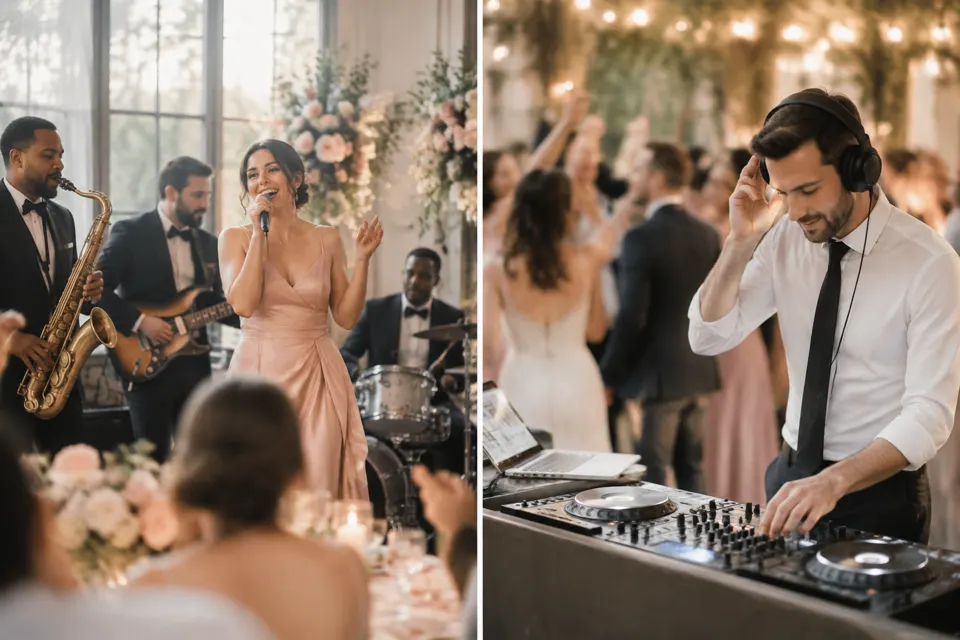
The Energy Dynamic: Performance vs. Versatility
Choosing between a live band and a professional DJ is the primary factor in determining the energy signature of your celebration. This decision dictates whether your reception feels like an intimate concert or a curated night at a high end club.
The psychological impact of a frontperson compared to a curator defines the entire guest experience. A live band offers a physical focal point, where a lead singer acts as a master of ceremonies who can lock eyes with guests to pull them onto the floor. This creates a performance dynamic where the music is an active spectacle. Conversely, a DJ acts as a sonic curator, focusing on the seamless flow between tracks to ensure the energy never dips. While a band provides raw, organic texture, a DJ offers the precision of original recordings that guests already know and love.
Evaluating the Atmosphere Matrix
To choose effectively, couples must evaluate their priorities using the Atmosphere Matrix, which weighs crowd interaction against genre flexibility. Sarah and Leo, a couple from London, prioritized a high octane concert feel for their wedding. They opted for a five piece soul band because they wanted the visual thrill of a brass section and a charismatic lead singer. For them, the slight pauses between songs were a fair trade for the authentic, grit filled energy of live instruments. They focused on the visceral connection that only a live ensemble can provide during a high energy set.
| Feature | Wedding Band | Wedding DJ |
|---|---|---|
| Primary Energy | Visual Performance | Continuous Flow |
| Genre Transitions | Fixed Arrangements | Instantaneous Mixing |
| Guest Interaction | Direct Engagement | Reactive Track Selection |
| Visual Impact | High Stage Presence | Minimalist Setup |
| Set Continuity | Structured Breaks | Non Stop Playback |
In contrast, Maya and Sam required a diverse musical landscape for their multicultural wedding in Toronto. Their guest list included various generations with distinct tastes, requiring a mix of Bollywood hits, 90s R and B, and Top 40 tracks. A live band would have struggled to master the specific production nuances of these varied genres. By choosing a DJ, Maya and Sam ensured that every cultural demographic felt represented through authentic tracks. The DJ used beat matching to bridge disparate styles, maintaining a packed dance floor by reacting to the crowd in real time.
When assessing wedding band versus dj, consider the psychological shift that occurs during a transition. A band provides a human element where mistakes or improvisations add character and a sense of exclusivity to the night. However, if your guests are sensitive to silence, the three second gap between live songs might feel like an energy leak. A DJ eliminates this risk by using crossfading techniques. Your choice depends on whether you value the unique, unrepeatable nature of a live show or the polished, relentless drive of a professional mix.
Energy Dynamic Decision Triggers
- Select a band if you want the music to be a primary entertainment attraction.
- Select a DJ if your playlist spans more than three distinct genres.
- Choose a band for a vintage, gala, or black tie aesthetic.
- Choose a DJ if you have a specific list of non negotiable original tracks.
- Opt for a band if the lead singer will double as your primary hype person.
- Opt for a DJ if you want to avoid the momentum loss of set breaks.
Ultimately, the energy dynamic is about the relationship between the performer and the audience. A band creates a communal experience centered around the stage, while a DJ creates a decentralized party atmosphere where the music serves as a backdrop to the dancing. Understanding your own social style as a couple is the first step in this global wedding planning journey. Whether you are in New York, Sydney, or Mumbai, the fundamental tension between performance and versatility remains the cornerstone of your reception entertainment strategy.
Logistics and Financial Architecture
When choosing between a wedding band versus dj, couples must evaluate the physical and fiscal footprint each option leaves on the venue and the budget. This section examines the technical demands and the specific cost formulas that differentiate these two entertainment tiers.
Technical requirements represent the first major divergence in the wedding band versus dj debate. A solo DJ typically requires a modest space of approximately 2 by 3 meters and a single dedicated 13 to 15 amp circuit. In contrast, a six piece band requires a stage area of at least 6 by 4 meters to accommodate a drum kit, amplifiers, and monitors. Bands also demand significant power draw, often requiring multiple circuits to avoid tripping breakers when lighting rigs and sound systems peak simultaneously. For a couple like Sarah and Marc, failing to check the venue power capacity resulted in a total blackout during the first dance because the band equipment overloaded the historical ballroom circuits.
The hidden cost of hospitality further separates these options. Every performer requires a hot meal and a place to rest during breaks. If a DJ is a solo act, the couple pays for one vendor meal. A high energy eight piece soul band requires eight meals. At a standard catering rate of 40 to 60 dollars per head, the hospitality cost for a band can equal the total travel fee of a DJ. Couples should also account for the green room space. A solo DJ can often prep in a small corner, while a large group requires a dedicated changing room, which may incur additional venue rental fees or suite upgrades.
The Cost Per Performer Formula
To understand the pricing gap, use the Cost Per Performer (CPP) formula. Calculate the total quote divided by the number of people on site. A DJ charging 1,500 dollars has a CPP of 1,500. A band charging 6,000 dollars with six members has a CPP of 1,000. While the band appears four times more expensive, the individual performers are often earning less than the DJ after the agency takes a cut. This explains why bands often cost 300 percent more than DJs. The complexity of coordinating multiple professional schedules, transporting large instruments, and sound checking for two hours justifies the higher total investment for live music.
| Region (Source/Year) | Total Budget | DJ Budget (5-10%) | Band Budget (15-25%) |
|---|---|---|---|
| USA (The Knot 2025) | $33,000 | $1,650 to $3,300 | $4,950 to $8,250 |
| UK (Which? 2024) | £23,000 | £1,150 to £2,300 | £3,450 to £5,750 |
| Australia (Easy Weddings 2025) | A$35,315 | A$1,765 to A$3,531 | A$5,297 to A$8,828 |
| Canada (RBC) | C$30,000 | C$1,500 to C$3,000 | C$4,500 to C$7,500 |
Placing these figures within a global context shows that entertainment is a significant portion of the total spend. In the UK, the average wedding cost is between 20,600 pounds (Bridebook 2024) and 23,000 pounds (Which? 2024). In these scenarios, hiring a premium band can consume nearly a quarter of the entire budget. Couples must decide if the live atmosphere is their primary priority. If the budget is fixed at the US average of 33,000 dollars (The Knot Real Weddings Study 2025), a band might require cutting costs in florals or guest count to maintain financial balance.
Logistical Readiness Checklist
- Verify venue stage dimensions against the band technical rider.
- Confirm the number of dedicated power circuits available at the performance site.
- Calculate total vendor meal count including all band members and road crew.
- Identify a secure, private changing area for performers.
- Check load in access for heavy equipment and drum hardware.
- Confirm if the venue requires a Noise Limiter or decibel cap.
- Review parking availability for multiple band vehicles versus one DJ van.
- Allocate 15 to 25 percent of the total budget for a live band.
The final logistical hurdle is the sound check. A DJ can be ready in 45 minutes with a simple line check. A band requires a full sound check that can last 90 minutes to ensure every instrument is balanced for the room acoustics. This means the band must arrive and set up much earlier in the day, potentially conflicting with the ceremony if it is held in the same room. Planning for a wedding band versus dj requires a rigorous assessment of the timeline to ensure the sound check does not disturb guests during the cocktail hour or formal photos.
The Repertoire Analysis: Selection Scripts
The musical selection process requires a strategic approach to repertoire, balancing a couple's specific tastes against the technical constraints of the entertainment provider. This section provides the precise language needed to evaluate whether a wedding band versus dj can accommodate your essential soundtrack.
When interviewing a live wedding band, the primary constraint is their fixed repertoire. Unlike a digital library, a band relies on physical practice and complex arrangements for every musician. Sarah and Mark, a couple planning an outdoor reception, initially assumed a six piece band could play any Top 40 hit. They learned that bands often require six to eight weeks to master a new song that is not in their standard rotation. You must determine their 'off menu' policy early. Many bands include one or two custom requests in their fee, but additional songs may incur an arrangement charge to cover rehearsal time.
Specific Scripts for Vendor Evaluation
Interview Scripts for Bands and DJs
- Band Script: We see your song list includes mostly Motown, but we love 90s Grunge. How many 'off menu' songs do you allow before charging an arrangement fee?
- Band Script: If we request a song outside your repertoire, do you perform it live or play the original track through the PA system during a break?
- DJ Script: We prefer seamless transitions rather than radio fades. Can you describe your mixing style and how you handle beat matching for high energy segments?
- DJ Script: How do you balance our specific requests with your ability to read the room and pivot if a certain genre is not resonating with the guests?
A DJ offers a starkly different advantage regarding volume and variety. While a band might master 60 to 100 songs, a DJ maintains a digital library of millions. This allows for spontaneous pivots based on the crowd's reaction. However, the risk with a DJ is a lack of curation. When quizzing a DJ, focus on their technical mixing ability. Ask how they transition between disparate genres like Latin Pop and Classic Rock. A skilled DJ will use phrasing and tempo matching to ensure the dance floor never feels a jarring shift, a luxury a live band cannot always provide.
| Feature | Wedding Band | Wedding DJ |
|---|---|---|
| Song Quantity | 50 to 150 practiced songs | Millions via digital library |
| Customization | Requires weeks of rehearsal | Instantaneous downloads |
| Genre Flexibility | Best for specific styles | Limitless across all eras |
| Transition Style | Brief pauses between sets | Continuous beat matched flow |
| Originality | Unique live interpretations | Exact studio recordings |
Understanding the limitations of live performance is essential for a realistic budget. If you require a high level of customization from a band, you may see costs rise due to extra rehearsal hours. For context on total wedding investments, the US average is about $33,000 (The Knot Real Weddings Study 2025), while in Australia it is about A$35,315 (Easy Weddings 2025). Canadian couples spend about C$30,000 (RBC). Within these budgets, entertainment usually represents 10 to 15 percent. Choosing a DJ often saves on these customization fees, as their primary cost is their time and equipment rather than rehearsals.
The Ultimate Must Play and Do Not Play Framework
- Identify at least 10 'Must Play' songs that define your relationship.
- List 5 'Do Not Play' songs, including specific genres or tropes like line dances.
- Specify which 'Must Play' songs must be the original version versus a cover.
- Determine if the band's 'off menu' limit covers your first dance.
- Confirm the DJ's policy on guest requests during the reception.
- Check if the band provides a recorded playlist during their 15 minute breaks.
- Verify the DJ has an offline backup of your 'Must Play' list.
- Ask the band for a video of them performing a song outside their main genre.
Finalizing your choice involves weighing the visceral energy of a live performance against the surgical precision of a DJ. A band brings a unique atmosphere that guests remember, but they are bound by the physical limits of their instruments and memory. A DJ acts as a musical encyclopedia, ready to fulfill a niche request in seconds. For couples like Sarah and Mark, who wanted a very specific blend of obscure indie tracks and Top 40, a DJ provided the necessary flexibility that a standard five piece band simply could not match without significant extra cost.
Venue Compatibility and Acoustic Constraints
The physical structure of your celebration space dictates whether a wedding band versus dj will succeed or struggle with sound quality. Choosing the right entertainment requires evaluating the specific acoustic profile of your venue and its legal decibel limitations.
Every venue presents a unique sonic challenge based on its materials and layout. Consider Sarah and David, who booked a 15th century stone castle. The hard surfaces created a massive natural echo that made a 7 piece brass band sound like a chaotic wall of noise. In contrast, Leo and Maya chose a modern glass marquee. While beautiful, the glass acted as a reflector, causing high frequencies to pierce the ears of guests sitting near the speakers. A DJ can often adjust digital equalization settings to compensate for these environmental flaws instantly, whereas a live band requires a sound engineer to manage the balance of individual acoustic instruments.
The Sound Limiter Challenge
Many venues, particularly in historic European districts or urban lofts, use sound limiters. These devices cut the power to the stage if the volume exceeds a pre set decibel limit, typically between 90 and 95 decibels. For a wedding band versus dj, this is a critical differentiator. A live drummer cannot easily lower their volume, as the physical strike of a snare drum often hits 100 decibels naturally. DJs have total control over their master output, making them the safer choice for venues with strict council noise restrictions or sensitive neighbors who might trigger a shutdown.
Historic venues often suffer from power fluctuations that can damage sensitive musical equipment. In a city loft, you might encounter issues with elevator interference or limited load in times that make a band's two hour setup impossible. If your venue is a historic site, ask if they require the use of an electric drum kit. This allows the band to control their volume via the mixing desk, mirroring the flexibility of a DJ while maintaining the visual energy of a live performance. Without this compromise, the music may be frequently interrupted by power cuts.
| Venue Type | Acoustic Profile | Best Fit | Primary Risk |
|---|---|---|---|
| Historic Castle | High Reverb/Echo | DJ or Small Duo | Muffled Vocals |
| Glass Marquee | High Reflection | Band with Sound Tech | Harsh Frequencies |
| Industrial Loft | Medium Absorption | Full Wedding Band | Power Surges |
| Outdoor Garden | High Sound Loss | Large Brass Band | Noise Complaints |
Couples must also account for the physical footprint of their choice. A wedding band versus dj comparison involves a significant difference in floor space. A six piece band requires at least 5 meters by 3 meters of stage space, which might push guest tables into 'dead zones' where the sound is too loud or completely obstructed. A DJ booth occupies roughly 2 meters by 2 meters, allowing for more flexible seating charts. Before committing, use a floor plan tool to ensure your entertainment does not compromise the comfort of your guests or the flow of the room.
Venue Walkthrough: Sound and Power Audit
- Locate the sound limiter and ask for its specific decibel cutoff level.
- Check for dedicated power circuits near the designated stage area.
- Identify large glass or stone surfaces that may cause excessive echo.
- Verify the height of the ceiling to ensure lighting rigs will fit.
- Confirm if the venue provides a PA system or if the act must bring their own.
- Measure the load in route for stairs or narrow elevators that hinder bands.
- Ask about neighborhood noise curfews that might force a volume drop after 10 PM.
- Check for thick curtains or soft furnishings that can help absorb sound.
- Test the cell signal or Wi-Fi if the DJ intends to stream requests.
The Hybrid Model: Best of Both Worlds
The debate of wedding band versus dj no longer requires a binary choice thanks to the rise of the hybrid entertainment model. This configuration blends the infinite song library of a digital professional with the visceral energy of live instrumentation.
The hybrid model addresses the primary friction point in the wedding band versus dj debate by layering live musicians over a dj setup. Typically, this involves a dj providing the foundational beats while a saxophonist, violinist, or percussionist performs live solos among the guests. This setup offers the flexibility to play any contemporary radio hit while maintaining the visual spectacle and improvisational flair that only a live performer can provide. For couples who want the high energy of a live show without the six figure space requirements of a ten piece brass band, the hybrid approach serves as a modern middle ground.
Navigating the Investment and Logistics Tree
To determine if this model fits your budget, consider the total wedding spend. With the US average wedding costing about $33,000 according to The Knot Real Weddings Study 2025 and Australia averaging about A$35,315 per Easy Weddings 2025, entertainment usually accounts for 10 to 15 percent of the total. If a full band exceeds this margin, the hybrid model often costs only 30 to 50 percent more than a solo dj. Consider a couple like Sarah and Marc who have a limited stage area. By choosing a dj with a roaming percussionist, they saved 40 percent compared to a full band while still ensuring a packed dance floor.
Signs the Hybrid Model is Your Best Fit
- You have a diverse guest list that requires genres a traditional band might struggle to cover accurately.
- Your venue has a strict sound limiter that would be triggered by a full drum kit.
- You want the interactive experience of a musician walking through the crowd during the party.
- Your floor plan is compact and cannot accommodate a large stage and lighting rig.
- You desire a continuous flow of music without the breaks typically required by a full live band.
- You want the original vocal tracks of your favorite songs rather than cover versions.
When structuring your evening, timing the live elements is crucial for maximum impact. A common mistake is having the live musician play for the entire four hour reception, which can lead to listener fatigue. Instead, utilize the dj for the first hour of dinner to set a relaxed atmosphere. Introduce the live element, such as a saxophonist, during the transition from the first dance into the first high energy set. This creates a distinct shift in momentum that signals to guests it is time to move. A hybrid setup allows for seamless transitions between these energy levels that a standard band often lacks.
| Time Block | Musical Component | Guest Experience | Energy Level |
|---|---|---|---|
| 19:00 - 20:30 | DJ Solo | Background Motown and Soul during dinner | Low: Conversational |
| 20:30 - 20:45 | DJ + Saxophonist | First dance transition into upbeat funk | Medium: High Interest |
| 20:45 - 22:00 | DJ + Percussion | Live bongo drums over house and pop hits | High: Peak Dance |
| 22:00 - 23:30 | Full Hybrid Trio | Sax, Percussion, and DJ interacting on floor | Maximum: Concert Feel |
| 23:30 - 00:00 | DJ Solo | Anthems and classic closing tracks | Medium: Wind Down |
Ultimately, the wedding band versus dj choice becomes a question of texture and variety. In the UK, where the average wedding cost is about £20,600 according to Bridebook 2024, many couples find that a hybrid duo provides a luxury feel that exceeds their price point. By hiring a dj who specializes in live collaborations, you ensure that the musician is not just playing over the music, but is integrated into the mix. This requires specific audio equipment, such as a multi channel mixer, to ensure the live instrument does not drown out the track or sound disconnected from the room acoustics.
Technical Requirements for a Hybrid Setup
- Confirm the DJ has a mixer with at least two spare XLR inputs.
- Ensure the live musician has a wireless roaming microphone or clip on pick up.
- Verify if the musician requires a separate monitor speaker to hear the DJ track.
- Check that the venue has enough power outlets for both the DJ booth and musician pedals.
- Ask the DJ for a recorded sample of a live collaboration to check the mix quality.
- Plan a 15 minute sound check while the room is empty to balance live levels.
- Discuss the dress code with the live performer to match the DJ and wedding theme.
- Identify a safe space for the musician to store instrument cases during the event.
Critical Entertainment Planning Mistakes
Even the most carefully curated wedding band versus dj decision can be derailed by overlooked logistical hurdles and micromanagement. Avoiding these three critical planning errors ensures the celebration remains seamless regardless of the chosen entertainment format.
The first major error involves neglecting the venue power capacity. While a DJ typically requires only two dedicated circuits, a full wedding band with amplifiers, monitors, and a lighting rig can easily overload standard residential or historic venue circuits. For example, Sarah and Mark booked an eight piece soul band for a remote villa wedding without checking the voltage. When the bassist plugged in, the entire kitchen wing lost power. Before signing any contract, couples must request a technical rider from the band or DJ and have the venue manager confirm in writing that the stage area can support the specific kilowatt draw.
Ignoring the break music plan is a second frequent mistake when choosing a wedding band versus dj. Bands typically perform in 45 or 60 minute sets, requiring 15 minute breaks to rest their voices. If you do not provide a pre recorded playlist or confirm the band will provide a secondary playback device, the energy in the room will plummet during these silences. Unlike a DJ who maintains a continuous flow, a band requires a deliberate transition strategy. Ensure your contract specifies who is responsible for the transition audio to avoid an awkward, silent dance floor in the middle of your reception.
Over Managing the DJ Setlist and Playlists
The third error is over managing the DJ setlist by providing a restrictive must play list of fifty or more songs. This prevents a professional from reading the room and adjusting the tempo based on guest reactions. Consider David and Elena, who insisted their DJ follow a rigid chronological list of 90s hits. When they noticed the older guests leaving the floor, the DJ was unable to pivot to Motown or disco because of the strict contract terms. Trusting the professional expertise of your entertainer is essential for maintaining the party atmosphere throughout the entire night.
Emergency Recovery Scripts for Entertainment Failures
- Scenario: A lead singer calls out sick four hours before the ceremony. Script: I understand this is an emergency. Please confirm the name of the replacement vocalist from your agency roster and ensure they have the specific lyrics for our first dance song.
- Scenario: The DJ experiences a hardware failure or laptop crash during dinner. Script: Please switch to the backup analog mixer and use the emergency phone playlist for the next ten minutes while you reboot the primary system.
- Scenario: The venue manager reports a noise complaint from neighbors. Script: Please reduce the low end bass frequencies on the subwoofers first to comply with local ordinances while keeping the vocal clarity high for the guests.
- Scenario: The contract lacks a clear substitution clause. Script: We need to add an addendum stating that in the event of illness, a performer of equal experience will be provided at no additional cost to us.
The importance of backup clauses in vendor contracts cannot be overstated. A robust contract should outline specific contingencies for equipment failure, travel delays, and health emergencies. While the average wedding cost in Australia is about A$35,315 according to Easy Weddings 2025, a significant portion of that budget is lost if the entertainment fails without a recovery plan. In the UK, where costs reach about £20,600 per Bridebook 2024, professional insurance and redundancy plans are standard expectations. Always verify that your entertainer carries their own public liability insurance and has a verified secondary gear kit on site.
Technical and Contractual Safeguards
- Verify venue circuit breakers can handle the total wattage of the band lighting rig.
- Confirm the specific individual who will act as the point of contact on the wedding day.
- Include a no play list to prevent songs that trigger negative emotions.
- Ensure the DJ has a secondary sound system for the cocktail hour in a separate room.
- Review the force majeure clause for specific protections against illness.
- Check that all electrical equipment has been safety tested and tagged.
- Coordinate the timing of the meal service with the band rest breaks.
- Establish a clear volume limit for the indoor and outdoor portions of the night.
- Double check the arrival and setup time to avoid sound checks during guest arrival.
The 5 Point Selection Framework
Choosing between a wedding band versus dj requires a systematic assessment of your specific logistics and preferences. This final framework ensures your choice aligns with your budget and guest expectations.
The 5 Point Selection Framework for Final Clarity
The first factor involves guest demographics and musical variety. If your guest list spans four generations, a DJ offers the library depth to transition from 1950s swing to modern pop seamlessly. However, if the priority is a specific atmosphere, a band provides a focal point. For a couple like Emma and David, who have an Australian budget of A$35,315 according to Easy Weddings 2025, they must decide if a mid range swing band creates the intended sophisticated energy. While a band is limited by their set list, their physical presence often compensates for a smaller repertoire by engaging the crowd visually.
Five Critical Questions for Final Selection
- Demographics: Does the crowd require more than 50 years of musical genres to stay engaged?
- Venue Size: Does the floor plan accommodate a five piece drum kit or just a small booth?
- Variety Needs: Are you satisfied with a specialized set list or do you need on demand requests?
- Budget Allocation: Does the entertainment cost exceed 15 percent of your total wedding spend?
- Personal Taste: Do you value the 'concert' experience over the 'nightclub' atmosphere?
Budget allocation remains a primary driver for couples worldwide. In Canada, where the average wedding cost is about C$30,000 according to RBC, spending C$8,000 on a high end band represents over a quarter of the total funds. Emma and David might find that a premium DJ allows them to reallocate C$5,000 toward better catering or a late night open bar. A mid range swing band might fit the budget but may lack the technical equipment of a specialized DJ. You must weigh the emotional impact of live instruments against the fiscal flexibility offered by a solo performer.
Venue size and acoustic constraints often dictate the final choice regardless of personal taste. A small, echoing ballroom can turn a live brass section into a wall of noise, whereas a DJ can fine tune the frequency output to suit the room. If Emma and David select a large outdoor marquee, a band is ideal to fill the space. However, in a compact city loft, the footprint of a full band might consume the entire dance floor. Always map out the square footage of the performance area before committing to a multi piece ensemble.
| Region and Source | Total Average Budget | DJ Value Proposition | Band Value Proposition |
|---|---|---|---|
| USA (The Knot 2025) | $33,000 | High end lighting and MC services | Four piece core ensemble |
| UK (Bridebook 2024) | £20,600 | Full evening coverage and requests | Standard function band |
| Australia (Easy Weddings 2025) | A$35,315 | Seamless genre transitions | Mid range swing or jazz trio |
| Canada (RBC) | C$30,000 | Premium sound engineering | Local acoustic duo or trio |
Finally, consider the energy dynamic that fits your personality. If you want a structured show where the musicians are the stars, the band is the winner. If you prefer a night where the music supports the social flow without stealing the spotlight, the DJ is the superior tool. Review your five answers from the framework. If three or more point toward versatility and budget control, hire the DJ. If three or more point toward live energy and a specific theme, the band is your best investment for a memorable night.