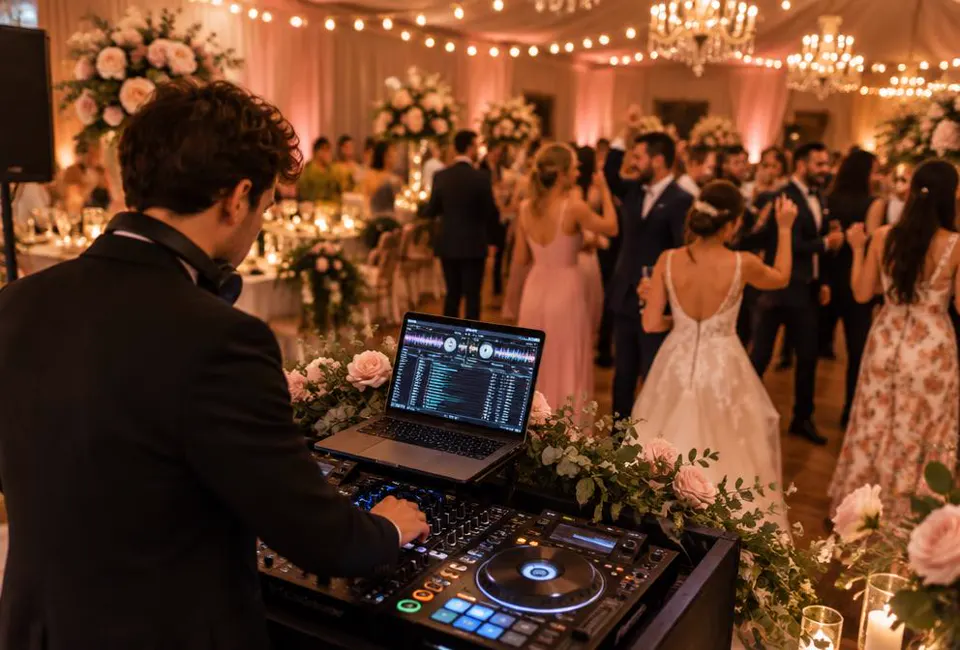
Defining Your Reception Atmosphere and Vibe
The first step in learning how to choose a wedding dj is moving beyond the simple search for a music provider and instead defining the specific emotional pulse of your celebration. Your entertainment priorities dictate every subsequent decision, from the equipment required to the level of microphone interaction your guests will experience.
Before browsing portfolios, you must determine where your celebration sits on the Energy Spectrum. This framework places a Sophisticated Background approach at one end and High Energy Hype at the other. For example, a couple like Sarah and Leo might prefer a Sophisticated Background vibe for their garden reception, where the music serves as a lush, melodic layer that encourages multi-generational conversation without interruption. In contrast, a couple like Marcus and Elena might seek a High Energy Hype style, where the DJ acts as a master of ceremonies who actively drives the crowd onto the dance floor through rhythmic transitions and vocal encouragement.
Navigating the Energy Spectrum Framework
The Energy Spectrum helps you identify your non-negotiable entertainment priorities based on your personality. A Sophisticated Background approach focuses on curated playlists of jazz, soul, or lounge music that fills the room without demanding center stage. It is ideal for couples who value an elegant, relaxed atmosphere. Conversely, the High Energy Hype approach uses the DJ as a focal point to maintain momentum. This style requires a professional who can read the room and adjust the tempo instantly to prevent the dance floor from emptying. Deciding this early prevents the mismatch of hiring a high energy club DJ for a quiet, intimate dinner.
| Feature | Sophisticated Background | High-Energy Hype |
|---|---|---|
| MC Interaction | Minimal, announcements only | Active, crowd engagement |
| Volume Levels | Conversational throughout | Increasing for dancing |
| Music Focus | Atmospheric, eclectic, deep cuts | Remixes, anthems, high BPM |
| Guest Reaction | Socializing and foot tapping | High-impact dancing and singing |
Identifying your guest demographics is the next crucial step in refining your vibe. A wedding with a 50 percent split between older relatives and younger friends requires a different musical strategy than an event dominated by college peers. Consider the musical eras that resonate with your attendees. A successful DJ will bridge these gaps using a transition plan that honors your must-have songs while avoiding your do-not-play list. By auditing your guest list by age and musical preference, you provide your future DJ with a roadmap to keep the majority of people engaged throughout the entire evening.
To formalize your vision, create a worksheet that categorizes your musical preferences into three distinct pillars: Must-Haves, Do-Not-Plays, and Guest Requests. The Must-Have list should be limited to 10 to 15 songs that define your relationship or cultural heritage. The Do-Not-Play list is equally vital, as it prevents the DJ from playing clichés or genres that do not fit your Sophisticated or High Energy goals. Finally, decide if you will allow guest requests. Some couples prefer a strict veto policy to maintain the vibe, while others embrace the spontaneity of guest input to keep the energy levels high.
Vibe and Music Worksheet Checklist
- Categorize your event style as either Background or Hype.
- List 10 Must-Have songs that represent your personality.
- List at least 5 genres or specific songs for the Do-Not-Play list.
- Audit guest ages to identify common musical eras.
- Determine if the DJ should take live requests from guests.
- Decide on the preferred level of DJ vocal interaction.
- Identify the 'First Dance' and 'Grand Entrance' tracks.
- Establish the volume expectations for the dinner portion.
Ultimately, your choice in atmosphere dictates the technical requirements you will discuss in later sections. A high-energy vibe may require specialized lighting or subwoofers, whereas a sophisticated background vibe might prioritize high-fidelity speakers with a smaller footprint. By establishing these priorities now, you ensure that you are interviewing DJs who specialize in your specific vision rather than trying to force a professional into a style they do not naturally perform. This clarity is the foundation of a successful wedding reception and a stress-free planning process for any couple worldwide.
The Three-Step Vetting Process for Professionals
Narrowing down potential vendors requires a systematic approach to ensure their performance matches your vision. This three-step vetting process moves from digital research to personal interaction and technical verification.
Step One: Digital Footprint and Mix Evaluation
Begin your search by analyzing the DJ's online presence through a critical lens. A professional should have a curated portfolio of live mixes on platforms like Mixcloud or SoundCloud. When listening, do not focus on your favorite songs. Instead, listen for seamless transitions and the energy flow between genres. For instance, a couple like Sarah and David noticed a candidate whose transitions were jarring or relied on fading to silence between tracks. This is a red flag indicating a lack of technical mixing skill. Check reviews for specific mentions of adaptability rather than generic praise like they were great. Look for comments about how the DJ handled unexpected guest requests or equipment malfunctions.
Step Two: Interaction and Technical Audit
A video call is non-negotiable for assessing personality and communication style. Ask the DJ to describe a time they lost the dance floor and how they recovered it. An experienced professional will explain their strategy for reading the room, such as switching from contemporary pop to classic soul when they notice older relatives leaving their seats. This ability to intuit the crowd's energy is significantly more valuable than the brand of their speakers. During this call, verify their technical backup plan. A professional must have a redundant system, including a secondary laptop and a backup controller, to ensure the music never stops during the celebration.
Red Flags to Identify During Online Review Audits
- Multiple reviews mentioning the DJ was too loud or ignored volume requests.
- Feedback suggesting the DJ spent more time talking on the microphone than playing music.
- Reviews indicating the DJ played songs from a do not play list.
- Lack of recent activity or reviews within the last twelve months.
- Vague responses to negative feedback that blame the couple or the venue.
- A digital portfolio that only contains studio recordings rather than live event captures.
While total wedding costs vary globally, the investment in a DJ typically represents a portion of the overall budget. According to The Knot Real Weddings Study 2025, the US average wedding cost is about $33,000. In Australia, the average is about A$35,315 according to Easy Weddings 2025. In Canada, costs average about C$30,000 per RBC. Regardless of the total spend, prioritizing a DJ who understands the flow of a reception over one who simply owns expensive lights is essential. A technical audit should focus on reliability. Ask if they use professional grade cables and if they have a plan for power surges. High quality sound depends more on gain staging and room acoustics than the price tag of the amplifier.
| Evaluation Metric | The Amateur Approach | The Professional Standard | Success Indicator |
|---|---|---|---|
| Music Transitions | Abrupt stops or fades | Beat matching and phrasing | Continuous dancing |
| Crowd Reading | Fixed playlist order | Real time energy adjustment | Multi generational appeal |
| Equipment Prep | Single laptop setup | Full hardware redundancy | Zero downtime |
| Communication | Delayed or vague emails | Scheduled consultations | Detailed event run sheet |
| MC Style | Overbearing or comedic | Polished and minimalist | Clear announcements |
Finalize your vetting by requesting a technical rider or an equipment summary. This document should outline their space requirements and power needs. If a DJ cannot explain how they manage sound distribution in a room with high ceilings or echoes, they may struggle with the acoustics of your specific venue. A couple named Leo and Maria avoided a potential disaster by asking a DJ about their wireless microphone range, discovering the equipment was unsuitable for their large outdoor ceremony. Always choose the professional who emphasizes the guest experience and technical stability over the one who merely promises a party atmosphere without a logistical framework to support it.
Final Vetting Checklist for Candidates
- Confirmed the DJ has at least three live mixes available for review.
- Verified a backup sound system is included in the standard package.
- Conducted a video call to assess verbal communication and tone.
- Checked that the DJ has performed at similar venue types before.
- Confirmed the DJ personally handles the setup and teardown process.
- Verified the DJ possesses public liability insurance for the event date.
- Ensured the DJ has a clear policy for handling song requests.
- Validated that the DJ uses professional, not consumer, grade audio software.
Interview Scripts: Questions That Reveal Reality
Standard questions often yield standard, rehearsed answers that do not reflect a DJ's actual performance skills. This section provides specific interview scripts designed to uncover how a professional manages complex musical transitions and crowd dynamics.
When you ask a professional how long they have been in the industry, you often receive a number rather than an insight into their competence. To understand how to choose a wedding dj who can actually manage a room, you must pivot toward situational questions. These scripts force the professional to explain their creative process rather than reciting their resume. By focusing on how they handle specific challenges, you can discern if they are a simple playlist operator or a skilled mixologist capable of maintaining the energy of your reception across various demographics and musical preferences.
The Transition Test: A Case Study Script
Consider the scenario of Sarah and Mark, a couple who wants to blend 90s hip-hop with classic Motown. To test a DJ's ability to bridge these distinct eras, they should not ask if the DJ likes both genres. Instead, the script should be: 'We want to transition from a high energy Motown set into 90s hip-hop without losing the older generation on the dance floor. Can you walk us through the specific tracks you would use as a bridge and how you would manage the BPM shift?' A skilled professional will mention techniques like beat-matching, harmonic mixing, or using a multi-generational anthem to keep the momentum steady.
| The Standard Question | The Reality Reveal Script | What the Answer Reveals |
|---|---|---|
| Do you have a backup plan? | If your primary mixer fails during the first dance, how many seconds until music resumes? | Technical redundancy and crisis readiness. |
| Do you take requests? | How do you decline a guest's song request that contradicts our 'do not play' list? | Diplomacy and adherence to your vision. |
| How do you get people dancing? | Describe a time the dance floor was empty. What specific track or tactic did you use? | Problem solving and crowd reading ability. |
| Are you comfortable on the mic? | How do you handle a guest who tries to take the microphone for an unscheduled speech? | Event management and boundary setting. |
The response to the 'empty dance floor' script is particularly telling. A novice might say they just turn up the volume or play a generic line dance. A seasoned professional will discuss observing the 'edge of the floor' to see which demographic is tapping their feet. They might suggest changing the decade or the tempo to re-engage the group. This level of detail confirms they are actively working the room. If their answer is vague or relies on light shows rather than musical selection, they may lack the fundamental skills needed for a dynamic wedding environment.
Finally, ask about their specific audio philosophy for different parts of the evening. Use this script: 'How do you adjust the EQ and volume levels between the cocktail hour and the late night dance set to ensure guests can talk during dinner but feel the music later?' This reveals their technical understanding of sound engineering. While the average wedding cost in Australia is A$35,315 according to Easy Weddings 2025, and in Canada it is C$30,000 according to RBC, the investment in a DJ should be justified by this technical expertise. A true professional understands that sound quality is as important as the song choice.
Red Flags to Listen For During Interviews
- Vague answers regarding technical backup equipment and timing.
- Refusal to share specific examples of past musical transitions.
- Over-reliance on 'standard' wedding playlists without customization.
- Speaking more about their own performance than your specific vibe.
- Inability to describe how they handle difficult or intoxicated guests.
- Lack of knowledge regarding the venue's specific acoustics or power needs.
- Dismissive attitude toward your 'do not play' list preferences.
- Failure to explain how they coordinate with other vendors like photographers.
Technical Requirements: Audio, Lighting, and Power
When learning how to choose a wedding dj, you must look beyond the playlist to the physical infrastructure required to power your celebration. This technical audit ensures the music stays loud, the speeches stay clear, and the dance floor remains vibrant without blowing a fuse.
A professional DJ functions as a mobile production house, but their performance depends heavily on the venue infrastructure. You must verify that your venue provides dedicated power circuits, ideally 20 amps, to avoid tripping breakers when the bass peaks. Consider the case of Sarah and David, whose outdoor marquee wedding nearly went silent because the DJ was sharing a single extension cord with the catering team's warming ovens. Before signing, confirm the DJ has a site visit planned or a technical rider that details their space requirements, including a flat surface for equipment and sufficient overhead clearance for lighting rigs.
Prioritizing Speech Clarity and Microphone Range
High quality audio is more than just loud speakers: it is about the intelligibility of words during the most emotional moments. You need to ensure the DJ provides at least two professional grade wireless microphones, such as UHF or digital systems, to avoid interference from local cell towers. One handheld or lapel microphone should be dedicated to the officiant or the couple, while another is reserved for toasts. Ask the DJ how they manage frequency coordination if your venue is in a dense urban area where radio signals often overlap and cause sudden static or dropouts during speeches.
| Lighting Type | Function | Atmospheric Impact |
|---|---|---|
| Static Uplighting | Painting walls with color | Creates depth and highlights architecture. |
| Wash Lighting | Broad coverage of the floor | Ensures guests can see each other clearly. |
| Moving Head Lights | Dynamic beams and patterns | Adds energy and excitement during dancing. |
| Pin Spotting | Focused narrow beams | Highlights the cake or centerpieces. |
| Haze or Fog | Enhances light beam visibility | Makes light textures appear three dimensional. |
Lighting is split into two categories: wash lighting and dance floor lighting. Wash lighting fills the room with a steady glow, often matching your wedding palette, while dance floor lighting involves moving heads or strobes that react to the beat. Avoid DJs who only offer 'sound activated' lights that blink randomly: look for professionals who use DMX programming. This allows them to control the intensity and color of the room instantly, shifting from a romantic dim during the first dance to a high energy strobe effect during the final set. This control prevents the 'middle school disco' look often associated with budget setups.
Modern couples often face a significant financial investment, with US weddings averaging about $33,000 according to The Knot Real Weddings Study 2025. In Australia, the average is about A$35,315 per Easy Weddings 2025. Protecting this investment requires a DJ who treats technical logistics as a priority. This includes using a sound system calibrated for the specific room acoustics. A ballroom with high ceilings and glass walls requires a different speaker placement than a low ceiling basement. Your DJ should be able to explain their plan for 'sound dispersion' to ensure the front row is not deafened while the back row hears nothing.
Technical Venue Audit for Your DJ
- Confirm at least two dedicated 15 to 20 amp circuits.
- Verify the distance from the DJ booth to the furthest speaker point.
- Check for local noise ordinances or decibel limits at the venue.
- Ensure the DJ has a rain plan for outdoor equipment setups.
- Test wireless microphone range from the podium to the receiver.
- Identify the location of the circuit breaker panel for quick access.
- Confirm if the venue requires a specific insurance certificate (COI) from the DJ.
- Determine if the DJ needs to provide their own table and linens.
Contract Clauses and Hidden Cost Analysis
Signing a contract is the most significant step in how to choose a wedding dj, as it transforms a verbal promise into a binding legal obligation. This section breaks down the complex terminology and financial structures that ensure your entertainment is guaranteed regardless of unforeseen circumstances.
When reviewing a contract, couples must look beyond the base fee to identify potential budget inflation. In the United States, where the average wedding cost is about $33,000 according to The Knot Real Weddings Study 2025, or in Australia, where the average is about A$35,315 according to Easy Weddings 2025, entertainment typically represents 5 to 10 percent of the total. However, hidden fees like travel surcharges for venues more than 50 kilometers away or mandatory equipment insurance fees can quickly push you over budget. Always request an all inclusive quote that accounts for the specific logistics of your venue to avoid surprise line items on the final invoice.
The Financial Realities of Live Performance Logistics
Consider the scenario of Sarah and David. They booked a DJ for five hours but the reception energy was so high they requested an extra hour at midnight. Because they did not pre negotiate an overtime rate, they were charged a premium on site. A professional contract should explicitly state the hourly rate for additional time, usually calculated in 30 or 60 minute increments. Furthermore, most professionals require a hot meal if they work more than six hours. Failure to provide this often results in a 'buy out' fee where you pay the DJ to order their own food, which is often more expensive than adding one guest to your catering count.
| Fee Category | Typical Calculation | Estimated Impact |
|---|---|---|
| Overtime Rate | Hourly or half hourly flat fee | 150 to 200 percent of base hourly rate |
| Travel Surcharge | Per kilometer or mile beyond a radius | 0.50 to 1.50 in local currency per unit |
| Vendor Meal | One hot main course per staff member | 30 to 50 percent of guest plate cost |
| Public Liability Insurance | Flat fee for venue compliance | Often included or 50 to 100 flat fee |
| Early Setup | Fee for arriving 3 plus hours early | Flat fee of 75 to 150 |
Cancellation and postponement clauses are vital for protecting your investment, especially given the global volatility of recent years. In the United Kingdom, where weddings average about £20,600 according to Bridebook 2024 or up to £23,000 according to Which? 2024, many DJs now offer 'Force Majeure' clauses that cover government mandates or natural disasters. Ensure your deposit is either refundable within a certain timeframe or transferable to a new date. If a DJ asks for 100 percent payment upfront more than six months in advance, this is a red flag. A standard 25 to 50 percent deposit is the industry norm for securing your date legally.
The Backup DJ Formula: Ensuring Continuity
The greatest fear for any couple is the DJ falling ill on the wedding morning. To mitigate this, apply the Backup DJ Formula. Your contract must include a 'Substitution Clause' that names a specific secondary professional or a reputable agency that guarantees a replacement of equal skill. Ask the DJ: 'If you are in a car accident at 10:00 AM, who exactly is the person who shows up at 4:00 PM, and how do they access my music library and timeline?' A professional uses cloud based software like Vibo or Planning Pod so a backup performer can download your specific preferences and scripts instantly. Do not accept a generic promise of a replacement. Demand a name or a clear agency guarantee.
Contractual Red Flag Checklist
- The contract lacks a specific start and end time for the performance.
- There is no mention of equipment breakdown insurance or backup gear.
- The travel fee is listed as 'to be determined' rather than a fixed sum.
- The document does not specify who is responsible for venue power requirements.
- There is no clause regarding the DJ's behavior, such as alcohol consumption.
- The cancellation policy only protects the DJ and offers no refund for the couple.
- Specific lighting or audio requests are not listed as included line items.
- The contract does not identify the specific individual who will perform.
Finally, review the payment schedule carefully. In Canada, where the average wedding costs C$30,000 according to RBC, many couples prefer to settle the final balance two weeks before the event. This prevents the stress of handling cash or bank transfers on the wedding day. Ensure the contract specifies the accepted payment methods and provides a receipt for every transaction. Clear documentation not only protects your money but also establishes a professional tone that encourages the DJ to deliver their best possible performance. Reading the fine print now prevents costly disputes later.
Collaborating on the Wedding Timeline
A professional wedding DJ serves as the director of your reception, ensuring that every transition between major events feels intentional rather than accidental. This section details how to synchronize your vision with their technical execution to maintain high energy from start to finish.
When learning how to choose a wedding dj, you must evaluate their ability to manage flow. The DJ is the heartbeat of the evening. They do not just play songs; they manage the physical movement of your guests. Consider a couple like Elena and Marcus who wanted a high energy party but forgot to plan the transition from dinner to the dance floor. Without a DJ acting as a director, guests often linger at tables, creating a lull that is difficult to break. Your DJ should provide a clear vocal cue and a musical shift that signals the start of a new chapter in the evening.
Structuring the Grand Entrance and Milestones
The grand entrance sets the tone for the entire night. Work with your DJ to decide if you want a high impact introduction with upbeat tracks or a sophisticated, low key arrival. For the first dance, discuss the exact second the DJ should fade the music or invite others to join you. Precise timing prevents that awkward moment where a couple circles the floor for four minutes with no exit strategy. Similarly, the cake cutting should be treated as a visual performance. The DJ must coordinate with the photographer to ensure guests are watching and the music swells as the first slice is made.
| Time Increment | Event Trigger | DJ Action | Guest Direction |
|---|---|---|---|
| 00:00 to 00:05 | Grand Entrance | High energy track at 100% volume | Stand and cheer |
| 00:05 to 00:10 | First Dance | Crossfade to romantic ballad | Gather around the floor |
| 00:45 to 00:50 | Main Course End | BPM increase to 110-120 range | Prepare for movement |
| 01:15 to 01:20 | Cake Cutting | Upbeat classic pop track | Move toward dessert station |
| 01:25 to 01:30 | Dance Floor Open | High energy anthem with lighting shift | All guests to the floor |
Effective timeline collaboration prevents the dead air that kills a party atmosphere. Dead air usually happens during 'micro transitions,' such as the time it takes for a best man to walk from his seat to the microphone. A skilled DJ uses 'fill music' or brief announcements to bridge these gaps. If you are budgeting based on global averages, such as the US average of $33,000 (The Knot Real Weddings Study 2025) or the UK average of £20,600 (Bridebook 2024), remember that the DJ's role in time management is one of your most valuable investments for guest satisfaction.
Communication scripts are essential during this planning phase. Instead of saying 'play music for two hours,' tell your DJ: 'We want the energy to build gradually during dinner, peaking exactly when the last plate is cleared.' Use a decision framework based on guest demographics. If 40 percent of your guests are older, schedule the loudest dance sets after the formal cake cutting so those who prefer quiet can depart comfortably. This level of detail ensures the DJ can pivot their style while maintaining the structural integrity of your specific wedding schedule.
Timeline Coordination Essentials
- Confirm the phonetic pronunciation of every wedding party member for the entrance.
- Establish a 'safe word' or signal to truncate the first dance if it feels too long.
- Identify who provides the microphone for toasts to avoid technical delays.
- Determine the exact song timestamp for the cake cutting photo opportunity.
- Sync the DJ start time with the arrival of the first guest from the ceremony.
- Schedule a final walk through of the timeline 14 days before the event.
- Designate a point of contact for the DJ other than the couple for real time shifts.
- Confirm the volume levels for the cocktail hour versus the late night party.
- Map out the physical path the couple will take during the grand entrance.
Finally, remember that the timeline must remain flexible. A great DJ monitors the room and may suggest moving the bouquet toss or a specific dance set if they notice the energy dipping. Trust their professional intuition. While the plan is your roadmap, their ability to read the room is what prevents a rigid schedule from feeling forced. By collaborating on these transitions early, you ensure that the flow of the night feels effortless, allowing you to focus entirely on the celebration rather than the clock.
Common Pitfalls and How to Avoid Them
The final stage of how to choose a wedding dj involves identifying behavioral red flags and programming errors that can derail an otherwise perfect evening. By recognizing these archetypes early, you can steer your celebration toward a balanced experience that satisfies both your vision and your guests.
The first pitfall is the Mic Hogging MC. This occurs when a DJ treats your reception like their personal comedy club or variety show. For example, consider Sarah and David, who hired a high energy personality only to find him interrupting every third song to make inside jokes or shout instructions. To avoid this, specify in your contract that the DJ should only speak for essential transitions, such as introducing the wedding party or announcing the cake cutting. Request a minimalist style where the music remains the focus, ensuring the professional facilitates the flow without becoming the center of attention.
Another common error is the Playlist Dictator, which manifests in two ways. Either the couple provides a rigid list of 100 songs that leaves no room for professional reading of the crowd, or the DJ ignores the couple's preferences entirely to play a standard set. Take the case of Priya and Mark, who insisted on an all indie folk set for a four hour dance party. The energy plummeted because the music lacked danceable beats. A professional avoids this by using a 70/30 music programming ratio, which balances your specific requests with crowd pleasing hits that ensure all generations stay on the floor.
The 70/30 Programming Strategy
The 70/30 ratio is a decision framework designed to harmonize your personal taste with guest engagement. Under this model, 70 percent of the music consists of familiar, high energy tracks across genres like pop, disco, or soul that appeal to a broad demographic. The remaining 30 percent is reserved for your niche favorites, cultural tracks, or deep cuts. This prevents the alienating effect of a playlist that is too obscure. By allowing your DJ the flexibility to weave your 30 percent into the 70 percent foundation, you ensure the party feels uniquely yours while keeping the dance floor packed.
| Archetype | The Mistake | Prevention Strategy |
|---|---|---|
| The Mic Hogger | Constant talking and jokes | Scripted announcements only |
| The Volume Blaster | Music too loud for talking | Set decibel limits for dinner |
| The Genre Looper | Sticking to one era too long | Apply the 70/30 ratio |
| The Request Ignorer | Dismissing guest suggestions | Define a 'Must Play' list |
| The Transition Fumbler | Dead air between songs | Review live mixing samples |
Finally, avoid the pitfall of failing to plan for multi generational transitions. A wedding is a rare event where teenagers and grandparents share a dance floor. If you play aggressive club music immediately after dinner, you risk clearing out the older guests before the night has truly begun. Start the evening with motown, funk, or classic pop that bridges the age gap. As the night progresses, you can shift into more contemporary or niche genres. This gradual evolution of sound keeps the energy building organically while ensuring that everyone feels included in the celebration for as long as possible.
Final Red Flag Review
- The DJ refuses to accept a Do Not Play list.
- They do not have a backup plan for equipment failure.
- The professional seems more interested in their gear than your timeline.
- They lack experience with your specific cultural traditions.
- The DJ uses pre recorded mixes rather than live transitions.
- They do not offer a site visit for complex venues.
- Communication is slow or dismissive during the planning phase.