Budgeting and Property Assessment
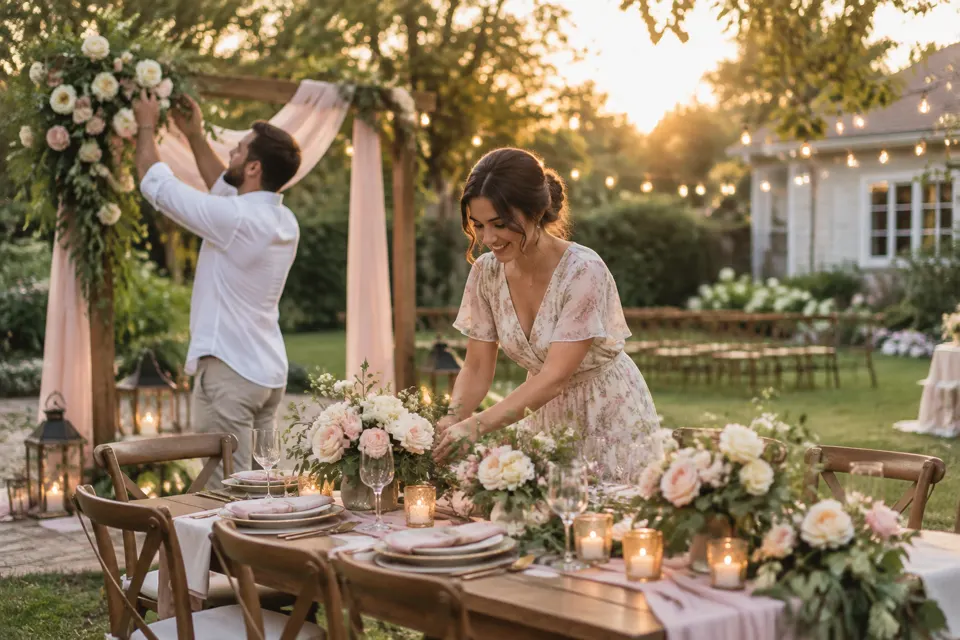
Planning a backyard wedding begins with reconciling your vision of the property with the logistical realities and costs involved in temporary infrastructure. While hosting at home offers a personal touch, it requires a rigorous assessment of the land to ensure the site can safely support your celebration.
The Financial Reality of Home Based Weddings
A common misconception is that knowing how to plan a backyard wedding automatically guarantees a cheaper event. While you save on venue hire fees, you often inherit costs for rentals that a traditional venue includes as standard. To set a baseline, the US average wedding cost is about $33,000 (The Knot Real Weddings Study 2025), and Canada is approximately C$30,000 (RBC). In the UK, costs range between £20,600 (Bridebook 2024) and £23,000 (Which? 2024), while Australia is about A$35,315 (Easy Weddings 2025). Couples like Sarah and Marcus often find that forty percent of their budget shifts from venue fees to tenting and power.
When building your budget, allocate at least fifteen percent for hidden site preparation costs. This includes landscaping, tree trimming, or leveling uneven ground. Unlike a ballroom, a backyard requires you to build a venue from the grass up. You must account for the delivery fees of tables, chairs, and flooring. If you fail to budget for the logistics of hauling equipment into a residential area, you may face unexpected surcharges. Successful couples prioritize their spending by identifying which elements of the home already shine and which require significant financial intervention to become event ready.
| Category | Home Cost Factor | Typical % of Total |
|---|---|---|
| Infrastructure | Tents, flooring, lighting | 25 to 30 percent |
| Rentals | Tables, chairs, linens | 15 to 20 percent |
| Site Prep | Landscaping, leveling | 5 to 10 percent |
| Logistics | Power, toilets, waste | 10 to 15 percent |
| Catering | Food and service | 25 to 35 percent |
Assessing the physical property is the next critical step. Square footage requirements are a nonnegotiable math problem. For a seated dinner with a dance floor, allow for at least two square meters or twenty square feet per guest. If your yard is split into different levels, ensure each zone serves a specific purpose, such as a ceremony lawn and a separate reception patio. The slope of the land is equally vital. Any grade steeper than three percent will require professional subflooring or staging, which can double your rental costs overnight. Drainage must also be checked to avoid mud pits.
Property Feasibility Checklist
- Measure total usable square footage excluding gardens and permanent structures.
- Identify high ground for the tent to avoid water pooling during rain.
- Check for overhead utility lines that might obstruct tent installation.
- Verify if the soil is firm enough to hold heavy tent stakes or weights.
- Locate external power outlets and evaluate the circuit breaker capacity.
- Ensure a minimum path width of 1.5 meters for catering equipment access.
- Assess the grade of the lawn using a level or string line.
- Identify the sun position during your planned ceremony time to avoid glare.
- Confirm if the driveway can handle the weight of delivery trucks.
Consider the guest experience during the transition from day to night. As shadows grow, you must identify trip hazards like roots or uneven pavers. A couple in Sydney, Liam and Chloe, used a simple flashlight test at night to map out where additional path lighting was needed. They discovered that their beautiful garden steps became a safety risk after sunset. Mapping the property from a guest perspective allows you to identify these bottlenecks early. Use the property assessment phase to decide if the space truly fits the guest count or if the guest list needs to shrink.
Finally, evaluate your home's interior access. Even if the wedding is strictly outdoors, you must decide if guests are allowed inside for any reason. If the house is off limits, your property assessment must include space for luxury portable toilets and a mobile cloakroom. Establishing these boundaries early prevents wear and tear on your personal residence. By treating the property as a professional venue during the planning stages, you avoid the common mistake of underestimating the physical impact that one hundred guests will have on your private landscape and local utility systems.
Navigating Legal and Insurance Requirements
Turning a private residence into a wedding venue requires more than just floral arrangements: it demands a rigorous approach to local regulations and liability protection. Couples must navigate the complex intersection of zoning laws and private insurance to ensure their celebration remains lawful and financially secure.
Before booking a single vendor, you must confirm that your property can legally host a commercial scale gathering. While the average US wedding costs about $33,000 according to The Knot Real Weddings Study 2025, a significant portion of that investment can be lost if a local council shuts down your event due to permit violations. Consider the case of Sarah and David, who assumed their rural property was exempt from city rules. They later discovered that their municipality classified any gathering over fifty people as a public assembly, requiring a specific temporary use permit filed sixty days in advance. Failure to secure this paperwork can result in immediate shutdowns on the wedding day.
Scripts for Municipal Inquiries
When calling your local council or zoning office, be precise with your language to get accurate answers. Use this script: I am calling to inquire about requirements for a one time private event at a residential address. Specifically, what is the maximum decibel limit allowed after 10 PM, and are there restrictions on street parking for more than twenty vehicles? If the official mentions a permit, ask: What is the specific name of the application, the processing fee, and the lead time required for approval? This direct approach prevents the vague answers that often lead to permit delays or unexpected fines during the setup phase of the wedding.
| Region | Average Cost | Primary Data Source | Year |
|---|---|---|---|
| United States | $33,000 | The Knot Real Weddings Study | 2025 |
| United Kingdom | £20,600 | Bridebook | 2024 |
| Australia | A$35,315 | Easy Weddings | 2025 |
| Canada | C$30,000 | RBC | 2024 |
Insurance is the most critical safety net for a backyard wedding. A common mistake is assuming that standard homeowner insurance policies cover large events. Most residential policies are designed for daily living and exclude high risk activities such as professional catering, dance floors, or large scale liquor service. If a guest trips on a temporary power cable or a fire starts in a rented catering tent, your primary home policy may deny the claim. Supplemental event insurance is non negotiable to protect your assets and the property owner from lawsuits or property damage that exceeds standard residential limits.
The Supplemental Insurance Framework
To choose the right coverage, use a risk based framework. First, evaluate the alcohol service. If you are providing the alcohol rather than using a licensed bar service, you need specific host liquor liability. Second, check your vendor contracts. Many professional caterers carry their own liability, but you still need an umbrella policy to cover gaps. For example, in Australia, where the average wedding cost is A$35,315 per Easy Weddings 2025, the cost of a comprehensive liability policy is a small percentage of the total budget. This policy should specifically name the property owners as additionally insured parties to protect their personal wealth from event related litigation.
Essential Legal and Insurance Milestone Checklist
- Verify local noise ordinances for specific decibel cutoffs.
- Check if a temporary liquor license is required for self service.
- Obtain a written parking plan approval from local authorities.
- Confirm the property is not restricted by HOA or strata bylaws.
- Secure a liability policy with at least two million in coverage.
- Verify that all external vendors have valid worker compensation.
- Document the pre event condition of the lawn and structures.
- Request a Certificate of Insurance from the marquee company.
- Submit the temporary event permit application 90 days prior.
Finalizing the paperwork requires a proactive stance toward the local community. In the UK, where costs reach £23,000 according to Which? 2024, councils often require a traffic management plan for narrow residential roads. By securing your permits and insurance early, you eliminate the risk of the local government intervening during your ceremony. This administrative phase is less glamorous than choosing decor, but it ensures that your backyard wedding is built on a foundation of legal security. Always keep physical copies of every permit and insurance certificate in a dedicated folder on site during the entire event duration for quick reference.
Managing Power, Water, and Restrooms
When learning how to plan a backyard wedding, many couples overlook the invisible infrastructure that keeps a celebration running smoothly. Managing power, water, and restroom logistics ensures that the party continues without flickering lights or plumbing disasters.
The most common technical failure at residential weddings occurs when the caterer, DJ, and lighting system all draw power from the same household circuit. A standard home circuit typically handles 15 to 20 amps, which is insufficient for commercial grade convection ovens and high output speakers. For example, a couple named Sarah and Mark might find that their DJ’s bass drop trips the breaker exactly when the caterer starts the coffee service. To prevent this, hire a licensed electrician to map your home circuits and identify outlets on different breakers. If your property lacks the necessary capacity, rent a silent tow-behind generator to isolate the event load from the main house.
Calculating Sanitation and Restroom Capacity
Providing adequate restrooms is a matter of guest comfort and property protection. A single residential bathroom cannot handle the high frequency use of 100 guests over six hours without risking a septic backup or significant clogs. As a rule of thumb, you should provide one restroom for every 25 to 30 guests. If alcohol is being served, increase the count by 15 percent to account for higher usage rates. For a wedding of 100 people lasting six hours, you will require at least four individual stalls. Luxury portable restroom trailers are the preferred choice, as they offer climate control and running water while operating on a self contained waste tank.
| Guest Count | 4 Hour Event | 6 Hour Event | 8 Hour Event |
|---|---|---|---|
| 50 Guests | 2 Stalls | 2 Stalls | 3 Stalls |
| 100 Guests | 3 Stalls | 4 Stalls | 5 Stalls |
| 150 Guests | 5 Stalls | 6 Stalls | 7 Stalls |
| 200 Guests | 7 Stalls | 8 Stalls | 9 Stalls |
Water access is equally critical for your catering team and guest hydration stations. Most caterers require a dedicated potable water source for cooking and cleaning. Ensure you have high quality, food grade hoses that are long enough to reach the designated catering tent without crossing main foot traffic paths. If your property relies on a well system, test the recovery rate weeks before the event. A sudden surge in water usage from multiple restrooms and kitchen prep could temporarily dry out a low yield well. In such cases, your restroom trailer provider may need to bring an external freshwater holding tank and pump.
Safety and visibility are the final components of your infrastructure plan. As the sun sets, your guests will need illuminated pathways leading to the restrooms. Use low voltage LED stake lights or string lights to define the walking path. Avoid running extension cords across grass where guests walk. If cords must cross a path, use heavy duty rubber cord ramps to prevent tripping hazards. Remember that the total budget for these utilities can impact your overall spending. For context, the average wedding costs about $33,000 according to The Knot Real Weddings Study 2025, and allocating funds for a generator or luxury trailer is a vital investment in that total.
Essential Infrastructure Checklist
- Identify and label all circuit breakers in the main electrical panel.
- Calculate total amperage requirements for the DJ, caterer, and lighting.
- Reserve a silent generator if total demand exceeds 60 percent of home capacity.
- Contract a luxury restroom trailer with a dedicated waste management plan.
- Confirm the location of the main water shut off valve in case of leaks.
- Purchase food grade hoses for catering and bar water supply.
- Install motion activated lighting for the restroom entrance area.
- Test all outdoor outlets for functionality and weatherproofing.
- Ensure the restroom trailer is placed on level, stable ground.
Consider the experience of a couple like Leo and Clara, who chose to host their reception in a rural garden. They initially planned to use the house bathroom but realized their old septic system would not sustain 80 guests. By renting a two stall luxury trailer, they kept guests outdoors and prevented indoor foot traffic. They also rented 100 meters of heavy duty cabling to run the caterer’s ovens from a generator parked far from the ceremony site. This proactive approach kept the noise levels down and the electricity stable, allowing the event to proceed without a single technical interruption or plumbing issue.
Designing a Functional Event Flow
When learning how to plan a backyard wedding, the physical layout of your property determines whether your day feels like a professional event or a chaotic house party. A strategic floor plan ensures that hundreds of guests move fluidly through the environment without overcrowding private residential areas.
Sarah and Mateo planned their wedding in a medium sized suburban garden but overlooked the narrow passage between the house and the garage. During the transition from the ceremony to the cocktail hour, all eighty guests tried to pass through this four foot gap simultaneously, creating a significant bottleneck that delayed the reception by thirty minutes. To avoid this, designers recommend designating three distinct zones: a ceremony area, a transition space for drinks, and a dining zone. Each zone should be separated by physical markers like potted plants or signage to subconsciously guide the guest flow and prevent people from clustering in utility areas.
Mastering Spatial Dimensions and Walkway Widths
Effective traffic management relies on the math of human movement. For main thoroughfares where two people need to walk side by side, a minimum width of six feet is the professional standard. If you expect guests to carry drinks or plates, increase this to eight feet. When plotting your layout on the lawn, use flags or spray chalk to visualize these paths before the tent arrives. Ensure that these walkways do not cross through the kitchen service route, as this prevents collisions between guests and staff carrying heavy trays. Proper spacing also preserves the lawn, as concentrated foot traffic on narrow paths can turn grass into mud within hours.
Strategies for Zonal Separation
- Position the bar as far as possible from the buffet to spread the crowd across the lawn.
- Use rugs or temporary flooring to define the 'dance floor' zone even if no tent is used.
- Create a 'decompression zone' near the entrance where guests can drop coats or gifts immediately.
- Place the cake table in a low traffic corner until the cutting ceremony to avoid accidental bumps.
- Use lighting, such as string lights or lanterns, to visually outline the intended walkways after dark.
Accessibility is often the most neglected aspect of a backyard layout. Uneven grass, hidden tree roots, and soft soil pose significant risks for guests with limited mobility or those wearing high heels. Every zone of the wedding must be accessible via a firm, flat path. You can create these routes using interlocking plastic flooring, plywood covered in outdoor carpet, or even temporary resin walkways. If your yard has a significant slope, you must rent a professional ramp system rather than relying on makeshift wooden planks. Test the route with a wheelchair or walker prior to the wedding day to ensure there are no steep grades or dangerous gaps.
Finally, consider the psychology of seating. While open floor plans feel airy, they can leave guests feeling lost. Grouping lounge furniture or bistro tables near the bar encourages smaller social clusters, which helps manage the overall density of the main reception area. If your budget allows for it, hiring a professional floor plan software service or a site coordinator can help you visualize the square footage. According to The Knot Real Weddings Study 2025, the US average wedding cost is about $33,000, so investing a small portion of that in layout planning ensures your investment is not wasted on a logistical disaster.
Backyard Layout Final Inspection
- Verify all main walkways are at least six feet wide.
- Confirm the catering path does not intersect with the guest restroom line.
- Test the stability of all tables on the lawn's natural grade.
- Check that the bar is located away from the entrance to prevent immediate clogs.
- Ensure there is a clear, paved or boarded path for mobility aids.
- Map out the power cord runs to ensure they do not cross walkways.
- Identify high wind areas that may require weighted signage or decor.
- Locate the sun's position during the ceremony to avoid blinding guests.
Backyard Catering and Kitchen Setup
When you move your reception to a private lawn, you are essentially asking your catering team to build a fully functional restaurant from the ground up. This requires meticulous planning to ensure food safety and efficiency without the convenience of a built-in commercial kitchen.
The most critical step in backyard catering is establishing a dedicated cook tent, a staging area tucked away from guest sightlines. Unlike a standard indoor venue, your home kitchen is likely insufficient for plating hundreds of meals simultaneously. Sarah and Liam, a couple planning their wedding, realized their caterer needed a 3 by 6 meter space separate from the house to avoid smoke and heat issues. This zone acts as a satellite kitchen, requiring a flat, dry surface like plywood flooring if the ground is soft. You must confirm with your vendor if they provide the tent or if you need to add this to your equipment rental list.
Water access and waste management are the silent pillars of a successful food service. You must provide a potable water source, usually via a food grade hose, for hand washing and light cleaning. For waste, follow a 20 percent surplus rule: if you expect five bags of trash, prepare for six. Create a designated disposal station behind the cook tent with separate bins for recycling, compost, and landfill. Ensure your catering contract specifies who is responsible for hauling this waste off site at the end of the night to prevent attracting local wildlife or leaving a mess for the morning.
Essential Rentals for Mobile Kitchen Success
| Equipment Category | Primary Function | Quantity Metric | Climate Consideration |
|---|---|---|---|
| Hot Boxes (Cambros) | Maintain food temp | 2 per 50 guests | Essential for cold nights |
| Convection Ovens | Final cooking/heating | 1 to 2 units | Requires high voltage power |
| Refrigeration Trailer | Store perishables | 1 unit (3 meter) | Vital for heat above 25C |
| Prep Tables | Plating and chopping | 4 to 6 units | Stainless steel preferred |
| Hand Wash Station | Sanitation compliance | 1 per 5 staff | Must include greywater tank |
Temperature control is your primary defense against foodborne illness, especially in regions with high humidity. If the ambient temperature exceeds 30 degrees Celsius, standard ice chests will not suffice for meat or dairy storage. Instead, budget for a refrigerated trailer or 'reefer' truck. For couples managing their finances, remember that the average wedding in Canada costs about C$30,000 (RBC) or A$35,315 in Australia (Easy Weddings 2025). A significant portion of this goes toward the infrastructure of food safety, so do not cut corners on refrigeration rentals or the power needed to run them throughout the day.
The Backyard Kitchen Infrastructure Checklist
- Confirm the caterer has walked the property to check for level ground.
- Secure two 20 amp circuits dedicated solely to the kitchen tent.
- Rent a minimum of two large hot boxes for resting proteins.
- Order double the amount of ice calculated for drinks to use for food chilling.
- Arrange for a gray water disposal plan that does not involve your lawn.
- Verify the caterer has a fire extinguisher rated for grease fires.
- Place heavy duty lighting inside the cook tent for late night cleanup.
- Coordinate a clear path for servers that avoids guest trip hazards.
Communication with your vendor about the site limitations is vital. A common mistake is assuming the caterer can use your indoor stove for 'just one thing.' Use this script when interviewing vendors: Our property has a single outdoor water spigot and limited indoor kitchen access; can your team operate entirely out of a 6 by 6 meter cook tent using portable propane and generator power? This clarifies expectations early. If they hesitate, they may not be the right fit for a backyard setting. By providing the right tools, you ensure the meal is served at the correct temperature regardless of the weather.
The Neighbor Strategy and Guest Arrivals
Managing the impact on your community is a vital component of how to plan a backyard wedding that maintains goodwill and ensures smooth logistics. Balancing guest comfort with neighborly courtesy requires proactive communication and a structured transport strategy.
The success of a residential celebration depends heavily on the 'Neighbor Strategy.' Three months before the event, send a formal notification to every household within a two block radius. This timeline allows neighbors to plan their own gatherings or travel away for the weekend. For instance, a couple named Sarah and David distributed handwritten cards that included their phone numbers and the specific window for amplified music. Providing this direct line of communication prevents neighbors from calling local authorities if the noise level fluctuates. Acknowledging the inconvenience early transforms potentially disgruntled residents into supportive community members who may even offer extra driveway space.
The Three Month Notification Script
When drafting your letter, clarity is more important than flowery language. Use this specific template: 'Dear Neighbor, we are excited to share that we will be hosting our wedding at [Address] on [Date]. We value your peace and want to inform you that our ceremony starts at [Time], with a reception following until [Time]. We have arranged off site parking to keep our street clear, but you may notice increased foot traffic. We have also hired a professional sound technician to monitor decibel levels. If you have any concerns on the day, please call our coordinator at [Phone Number]. Thank you for your patience as we celebrate this milestone.'
Parking logistics often represent the biggest hurdle in residential areas. A common mistake is assuming guests will naturally find spots or that street parking can handle forty cars. To prevent congestion, implement a shuttle system from a nearby commercial lot or community center. For a wedding of 100 guests, one 20 passenger shuttle running loops for 90 minutes before the ceremony and two hours during the exit is sufficient. This removes the stress of parallel parking on narrow roads and ensures that emergency vehicles or local residents can pass through without obstruction. Always secure written permission from the lot owner before directing guests there.
Mitigating Local Traffic Disruptions
- Notify the local police department non-emergency line two weeks prior to alert them to the increased traffic flow.
- Hire a professional parking attendant to stand at the entrance of the street to redirect cars to the shuttle lot.
- Provide clear digital maps in your wedding invitations showing exactly where guests should drop off their vehicles.
- Ensure the shuttle drop off point is clearly marked with signage so guests do not wander into neighbors' yards.
- Verify that no local roadwork or municipal festivals are scheduled for the same day as your wedding.
Navigating the financial aspect of logistics requires looking at the global averages for context. While the US average for a wedding is about $33,000 (The Knot Real Weddings Study 2025), and Australia sits at about A$35,315 (Easy Weddings 2025), logistics like shuttles can take up 5 to 10 percent of the total budget. In Canada, where the average is about C$30,000 (RBC), or the UK, where costs range from £20,600 (Bridebook 2024) to £23,000 (Which? 2024), these transport fees are often offset by the lack of a traditional venue rental fee. Investing in professional logistics ensures that your guest arrivals do not become a legal or social liability.
Logistics and Neighbor Relations Checklist
- Distribute neighbor notification letters twelve weeks in advance.
- Confirm shuttle rental contract and pickup/dropoff schedule.
- Obtain written permission for use of the off site parking lot.
- Call the local police precinct to report the event date and expected traffic.
- Create a 'Day of Coordinator' contact card for neighbors.
- Check local noise ordinances for specific cut off times.
- Post 'No Wedding Parking' signs in front of neighbor driveways.
- Inspect the street for any low hanging branches that might hit high profile shuttles.
- Prepare small 'thank you' gifts for immediate neighbors post event.
Finally, consider the arrival experience for your guests. As they step off the shuttle, there should be a clear transition from the street to the event space. Use lanterns, draped fabric, or floral markers to define the entrance. A couple named Marcus and Elena used a simple chalkboard sign at the end of their driveway to welcome guests, which immediately signaled they were in the right place. This prevents guests from knocking on the wrong door or lingering on the sidewalk. By controlling the flow of people from the moment they arrive, you maintain the privacy of your home while creating a professional and welcoming atmosphere.
Comprehensive Weather Backup Plans
When learning how to plan a backyard wedding, your weather contingency strategy must be more than a simple tent rental. It requires a logistical framework that addresses ground conditions, temperature control, and a hard deadline for executive decisions.
True weather preparedness accounts for the ground beneath your feet as much as the clouds above. If a heavy storm saturates the lawn two days prior, the resulting mud can ruin formal footwear and create safety hazards. Consider a couple like Sarah and Marc who hosted their event on a family farm. They realized that a tent protects from falling rain but does not stop water from pooling on the grass. To prevent a mud pit, they pre-arranged floor boarding through their rental company. This involves interlocking plastic or wooden subflooring that elevates the event space. While this can increase the rental portion of a budget significantly, it is the only way to ensure the reception remains walkable during a downpour.
Engineering a Comfortable Climate
Temperature management is an often overlooked component of the backyard experience. For high heat scenarios, standard pedestal fans are usually insufficient for large crowds. You should source industrial drum fans or evaporative cooling units, placing them strategically in corners to circulate air without creating excessive noise. Conversely, for autumn or spring evenings, propane patio heaters are essential. A common mistake is placing heaters too far apart. You generally need one heater for every three to four tables to maintain a consistent ambient temperature. Ensure you have a designated person responsible for monitoring fuel levels and safely igniting the units as the sun sets.
Global wedding data highlights the importance of professional planning in these scenarios. In the UK, where rain is a constant consideration, the average wedding costs about £20,600 (Bridebook 2024) to £23,000 (Which? 2024). In Canada, costs average about C$30,000 (RBC). Regardless of the country, roughly 15 to 20 percent of a backyard budget should be held in reserve for last minute weather rentals. This financial cushion allows you to add tent walls or extra heating without the stress of overextending your primary funds. It is better to have the equipment on standby and not need it than to watch guests leave early because they are shivering.
| Weather Condition | Primary Equipment | Key Action Item |
|---|---|---|
| Heavy Rain | Tent Side Walls | Seal edges to prevent windblown spray |
| Saturated Ground | Pro-Floor or Plywood | Install before guests arrive to prevent sinking |
| High Heat | Misting Fans | Place near bar and dance floor areas |
| Cold Snap | Propane Tower Heaters | Assign a safety monitor for fuel levels |
| High Wind | Ratchet Straps | Ensure tent stakes are double driven into soil |
Communication is the final piece of the weather puzzle. If your Plan B trigger is activated, use a pre-written script for your wedding website or mass messaging app. A sample script could read: Due to the forecast, we are moving our celebration to the fully enclosed tent area. Please wear shoes suitable for soft grass and bring a light jacket. Providing this clarity 48 hours in advance reduces guest anxiety and ensures everyone arrives prepared for the environment. By treating the backup plan as a definitive path rather than a disappointment, you maintain the celebratory atmosphere regardless of the climate.
Final Weather Preparation Tasks
- Confirm the 48 hour delivery window for extra heaters or fans.
- Check that your rental contract includes a strike fee for wet equipment.
- Designate a specific person to monitor the local radar on the wedding day.
- Purchase two dozen umbrellas to be kept at the guest transport drop off point.
- Verify that your generator can handle the additional load of industrial fans.
- Ensure the tent company uses long stakes if the soil is sandy or loose.
- Test all propane igniters the evening before the event.
- Place heavy duty walk off mats at all tent entrances to catch mud.