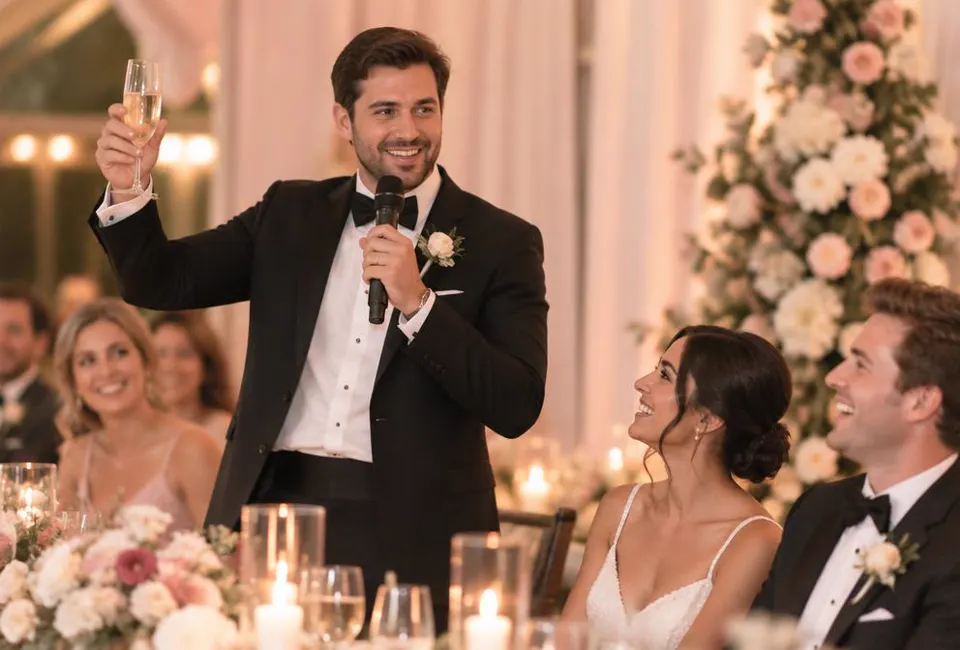
The Universal Wedding Toast Framework
The foundation of a successful wedding speech planning guide begins with understanding the structure and sequence that keep a reception moving seamlessly. This section establishes a predictable rhythm for guests while ensuring every speaker understands their unique objective within the program.
The traditional order of speakers serves as the skeletal structure of the reception. Typically, the sequence begins with the host, often a parent of the bride or groom, who welcomes guests and acknowledges those who traveled long distances. Following the host, the Best Man and Maid of Honor provide personal anecdotes that bridge the gap between the couple’s past and their shared future. Finally, the couple offers a response to thank their guests and vendors. While cultural norms vary, this sequence ensures that the most formal gratitude occurs early, allowing the energy to build toward the more lighthearted and emotional stories shared by close friends later in the night.
The 1:3:1 Formula for Speech Success
To maintain a lively pace for a modern audience, every speaker should adhere to the 1:3:1 formula. This framework allocates one minute for a clear opening that establishes your relationship to the couple, three minutes for a central narrative or series of related anecdotes, and one minute for a concluding toast. For example, if Sarah is speaking at David and Elena’s wedding, she spends the first minute explaining her twenty year friendship with Elena. She then uses the three minute middle block to describe a specific time David supported Elena during a career change, finally closing with a sixty second toast to their resilience.
Managing cultural expectations requires a balance between tradition and brevity. In some cultures, long speeches are a sign of respect and deep affection, but modern global weddings often feature diverse guest lists with varying attention spans. According to The Knot Real Weddings Study 2025, the US average wedding cost is about $33,000, while Easy Weddings 2025 reports the Australian average at A$35,315. With such significant investments per minute of the event, speakers must respect the timeline. If a cultural tradition demands lengthy tributes, consider moving longer readings to the rehearsal dinner or a private family morning event to keep the main reception focused and energetic.
| Speaker Role | Primary Goal | Key Requirement |
|---|---|---|
| The Host | Welcome and Hospitality | Acknowledge travel and hosts |
| Maid of Honor | Emotional Connection | Highlight the bride's growth |
| Best Man | Character Witness | Share the groom's best traits |
| The Couple | Gratitude and Vision | Thank vendors and guests |
| Family Elder | Legacy and Wisdom | Offer marital advice |
A common mistake is the assumption that a speech must be a chronological biography. Instead, effective wedding speech planning guide users focus on a single theme. If the theme is adventure, every story in that three minute middle section should relate to a journey or a challenge the couple faced. This prevents the speech from wandering into inside jokes that exclude 90 percent of the room. When speakers like Marcus or Chloe stick to a specific theme, they create a cohesive narrative that feels intentional. This thematic approach ensures that even guests who do not know the speaker personally can follow the emotional arc of the tribute.
Universal Framework Checklist
- Confirm the specific order of speakers with the wedding coordinator.
- Verify that all speakers are aware of the five minute total limit.
- Identify the host who will provide the opening welcome.
- Select a central theme for the storytelling middle section.
- Ensure the closing toast is clearly signaled to the audience.
- Prepare a written transition between each speaker.
- Coordinate with the DJ or MC to manage the microphone handoffs.
- Check that the toast glass is filled before starting the speech.
Ultimately, the framework serves the guests as much as the couple. By providing a clear beginning, middle, and end, you remove the anxiety of the unknown. When a speaker stands up and the audience knows they will only be occupied for five minutes, they are more likely to listen attentively. Respecting the clock is the greatest gift a speaker can give to the couple, especially when considering the significant costs involved, such as the UK average of £20,600 to £23,000 cited by Bridebook 2024 and Which? 2024. A well timed speech keeps the celebration focused on joy rather than the logistics of the schedule.
Timing and Duration Mathematics
Mastering the wedding speech planning guide requires a deep understanding of the clock because even the most heartfelt stories lose their impact if they overstay their welcome. This section provides the mathematical framework to ensure every speaker maintains the perfect momentum throughout the reception.
Effective wedding speech planning guide strategies center on the constraints of human attention spans during a high energy celebration. While speakers often feel they have a lifetime of stories to share, the audience generally loses focus after the five minute mark. The Best Man and Maid of Honor should treat five minutes as their absolute ceiling, aiming for a tight four minute delivery. This allows for laughter breaks and natural pauses without pushing the schedule into a territory that delays the meal or the first dance. A focused speech ensures that the emotional highlights resonate rather than getting lost in a sea of unnecessary anecdotes.
The Word Count Calculation Formula
To calculate your specific script length, you must account for the average speaking rate of 130 words per minute. This rate allows for clear enunciation and pauses for audience reaction. If you are a fast talker, you might try to cram more in, but this often leads to a nervous delivery that guests cannot follow. A five minute slot translates to a maximum limit of 650 to 750 words. If your draft for a couple like Marcus and Elena exceeds 800 words, you are mathematically guaranteed to run overtime once you factor in the cheers, applause, or inevitable emotional pauses that occur in a live setting.
| Speaker Role | Target Duration | Ideal Word Count | Maximum Word Count |
|---|---|---|---|
| Best Man | 4 to 5 Minutes | 550 Words | 700 Words |
| Maid of Honor | 4 to 5 Minutes | 550 Words | 700 Words |
| Parents | 3 to 6 Minutes | 400 Words | 800 Words |
| The Couple | 3 to 7 Minutes | 400 Words | 900 Words |
| Grandparents | 2 to 3 Minutes | 250 Words | 400 Words |
Parents and the couple themselves have slightly more flexibility, ranging from three to seven minutes. For parents, the extra time allows for a transition from childhood nostalgia to welcoming a new partner into the family. When the couple speaks, they must balance personal gratitude with logistical thank yous to the guests. If Sarah and David decide to give a joint response, they should aim for a combined 800 words. This ensures they acknowledge their parents, the wedding party, and those who traveled long distances without turning the reception into a series of award ceremony speeches that stifle the party atmosphere.
Common mistakes in timing often stem from a lack of rehearsal with a stopwatch. Speakers frequently assume that a three page document is short, but when read aloud at a conversational pace, it can easily stretch to ten minutes. You must also account for the environment. A crowded room in a city where the average wedding costs about $33,000 (The Knot Real Weddings Study 2025) or a UK celebration costing £20,600 (Bridebook 2024) often has a strict venue curfew. Every minute you go over is a minute taken away from the music and dancing that the couple has invested in so heavily for their guests enjoyment.
Timing Accuracy Checklist
- Time your first reading at a slow, deliberate pace.
- Highlight sections that can be cut if the schedule runs behind.
- Add ten percent to your time for laughter and applause.
- Confirm the total number of speakers with the couple.
- Ensure your script is under the 750 word limit for five minutes.
- Practice using a microphone to account for slower delivery.
- Ask a friend to listen and flag any repetitive stories.
- Check that the transition between speakers takes less than 30 seconds.
Finally, remember that the goal of the timing mathematics is to leave the audience wanting more. A three minute speech that is punchy, emotional, and well paced is infinitely better than a seven minute speech that repeats themes or meanders through inside jokes. By sticking to the 130 words per minute rule, you respect the couples timeline and the guests patience. Whether you are in Canada where the average cost is C$30,000 (RBC) or Australia where it is A$35,315 (Easy Weddings 2025), brevity remains the most appreciated trait of any wedding speaker regardless of the culture or location.
A Foolproof Narrative Formula
Developing a cohesive narrative structure is the most effective way to eliminate the common problem of aimless rambling during a ceremony. This section introduces the Past, Present, Future framework, a reliable architecture used in the wedding speech planning guide to ensure every story serves a specific purpose.
The greatest challenge for any speaker is organizing a lifetime of memories into a five minute window. Without a roadmap, speakers often fall into the trap of listing unrelated inside jokes that alienate the broader audience. The Past, Present, Future method solves this by providing a chronological and emotional anchor. It starts by establishing the speaker's history with the groom or bride, transitions into the transformative impact of the new partner, and concludes with a forward looking vision. This flow mirrors the natural progression of life and allows the audience to follow a clear emotional arc from beginning to end.
The Past, Present, Future Case Study
To visualize this, consider a best man named Marcus speaking for his friend Liam who is marrying Sophia. Marcus begins with the Past by recounting a childhood anecdote from their time on a local football team. He describes Liam as a person who was always focused on the goal but occasionally missed the joy of the game. This establishes Liam's character before he met Sophia. By starting here, Marcus invites the guests into their shared history, making the audience feel like insiders. The goal of the Past section is to humanize the subject through a brief, relatable lens.
The narrative then shifts to the Present by introducing Sophia's arrival into Liam's life. Marcus explains that since Liam met Sophia, his intensity has been balanced by her sense of humor and perspective. He describes their current dynamic as a partnership where Sophia provides the laughter that Liam previously lacked. This section validates the couple as a unit. It moves the focus from the speaker's relationship with one person to the beauty of the new couple. It demonstrates how Sophia has improved Liam, which is the core objective of a successful wedding toast.
Finally, Marcus concludes with the Future by projecting these observed strengths into their married life. He offers a specific wish that their home remains a place where Liam's drive is always met by Sophia's warmth. By linking the wish directly to the traits mentioned in the Present section, the speech feels unified rather than a collection of random sentiments. This conclusion provides a natural signal to the audience to raise their glasses. It transitions the focus away from the speaker and back to the couple, which is the primary goal of the wedding speech planning guide.
| Phase | Function | Example Transition Script |
|---|---|---|
| Past | Establish Foundation | When I first met Liam back in primary school, he was... |
| Transition | The Catalyst | Everything changed the day he told me about a girl named Sophia. |
| Present | Current Dynamic | Watching them today, it is clear that Sophia brings out a side... |
| Future | The Send-Off | As you build your new life together, my hope is that you... |
Narrative Flow Quality Check
- Ensure the Past anecdote takes up no more than 30 percent of the total speech time.
- Check that the Present section highlights a specific positive change in the partner.
- Verify that the Future wish is grounded in a trait mentioned earlier in the speech.
- Remove any inside jokes that require more than ten seconds of explanation.
- Confirm the transition between the speaker's history and the partner's arrival is smooth.
- Limit the number of childhood stories to one single, impactful narrative.
- Ensure the tone shifts from humorous in the Past to sincere in the Future.
- Double check that the partner is mentioned by name at least three times.
- Practice the final sentence to ensure it leads clearly into a toast.
Applying this formula prevents the common mistake of oversharing or losing the audience's attention. A speech that follows this trajectory feels intentional and professional, regardless of the speaker's experience level. By focusing on the transformation of the individual into a partner, you honor the couple's journey while keeping the guests engaged. This structure acts as a safety net, ensuring that even if nerves take over, the logical progression of the story will carry the speaker to a successful and meaningful conclusion.
The Couples Response and Thank You
The couple's speech serves as the final emotional anchor of the reception, pivoting from receiving praise to expressing profound gratitude toward their community. This section provides a strategic framework for the wedding speech planning guide to ensure every contributor feels seen and valued.
Expressing gratitude is not merely a polite gesture but a necessary acknowledgment of the significant investment made to celebrate your union. Global wedding costs underscore this reality. In the United Kingdom, averages range from £20,600 according to Bridebook 2024 to £23,000 according to Which? 2024. Meanwhile, the US average sits at about $33,000 per The Knot Real Weddings Study 2025, with Canada at C$30,000 according to RBC and Australia at A$35,315 via Easy Weddings 2025. Whether the funds came from your savings or your parents, the couples response must address the financial and emotional weight of the day with genuine humility and warmth.
The Gratitude Hierarchy and Mention Logic
When drafting your thank yous, follow a logical flow from the furthest reaches of your guest list to the most intimate contributors. Start by welcoming guests who traveled long distances, then move to your vendors, the wedding party, and finally your parents. For example, Sarah and Mark might highlight their photographer or caterer by name to add a personal touch. This sequence ensures the energy builds toward the most emotional tributes. Keep the mentions specific. Instead of saying thanks for coming, mention the effort of flights, childcare arrangements, and the time spent away from work to be present for your milestone.
Essential Gratitude Checklist
- The Guests: Acknowledge those who traveled from other cities or countries.
- The Parents: Thank them for their lifelong support and specific wedding contributions.
- The Wedding Party: Mention the bridesmaids, groomsmen, and attendants by name.
- The Vendors: Publicly thank the caterers, venue staff, and planners for their labor.
- The Absent Loved Ones: Offer a brief, respectful nod to those who have passed.
- The Partner: Dedicate a specific segment to your new spouse.
- The Hosts: Formally thank whoever provided the financial backing for the event.
A common mistake is forgetting the vendors who are working behind the scenes during the speech itself. Acknowledge the kitchen staff and the floor team. This does not require a long story, but a simple recognition of their hard work elevates the tone of the evening. Use a script formula like: We want to thank [Name] for making this vision a reality. Their expertise allowed us to focus on the joy of the day. This creates a professional yet warm atmosphere that resonates with everyone in the room, showing you are observant and appreciative hosts.
| Recipient | Key Sentiment | Example Phrasing |
|---|---|---|
| Parents | Foundation | We are here because of the values and love you instilled in us. |
| Travelers | Sacrifice | To those who flew across oceans, your presence is the greatest gift. |
| Vendors | Craftsmanship | Our thanks to the team at the venue for their tireless coordination. |
| New Spouse | Future | Standing here with you is the highlight of my life so far. |
Conclude your section of the wedding speech planning guide by focusing on the transition to the party. The couples response should end on a high note that invites everyone to enjoy the hospitality provided. Avoid lingering too long on sentimental points that might dampen the celebratory mood. Instead, use a firm closing statement such as: Please join us in raising a glass to the people who made today possible. Then, signal the band or DJ to take over. This clear transition provides a professional finish to the formal proceedings and sets the stage for the rest of the night.
Practical Delivery and Anxiety Management
Preparing a wedding speech planning guide requires as much focus on physical execution as it does on the written word. This section ensures your delivery remains polished and your nerves stay steady under the reception lights.
The physical medium of your speech dictates your level of presence. You should never read your speech from a smartphone or tablet screen. Digital screens often dim automatically, display distracting notifications, or catch glare from professional lighting rigs. Instead, print your words on physical paper or cardstock using a 14 point sans serif font. This size is large enough to read at a distance if your hand shakes or if the room lighting is low. Physical paper also provides a steady weight for your hands and allows you to track your progress by moving pages from front to back.
Microphone Logistics and Visual Engagement
Microphone technique is the difference between a clear message and muffled noise. If using a handheld microphone, hold it approximately two inches from your chin, pointing toward your mouth rather than straight up. Avoid covering the top of the grill with your hand, as this creates a muffled sound. If the venue uses a stand, do not lean down toward it. Instead, adjust the stand to your height before you begin. For engagement, use the triangle method. Look at the couple for twenty percent of the time, the front tables for forty percent, and the back of the room for the remainder.
| Scenario | Common Error | Corrective Action |
|---|---|---|
| The Echo Effect | Speaking faster to finish | Pause for two seconds between sentences |
| Hand Tremors | Holding thin paper | Use heavy cardstock or a lectern |
| Lost Place | Panicked silence | Use a highlighter for paragraph breaks |
| Low Volume | Pulling mic away | Keep mic at chin level consistently |
| Eye Contact | Staring at the floor | Pick three friendly faces to rotate |
Managing physiological anxiety is essential when the spotlight hits. Use the 4-7-8 breathing technique three minutes before your scheduled slot. Inhale through your nose for a count of four, hold the breath for a count of seven, and exhale audibly through your mouth for a count of eight. This rhythm acts as a natural tranquilizer for the nervous system by slowing the heart rate and lowering blood pressure. Consider Sarah and Mark at their reception. Sarah felt her chest tighten as the appetizers were cleared, but by repeating this cycle four times, she stabilized her voice before grabbing the microphone.
Engagement involves more than just reading words. It is about emotional connection. When you mention a specific person, such as the groom, look him in the eye for the duration of that sentence. If you share a joke intended for the whole room, look toward the back corners to include everyone in the laughter. Avoid scanning the room too quickly like a lighthouse. Instead, park your gaze on one person for a full thought before moving to the next. This creates a sense of intimacy and ensures that your message reaches every guest in the venue regardless of their seating position.
Day-of Delivery Checklist
- Confirm the microphone is turned on before approaching the stage
- Check that you have two printed copies of your speech in 14 point font
- Identify the three anchor people in the room for your gaze triangle
- Perform four cycles of the 4-7-8 breathing exercise
- Hold a glass of water nearby to clear your throat if needed
- Ensure your phone is on silent and stored away from your person
- Take a three second pause after every joke to allow for laughter
- Keep your feet shoulder width apart to maintain a steady posture
Final preparations should focus on the transition. Walk to your position with confidence and wait for the room to settle before speaking your first word. Silence is a powerful tool that signals to the guests that something important is about to happen. By combining the 4-7-8 breathing method with a legible 14 point font script, you eliminate the technical hurdles that often cause speakers to stumble. Remember that the audience is on your side. They want you to succeed because your success contributes to the joy of the couple celebration.
The Seven Deadly Sins of Wedding Toasts
Even the most heartfelt wedding speech planning guide can be derailed by common social pitfalls that turn a celebratory moment into an uncomfortable silence. Avoiding these seven deadly sins ensures your tribute remains a highlight of the evening rather than a cautionary tale for the guests.
The Perils of Insider Knowledge and Past Lives
The first major sin involves excluding the audience through excessive inside jokes. When Leo spends five minutes laughing with the groom about a specific summer camp incident from 2005, ninety percent of the room feels like unwanted spectators. A wedding is a public performance of private affection. If a story requires a three minute preamble to explain why a specific word is funny, it does not belong in the toast. Similarly, mentioning former partners is an unforgivable error. Even a passing comment comparing the new spouse to an ex creates an immediate chill. Focus exclusively on the person standing in the room today.
Liquid courage is the third deadly sin that frequently ruins potential highlights. While a glass of champagne might steady the nerves, exceeding one drink before the speech often leads to slurred delivery and poor judgment. Excessive drinking lowers inhibitions, making speakers prone to the fourth sin: oversharing. This includes mentioning details about the wedding night or revealing sensitive financial information. Remember that the audience includes grandparents and professional colleagues. If a story makes you blush when you imagine telling it to your boss, it is probably too scandalous for the reception microphone. Maintain a professional yet warm standard throughout your delivery.
| The Risky Content | The Potential Danger | The Fix It Alternative |
|---|---|---|
| Niche college acronyms | Excludes non alumni | Explain the context briefly as a shared passion. |
| The groom's wild party era | Disrespects the parents | Reframe as his energetic or social nature. |
| Teasing the bride's cooking | Can sound mean spirited | Pivot to how she excels in other caring ways. |
| Stories about the cost | Breaks the magic | Focus on the effort and love put into the day. |
| Generic internet jokes | Feels impersonal | Replace with a specific observation about the couple. |
The fifth sin is the 'Me Monster' effect, where a speaker spends more time talking about their own life than the couple. For example, Sarah might spend four minutes discussing her own recent promotion before mentioning the bride. The sixth sin is excessive length, which disrespects the schedule. With Australian weddings costing about A$35,315 according to Easy Weddings 2025, every minute of the reception is valuable. A speech that drags past the six minute mark often delays the meal or the first dance, causing logistical friction for the couple. Keep your narrative tight and your focus squarely on the newlyweds.
Finally, the seventh sin is lack of preparation, often disguised as spontaneity. Some speakers believe that winging it will result in a more authentic moment, but this usually leads to rambling and repetition. Without a written guide, speakers often default to filler words or inappropriate humor to fill the silence. Use your wedding speech planning guide to structure your thoughts long before you reach for the microphone. A well prepared speaker shows respect for the occasion and the audience. By avoiding these errors, you ensure your words contribute to the joy of the celebration rather than creating a social catastrophe.
The Toast Safety Audit
- Check that all inside jokes are explained or removed.
- Verify that no former romantic partners are mentioned by name or implication.
- Limit alcohol consumption to one unit before the speech begins.
- Remove any stories involving illegal activities or excessive intoxication.
- Ensure the focus is 80 percent on the couple and only 20 percent on yourself.
- Time the speech to ensure it stays under the six minute maximum.
- Read the draft aloud to a neutral party to check for unintentional offense.
- Confirm the tone matches the formality of the venue and the guest list.
- Prepare a physical script or notes to avoid rambling during the moment.
The Final Countdown: Rehearsal Steps
The final stage of the wedding speech planning guide transforms a written script into a polished performance. This seven day countdown ensures that logistical hurdles and nerves do not overshadow your message to the couple.
Seven days before the wedding, shift your focus from editing words to mastering rhythm. Open your phone and record a voice memo of the entire speech. When you listen back, pay close attention to filler words like 'um' or 'like' and identify where you are rushing. For example, a speaker named Marcus found that his jokes landed better when he added a three second pause after the punchline. Use this recording to verify that your timing fits within the window defined earlier in this wedding speech planning guide. Aim for a pace that feels slightly slower than your natural conversational speed to account for venue echoes.
Once you are comfortable with the recording, perform the speech for one trusted friend who can provide objective feedback. Choose someone like Sarah, a bridesmaid who knows the couple well but can be honest about what feels inside jokey or confusing. Ask them specifically if the transition between the opening hook and the main narrative feels seamless. This is the time to cut any sentences that feel clunky or difficult to pronounce. If your friend looks confused during a specific anecdote, simplify the context or remove the story entirely to maintain the flow for a global audience.
Mastering the Environment
Technical glitches are a common source of anxiety, but they are preventable with a site visit. If the venue allows, arrive early to test the sound system. Stand exactly where you will be speaking and check the lighting. If a bright spotlight is aimed at your face, it may be difficult to see your notes. Ensure there is a small table nearby for a glass of water or your printed script. Understanding the physical layout helps you visualize the moment, which significantly reduces the adrenaline spike when you are finally introduced by the master of ceremonies.
The 72 Hour Final Preparation List
- Print two copies of your speech in 14 point bold font for easy reading.
- Check that your printed copies are not on glossy paper that reflects stage lights.
- Verify with the venue coordinator that a cordless microphone is available.
- Confirm the order of speakers with the wedding planner or best man.
- Practice standing still without swaying or shifting your weight.
- Hydrate consistently to avoid a dry throat during the toast.
- Place one backup copy of the speech in the glove box of your car or with a parent.
- Read the speech aloud one final time to ensure no words are skipped.
On the morning of the wedding, do not try to memorize the speech word for word. Instead, focus on the emotional beats. If you are the groom, such as David, who is managing a high pressure event, remember that the average wedding costs about A$35,315 in Australia according to Easy Weddings 2025. With such a significant investment, the guests are there to celebrate and support you, not to judge your public speaking skills. Take a deep breath, trust the preparation you have done throughout this wedding speech planning guide, and speak from a place of genuine gratitude.
| Days Out | Primary Goal | Action Item |
|---|---|---|
| 7 to 5 | Pacing | Record voice memos and adjust speed. |
| 4 to 3 | External Review | Perform for one trusted friend. |
| 2 | Logistics | Visit venue and test microphone. |
| 1 | Rest | Final read through then put it away. |
| Day Of | Execution | Keep notes accessible and stay hydrated. |
Finally, remember that the audience is your biggest ally. They want you to succeed because your success contributes to the joy of the day. By following this step by step plan for the week leading up to the ceremony, you replace uncertainty with confidence. Whether you are in Canada where weddings average C$30,000 according to RBC, or the UK where costs are about £20,600 according to Bridebook 2024, the value of a heartfelt, well prepared speech remains priceless. Step up to the microphone, make eye contact, and deliver the tribute the couple deserves.