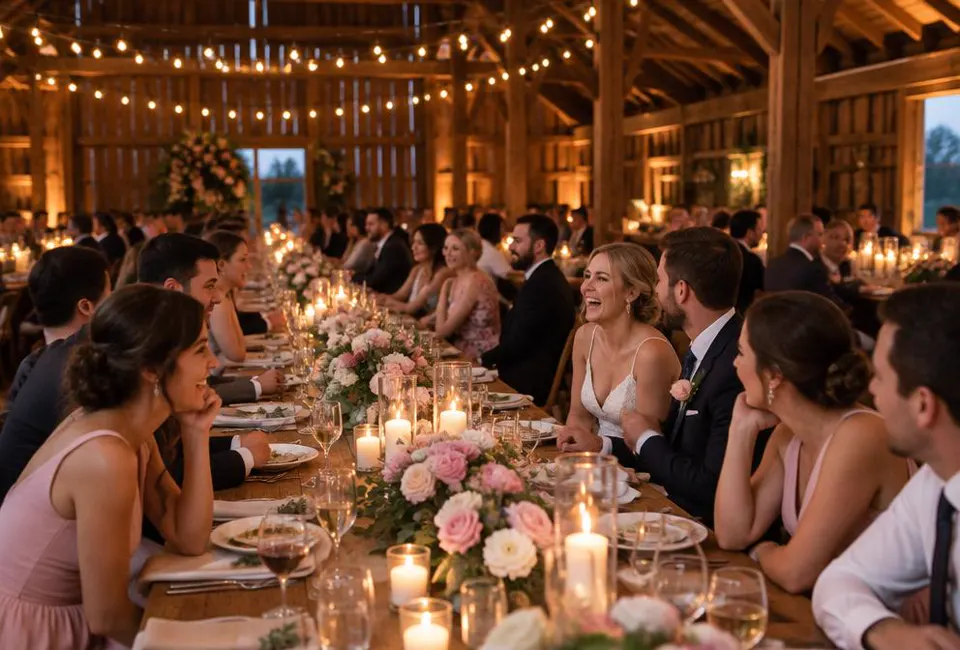
Establishing Your Reception Budget Framework
The foundation of a successful wedding reception planning guide begins with a clear financial architecture that aligns your vision with practical spending limits. By establishing a percentage based framework, you can allocate funds to your highest priorities while ensuring the essential elements of the celebration are fully covered.
Before selecting a single flower or tasting a menu, you must understand the global landscape of wedding costs to ground your expectations. Recent data shows the average wedding cost is about $33,000 in the US (The Knot Real Weddings Study 2025), while UK couples spend between £20,600 (Bridebook 2024) and £23,000 (Which? 2024). In Australia, the average is A$35,315 (Easy Weddings 2025), and in Canada, it is approximately C$30,000 (RBC). Regardless of your total amount, the reception typically consumes the largest portion of these totals. Using percentages allows you to scale your plan whether your budget is modest or expansive.
The 40 to 50 Percent Rule for Core Expenses
The golden rule of reception planning is to reserve 40 to 50 percent of your total budget for the combination of venue hire and catering. This figure should include the physical space, tables, chairs, food, and beverages. If a venue offers a low rental fee but requires an expensive exclusive caterer, the total must still stay within this half of your funds. Failure to adhere to this percentage often leads to debt or the inability to afford other vital services like photography or transportation. Always calculate the inclusive cost, including service fees and taxes, before signing a contract.
| Category | Percentage Range | Included Items |
|---|---|---|
| Venue and Catering | 40 to 50 percent | Rental, food, alcohol, service |
| Photography and Film | 10 to 12 percent | Main shooter, prints, editing |
| Attire and Beauty | 8 to 10 percent | Gown, suit, hair, makeup |
| Entertainment | 5 to 10 percent | Live band, DJ, equipment |
| Decor and Florals | 8 to 10 percent | Bouquets, centerpieces, lighting |
| Contingency Fund | 5 percent | Hidden fees, last minute needs |
To visualize how this works, consider the scenario of Elena and Marcus. They determined that their highest priority was a high energy dance floor. To stay within their limits, they chose to prioritize live music over elaborate floral decor. They allocated 12 percent of their budget to a premium eight piece band, which is above the standard range. To balance this, they spent only 4 percent on florals by using greenery and candles. This trade off allowed them to maintain their venue and catering at 45 percent without exceeding their total bottom line. Their guests remembered the music more than the table settings.
Establishing a framework also requires a firm commitment to a contingency fund. Every wedding reception encounters small, unforeseen costs such as extra hours for a photographer, postage for late invitations, or additional guest meals. By setting aside 5 percent of your total budget as a buffer, you protect yourself from the stress of these minor fluctuations. This fund should remain untouched until the final month of planning. If it remains unused by the day of the event, it becomes a welcome bonus for your honeymoon or savings. Discipline in this area ensures a smooth financial experience.
Initial Budget Planning Steps
- Total all available funds from savings and contributions.
- Calculate the 50 percent maximum for venue and food.
- List your top three non negotiable reception priorities.
- Research local service tax and gratuity percentages.
- Identify areas where you can reduce spending for balance.
- Create a dedicated bank account for wedding transactions.
- Set a firm maximum guest count based on per head costs.
- Account for the 5 percent emergency contingency fund.
- Review the framework with all contributing stakeholders.
Venue Logistics and Spatial Planning
This section of the wedding reception planning guide provides the technical framework needed to transform a physical space into a functional event environment. By calculating specific square footage and auditing site infrastructure, you ensure guest comfort and operational flow.
Effective spatial planning begins with the math of movement rather than the aesthetics of decor. When couples like Sarah and Mateo select a venue, they often overlook how the service style dictates the required footprint. A sit down dinner requires significantly more space to accommodate chairs, table legs, and service lanes for staff. Conversely, a standing cocktail reception allows for higher density because guests remain mobile and furniture is limited to high top tables. Miscalculating this ratio leads to cramped conditions where guests struggle to reach the bar or navigate between tables, ultimately dampening the celebratory atmosphere.
Calculating Capacity by Service Style
To determine your ideal venue size, apply the standard formula of square footage per guest. For a formal sit down dinner, allocate 15 square feet per person. This accounts for a standard round table, ten chairs, and the necessary clearance for waitstaff to pass behind seated guests. If your vision involves a cocktail style reception with limited seating, you can reduce this to 10 square feet per person. Using these metrics ensures that a 2,000 square foot ballroom is comfortably capped at 133 guests for dinner, rather than the higher numbers often quoted by venue sales teams who ignore service logistics.
| Reception Style | Sq Ft Per Guest | 100 Guest Venue Size | 150 Guest Venue Size |
|---|---|---|---|
| Formal Sit Down | 15 sq ft | 1,500 sq ft | 2,250 sq ft |
| Buffet Service | 18 sq ft | 1,800 sq ft | 2,700 sq ft |
| Cocktail Standing | 10 sq ft | 1,000 sq ft | 1,500 sq ft |
| Dance Floor Area | 3 sq ft | 300 sq ft | 450 sq ft |
Beyond the tables, you must integrate fixed architectural elements into your floor plan. Pillars, low ceilings, and permanent bars act as obstacles that dictate the flow of traffic. Imagine a scenario where a couple, Alex and Jordan, placed their photo booth in a narrow corridor near the kitchen entrance. The resulting bottleneck prevented servers from delivering hot meals and created a safety hazard. Always map out high traffic zones: the path from the entrance to the bar, the route to the restrooms, and the clearance around the buffet. A buffer of at least five feet is recommended for these primary arteries.
Technical Infrastructure and Accessibility Audit
- Verify dedicated 20 amp circuits for the DJ or live band equipment.
- Ensure the catering prep area has sufficient power for warming ovens.
- Check for step free access from the parking area to the main floor.
- Confirm restroom door widths meet local accessibility standards.
- Locate all emergency exits and ensure they remain unobstructed by decor.
- Test outdoor lighting for guest paths if the event extends into the evening.
- Identify the location of the circuit breaker box in case of a power surge.
- Assess the proximity of the loading dock for efficient vendor setup.
- Measure elevator dimensions if the reception is on an upper floor.
Logistics also encompass the invisible elements of the room like power distribution and temperature control. Modern receptions involve heavy electrical loads from professional lighting rigs and high end sound systems. If your venue is a historic home or a remote barn, you must ask the manager for a circuit map. Drawing too much power from a single outlet can result in a total blackout during the first dance. While global wedding costs vary, such as the UK average of 20,600 Pounds (Bridebook 2024) or the Australian average of 35,315 Dollars (Easy Weddings 2025), infrastructure failures are a universal risk that proper planning prevents.
Catering Models and Menu Strategy
The catering model defines the rhythm of your wedding reception, influencing both guest interaction and your overall food expenditure. Selecting the right service style allows you to balance formal elegance with the practical logistics of feeding a diverse crowd.
Analyzing Plated, Buffet, and Family Style Dining
Plated service remains the gold standard for formal receptions, offering a controlled environment where every guest is served simultaneously. While this model minimizes food waste and maintains a clean table aesthetic, it often requires a higher staff to guest ratio, which can increase labor costs significantly. Conversely, buffet service encourages a relaxed atmosphere and allows guests to choose their portions. While buffets can lead to longer queues if not managed with multiple stations, they provide the most variety for different appetites. Family style dining serves as a middle ground, where large platters are placed on tables for guests to share. This promotes conversation but requires ample table space to avoid a cluttered look.
| Feature | Plated Service | Buffet Style | Family Style |
|---|---|---|---|
| Labor Cost | High | Low | Medium |
| Social Interaction | Low | Medium | High |
| Portion Control | Precise | Variable | Moderate |
| Space Required | Minimal | High | Moderate |
| Pacing | Controlled | Self-paced | Flexible |
When negotiating with your caterer, clear communication regarding dietary restrictions is essential to avoid last minute kitchen stress. Use this script to ensure no guest is left hungry: We have several guests with specific dietary needs, including vegan and gluten free requirements. Rather than creating entirely separate dishes that increase labor and ingredient costs, how can we adapt the primary menu to be naturally inclusive? Can we focus on a base menu where proteins and grains are prepared separately to accommodate these needs without requiring a custom plate for every individual? This approach keeps the kitchen efficient and ensures every guest feels considered during the meal.
Cost Effective Menu Building: Chloe and Sam
Consider the example of Chloe and Sam, a couple aiming to accommodate ten vegan and fifteen gluten free guests among their 100 attendees. Instead of paying for 25 premium special order meals, they worked with their caterer to build a naturally inclusive menu. They selected a Mediterranean theme featuring roasted lemon chicken and a hearty chickpea tagine as the primary proteins. By ensuring the tagine was both vegan and gluten free, they satisfied all dietary groups with a single, high quality dish. They opted for sides like herb roasted potatoes and seasonal greens sauteed in olive oil rather than butter. This strategy allowed them to stay within their budget while providing a seamless dining experience.
A successful wedding reception planning guide must account for the reality of global wedding costs. The Knot Real Weddings Study 2025 notes the US average is about $33,000, while Bridebook 2024 reports the UK average at £20,600. In Australia, Easy Weddings 2025 puts the average at A$35,315, and RBC estimates Canada at C$30,000. With food and beverage typically consuming 40 to 50 percent of these totals, strategic menu design is your most effective tool for fiscal control. By prioritizing versatile ingredients and efficient service styles, you ensure a high guest satisfaction rate without exceeding your allocated reception budget.
Catering Logistics and Menu Review
- Confirm the ratio of servers to guests for your chosen service style.
- Verify that all sauces and dressings are served on the side.
- Request a detailed list of ingredients for potential allergens.
- Discuss the timeline for clearing plates to maintain table flow.
- Ensure the caterer has a plan for vendor meals.
- Check if the venue provides necessary linens and service ware.
- Review the policy for leftover food and waste management.
- Audit the menu for naturally gluten free and plant based options.
The Minute by Minute Reception Timeline
Developing a precise schedule ensures that every transition feels intentional rather than chaotic during your wedding reception planning guide process. A structured minute by minute timeline allows couples to relax, knowing the flow from the grand entrance to the final departure is managed by their coordinators.
The reception sequence begins the moment the cocktail hour concludes and guests are ushered into the main dining area. The grand entrance serves as the official energy catalyst for the evening. For example, a couple like Sofia and Liam might choose an upbeat track to introduce their wedding party before transitioning immediately into their first dance. By placing the first dance at the start, you capture the full attention of your guests while they are still fresh and seated. This creates a natural bridge into the first course of the meal, allowing the catering staff to begin service while the emotional momentum is at its peak.
Mastering the Toast Formula and Timing
Toasts are often the most unpredictable element of the night. To maintain momentum, apply a strict formula: each speaker is allotted no more than five minutes. This prevents the energy from dipping and ensures the kitchen remains on schedule. If you have four speakers, this total of twenty minutes should be spaced between courses. For instance, the Best Man might speak after the appetizer, while the Maid of Honor speaks after the main course. This spacing keeps guests engaged with the program without feeling like they are sitting through a lengthy lecture, preserving the celebratory atmosphere you have worked hard to build.
| Time Increment | Event Phase | Key Action Item |
|---|---|---|
| 00:00 to 00:20 | Grand Entrance | Introductions and First Dance |
| 00:20 to 01:30 | Dinner Service | Toasts delivered between courses |
| 01:30 to 01:50 | Transition | Cake cutting and parent dances |
| 01:50 to 04:45 | Open Floor | High energy music and dancing |
| 04:45 to 05:00 | Grand Finale | Last song and guest departure |
The transition from dinner to the dance floor is a critical pivot point. Once the main course is cleared, the cake cutting ceremony serves as a visual signal that the formal dining portion has ended. This should lead directly into parent dances or a floor filler track that invites everyone to join. Avoid long lulls where guests are left sitting at empty tables. If the music starts immediately after the cake is cut, the energy remains high. A common mistake is waiting too long for coffee service to finish before starting the music, which can lead to a premature exodus of older guests who may feel the night has concluded.
As the evening winds down, the final departure requires just as much planning as the entrance. The last fifteen minutes should feature a clear climax, such as a final upbeat anthem followed by a slower, sentimental track. Coordinate with your venue to ensure guest transportation like shuttles or taxis are lined up ten minutes before the final song ends. A coordinated exit, whether it involves sparkles, petals, or a simple cheering line, provides a definitive end to the event. This prevents the evening from fizzling out and ensures the last memory for your guests is one of high energy and celebration.
Reception Flow Essentials
- Confirm entrance song start times with the DJ or band.
- Brief all speakers on the five minute maximum time limit.
- Coordinate with the caterer on exact toast intervals.
- Plan the transition music for the cake cutting ceremony.
- Assign a bridesmaid or groomsman to gather guests for the exit.
- Verify transportation arrival times for the final departure.
- Check that the venue lights are dimmed for the dancing portion.
- Ensure the photographer is aware of the cake cutting time.
- Set a specific time for the distribution of late night snacks.
Effective Vendor Communication and Contracts
Developing a robust communication strategy ensures your wedding reception planning guide remains on track while protecting your financial investment through ironclad agreements. This section details how to navigate the complexities of hiring professional talent and understanding the legal fine print that governs these partnerships.
When hiring DJs, photographers, and decorators, the initial outreach sets the tone for the entire relationship. Instead of simply asking for availability, provide vendors with a detailed profile of your vision to receive accurate quotes. For example, a couple named Sarah and David provided their photographer with a list of specific lighting challenges at their industrial venue, which allowed the professional to quote for additional equipment early. This proactive approach prevents hidden costs from surfacing weeks before the event. Aim to interview at least three professionals per category to benchmark service levels against international standards and local market rates.
Critical Contract Clauses and Risk Mitigation
Contracts serve as your primary defense against unforeseen circumstances. The force majeure clause is essential, as it defines what happens if an act of God or government restriction prevents the event from occurring. Ensure this clause includes language regarding the portability of deposits to a future date. Cancellation policies must also be transparent. While the US average wedding cost is about $33,000 according to The Knot Real Weddings Study 2025, a significant portion of that is often tied up in non refundable deposits. Verify if the vendor offers a sliding scale refund policy based on how far in advance the cancellation occurs.
Specific service expectations should be documented to avoid ambiguity. For a DJ, this includes not just the hours of performance, but also the arrival time for sound checks and a backup plan for equipment failure. For decorators, the contract should list every item from silk linens to specific floral varieties. If you are planning in Australia, where the average cost is A$35,315 according to Easy Weddings 2025, or Canada at C$30,000 per RBC, ensuring these details are in writing prevents the scope creep that often leads to budget overruns.
| Evaluation Factor | Vendor A (Premium) | Vendor B (Mid-Range) | Vendor C (Budget) |
|---|---|---|---|
| Experience Level | 10 plus years with portfolio proof | 5 years with consistent style | 1 to 2 years, building portfolio |
| Backup Provisions | Full secondary kit and assistant | Single backup for main unit | No formal backup plan stated |
| Communication Speed | Instant or same day response | Within 48 hours | Variable or inconsistent |
| Contract Flexibility | Fair Force Majeure included | Standard rigid terms | Minimalist or vague terms |
| Total Value Score | High: lower risk of failure | Moderate: balanced risk | Low: high management required |
Effective communication requires a centralized hub for all documents and threads. Use a dedicated wedding email address to prevent important contracts from being buried in personal inboxes. When discussing revisions with decorators, always follow up phone calls with a written summary. This creates a paper trail that protects both parties. Whether your budget aligns with the UK average of £20,600 according to Bridebook 2024 or £23,000 according to Which? 2024, maintaining professional boundaries and clear deadlines ensures your vendors can perform their best work without administrative confusion.
Vendor Hiring and Contract Checklist
- Verify business insurance and liability coverage for all on site workers.
- Check that the force majeure clause covers pandemic related closures.
- Confirm the specific individual who will be performing on the day.
- Review the overtime hourly rate to avoid surprise end of night fees.
- Ensure the payment schedule is clearly mapped to specific milestones.
- Validate the equipment requirements such as power outlets and tables.
- Request a list of required breaks and meal provisions for staff.
- Document the delivery and strike times for all physical decor items.
- Check the social media usage rights for your personal wedding photos.
Guest Experience and Seating Dynamics
The success of your wedding reception planning guide rests heavily on the comfort of your guests and the intentional flow of social interactions throughout the evening. Mastering seating dynamics and logistical hospitality ensures that every attendee feels valued rather than like an afterthought.
Strategic seating is the primary tool for minimizing social friction and maximizing enjoyment. Couples like Maria and David found success by categorizing guests into social clusters before assigning specific chairs. Instead of grouping all strangers together at a 'leftover' table, they integrated solo guests into groups with shared interests or life stages. This approach prevents the awkwardness of a table where no one speaks. When building your chart, prioritize sightlines to the head table or dance floor for elderly guests while placing younger, high energy groups near the speakers where volume is highest. This spatial awareness reduces physical discomfort and encourages natural conversation flow.
Applying the Concentric Circle Method
The concentric circle method is a decision framework that places the couple at the epicenter of the room. The first ring consists of immediate family and the wedding party, ensuring they have the most intimate view of the festivities. The second ring radiates outward to include close extended family and lifelong friends. The outermost ring is reserved for colleagues and casual acquaintances. This structure honors your closest relationships while allowing those who may leave earlier to do so without disrupting the core energy of the party. It also naturally places the most talkative groups in the center, creating a vibrant hub of activity that pulls the rest of the room inward.
For destination guests, the experience begins long before the first course is served. Hospitality starts at the hotel with a curated welcome bag that addresses local needs. Essential items include two bottles of water, a local snack, a printed itinerary, and small comfort items like pain relievers or electrolytes. If you are hosting in a specific climate, include sunblock or hand warmers. This small investment, which typically accounts for less than 2 percent of the total budget, significantly lowers guest stress. According to The Knot Real Weddings Study 2025, the US average wedding cost is about $33,000, and allocating a small portion to guest comfort is a top priority for modern couples.
| Guest Scenario | Vehicle Type | Buffer Time | Primary Goal |
|---|---|---|---|
| Local Hotel Block | Shuttle Bus | 15 Minutes | Punctual Arrivals |
| Remote Venue | Charter Coach | 30 Minutes | Safety and Comfort |
| Urban Setting | Rideshare Vouchers | 5 Minutes | Flexibility |
| Rural Estate | Private Mini-Van | 20 Minutes | Navigation Ease |
Managing transportation logistics is a critical component of the wedding reception planning guide. If your ceremony and reception are in different locations, providing a shuttle service is not just a luxury but a safety measure. For example, Sarah and Liam utilized a shuttle loop that ran every thirty minutes starting two hours before the end of the night. This allowed guests who were tired to return to their hotels safely while others continued dancing. Clear communication is vital: print the shuttle schedule on the back of the menu cards or include a dedicated card in the welcome bags. This removes the burden of navigation from your guests and ensures a cohesive experience.
Guest Comfort and Logistics Final Review
- Verify all guest names are spelled correctly on place cards.
- Confirm that high chairs are placed at tables with toddlers.
- Check that the shuttle driver has the correct venue gate codes.
- Ensure welcome bags are delivered to the hotel front desk 24 hours early.
- Place a printed emergency contact list in the transportation vehicles.
- Test the microphone range at the furthest guest tables.
- Include a physical map in welcome bags for areas with poor cell service.
- Assign a specific guest to help direct people to their shuttle at night.
- Review the seating chart for potential interpersonal conflicts.
Common Mistakes and How to Avoid Them
The final phase of a wedding reception planning guide involves anticipating obstacles to ensure your celebration remains resilient against common logistical errors. By identifying frequent pitfalls early, couples can implement specific safeguards that preserve the joy of the occasion regardless of external disruptions.
The most frequent error in reception planning is the overstuffed timeline which ignores the reality of human movement. Many couples, like Marcus and Elena, attempt to squeeze a three course meal, five speeches, and three special dances into a tight two hour window. This lack of buffer time creates a high pressure environment where guests feel rushed and vendors become stressed. To avoid this, apply a fifteen percent time buffer to every scheduled transition. If a transition is scheduled for ten minutes, allocate fifteen. This prevents a single late arrival or a long winded toast from derailing the entire evening flow.
Navigating Financial Traps and Technical Failures
The hidden fee trap often catches couples off guard when they fail to account for service charges and taxes. While the US average cost for a wedding is about $33,000 according to The Knot Real Weddings Study 2025, many budgets exceed this due to overlooked line items like cake cutting fees or power distribution surcharges. Always request a fully inclusive quote that covers gratuities and setup labor before signing. For technical failures, such as a failing sound system, ensure your venue has a backup generator and your DJ has a secondary wired microphone. A prepared recovery plan allows for a seamless transition without the guests noticing the hitch.
Essential Recovery Protocols for Common Reception Hazards
- Confirm the location of the venue breaker box and on-site technician contact info.
- Designate one person to manage the weather contingency plan two hours before start.
- Maintain a physical copy of the vendor contact list in the bridal suite.
- Store a basic sewing kit and stain remover behind the bar for emergencies.
- Verify that the catering team has a list of guests with severe anaphylactic allergies.
- Prepare a backup playlist on a mobile device that can plug directly into the speakers.
- Establish a clear signal with the coordinator to cut long speeches short if needed.
Weather changes represent a significant risk for outdoor receptions, requiring more than just a simple tent. If the temperature drops or rain begins, the shift can ruin the guest experience if not handled with a pre defined decision framework. Consider Sarah and Liam, who set a hard deadline for four hours before the ceremony to trigger their Plan B. This allowed their rental team to move tables and decor under cover without panic. Deciding on a cut off time prevents the indecision that leads to soaked linens and disgruntled guests, keeping the focus on the celebration rather than the elements.
Another common mistake involves neglecting the vendor meal and break schedule. Tired or hungry photographers and musicians cannot perform at their peak. Ensure your contract specifies exactly when these professionals will eat, ideally at the same time as the guests to avoid missing key moments. Additionally, clarify who is responsible for cleaning up at the end of the night. Assuming the venue handles everything when they only provide the space leads to lost security deposits. Clear communication during the final weeks ensures every party understands their role, preventing friction when the event concludes.
| Potential Conflict | Immediate Action | Prevention Strategy |
|---|---|---|
| Speech exceeds time limit | Coordinator signals DJ to fade in music | Provide speakers with a strict three minute limit |
| Audio equipment failure | Switch to secondary wired backup system | Conduct a full sound check sixty minutes prior |
| Unexpected rain shower | Deploy pre staged umbrellas and move indoors | Set a four hour decision deadline for Plan B |
| Vendor meal missing | Direct catering manager to serve staff plates | Include vendor counts in the final catering BEO |