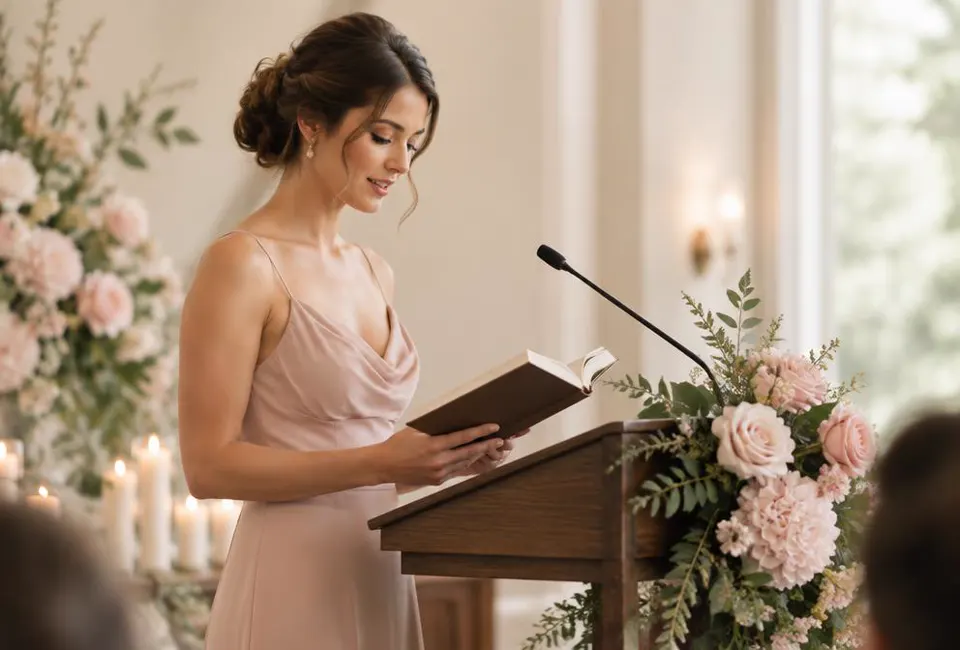
Defining the Purpose and Tone of Your Readings
The wedding readings guide begins by establishing the emotional foundation of your ceremony, ensuring every spoken word aligns with your shared history and future intentions. Before browsing anthologies, you must define the specific energy you want your guests to experience as they witness your union.
Wedding readings serve as the essential connective tissue of a ceremony, functioning as strategic transitions between formal ritual actions. They are not merely interruptions in the flow. Instead, they provide a necessary pause for reflection after the procession and before the exchange of vows. By selecting the right text, you guide the audience from the excitement of the arrival into a focused state of mind. This structural role allows the officiant to pivot from the introduction to the legal or spiritual core of the day, making the ceremony feel cohesive rather than a series of disjointed events.
The Three Step Framework for Ceremony Tone
To identify your ceremony vibe, apply a three step framework: formal, whimsical, or philosophical. A formal tone utilizes classical literature or traditional religious texts to emphasize the weight and history of marriage. A whimsical tone uses contemporary poetry or lighthearted prose to celebrate the joy and humor inherent in a partnership. A philosophical tone focuses on the abstract nature of love and the social significance of the commitment. Choosing one primary vibe prevents the ceremony from feeling tonally inconsistent, ensuring that the readings support the overall atmosphere you have meticulously planned.
| Vibe Category | Primary Goal | Common Source Material | Emotional Impact |
|---|---|---|---|
| Formal | Establishing Tradition | Shakespeare or Scripture | Reverence and Stature |
| Whimsical | Sharing Joy | Children's Books or Pop Culture | Warmth and Laughter |
| Philosophical | Exploring Meaning | Essays or Modern Poetry | Introspection and Depth |
| Eclectic | Personal Narrative | Song Lyrics or Personal Letters | Intimacy and Connection |
Consider a couple like Liam and Sofia, who are planning their wedding with a global guest list in mind. To narrow their search, they conducted a naming exercise where they identified three core values: Resilience, Curiosity, and Adventure. By pinning these words to their wedding readings guide, they realized that a standard reading about romantic bliss did not fit. Instead, they looked for texts that discussed the challenges of travel and the strength found in long term companionship. This exercise ensures that the selected words act as a true reflection of their unique bond rather than a generic placeholder.
Remember that the tone of your readings often mirrors the scale and investment of the event. While the average wedding in Australia costs about A$35,315 according to Easy Weddings 2025 and the UK average is approximately £20,600 according to Bridebook 2024, the emotional value of the ceremony is dictated by the words spoken. A well chosen reading can elevate a simple courthouse gathering or ground a lavish celebration. By prioritizing the purpose of the text now, you ensure that your ceremony remains a meaningful reflection of your identity regardless of the venue or guest count.
Values Identification Exercise
- Select five adjectives that describe your relationship.
- Remove two adjectives to leave three core values.
- Determine if these values lean toward formal or informal styles.
- Compare these values with your partner to find common ground.
- Write a one sentence mission statement for the ceremony.
- Test potential readings against this mission statement.
- Ensure the tone matches the physical setting of the venue.
The Selection Framework: Finding the Right Text
The process of curating your wedding readings guide requires a systematic approach to ensure your chosen texts resonate with your history and surroundings. By applying a deliberate selection framework, couples can avoid the trap of generic choices and instead present words that feel uniquely theirs.
Selecting the perfect text often feels like searching for a needle in a haystack. To simplify this, use the Wedding Style Formula: (Relationship Length + Core Shared Hobby) multiplied by Ceremony Venue equals your Reading Style. For example, if Elena and Marcus have been together for ten years and share a love for sailing, their ten year history suggests depth and wisdom while their hobby implies movement. If they are marrying in a historic library, the venue dictates a classic or academic tone. This formula prevents stylistic clashes, ensuring that a lighthearted poem does not feel out of place in a cathedral or that a dense philosophical treatise does not bore guests at a beach party.
Bridging Traditions and Global Backgrounds
For international couples, the selection framework must account for linguistic and cultural diversity. Consider the case of Priya and Hans, who combined Vedic poetry with German folklore. To make this work, they selected shorter passages from each tradition that shared a common theme of 'growth.' When blending cultures, the rule is to prioritize universal sentiments over niche references that might confuse half of the room. You can also provide translated programs to bridge the gap. This ensures every guest feels included in the narrative rather than observing a ceremony they cannot fully comprehend or follow.
| Scenario | Venue Type | Primary Tone | Suggested Genre |
|---|---|---|---|
| Long term + Hiking | Mountain Peak | Rugged/Enduring | Nature Poetry |
| Recent + Cooking | Urban Bistro | Sensory/Warm | Modern Prose |
| Long term + History | Ancient Castle | Grand/Formal | Classic Literature |
| Mid term + Travel | Botanic Garden | Whimsical/Expansive | Contemporary Lyrics |
| International + Art | Modern Gallery | Abstract/Eclectic | Bilingual Verse |
If you are struggling to find texts, outsourcing the search to trusted mentors can provide fresh perspectives. Use a script like this: Dear [Name], we are building our wedding readings guide and would value your input. Given our shared history of [shared value], is there a passage from a book or poem that reminds you of our partnership? We are looking for something under three minutes in length that reflects a [Tone] atmosphere. This approach often unearths hidden gems that a couple might never find on their own, adding a layer of communal meaning to the ceremony proceedings.
Vetting for length is the final and most critical step in the selection framework. A common mistake is choosing a beautiful text that is simply too long. To maintain guest engagement, no single reading should exceed three minutes. On average, a person speaks at 130 to 150 words per minute. This means your selected text should be approximately 400 words or fewer. If a beloved passage is longer, you must edit it down to its core essence. Always read the text aloud with a stopwatch to account for the slower pace and emotional pauses that naturally occur during a live wedding ceremony.
Text Vetting Checklist
- Does the text pass the three minute read aloud test?
- Is the language accessible to guests of all ages?
- Does the tone align with the ceremony venue constraints?
- Have you removed any gendered language that feels dated?
- Does the reading avoid inside jokes that exclude guests?
- Is the text free of complex jargon or difficult pronunciation?
- Does it reflect the current stage of your relationship?
- Is there a clear beginning, middle, and end to the passage?
Once you have filtered your choices through these logistical and emotional lenses, you will have a shortlist that feels balanced. Remember that the goal is not to educate the audience but to provide a window into your shared world. By adhering to the time limits and the style formula, you ensure that the readings serve as a highlight rather than a lull in the day. This systematic vetting process transforms the task from an overwhelming search into a creative exercise that reinforces your bond and respects the attention of your gathered friends and family.
Navigating Legal and Religious Requirements
As you build your wedding readings guide, understanding the regulatory landscape of your venue is essential for avoiding last minute script revisions. Legal and religious constraints vary significantly by jurisdiction, often dictating exactly what can or cannot be spoken during the ceremony.
The location of your ceremony creates the legal framework for your spoken content. In countries like the UK or Australia, civil ceremonies performed by government registrars are strictly secular. This means any reading containing religious references, including mentions of God, heaven, or scripture, is legally prohibited from the ceremony. Conversely, religious institutions may require all readings to be sourced from specific holy texts, leaving no room for contemporary poetry. For example, a couple like Elena and Marcus marrying in a Catholic church in Rome may find they are limited to a specific list of biblical excerpts, whereas their peers marrying in a public park in Melbourne must scrub all spiritual language to satisfy the Marriage Act requirements.
Navigating these restrictions requires a nuanced approach to text selection. If you are restricted by secular laws, you can retain the historical weight of classic literature by choosing passages that focus on universal human experiences. A common mistake is assuming that 'secular' means 'modern.' In reality, many ancient Greek or Roman texts offer the same gravitas as religious liturgy without violating legal constraints. By focusing on philosophical concepts such as virtue, loyalty, and time, couples can maintain a sense of formal tradition. This allows the ceremony to feel significant and grounded in history without crossing the line into prohibited religious territory.
Adapting Traditional Texts for Modern Standards
When adapting traditional or older texts to meet modern secular standards, the goal is to preserve the cadence while updating the context. Consider the 'Structural Substitution' formula: identify the core metaphor of a historical text and swap the deity or religious instruction for a secular equivalent like 'the community' or 'the force of nature.' For instance, instead of a blessing that invokes divine protection, choose a reading from Khalil Gibran or Victor Hugo that uses architectural or seasonal metaphors to describe the strength of a union. This maintains the aesthetic of a timeless reading while ensuring the content remains compliant with the legal or personal requirements of your specific venue.
| Venue Type | Typical Content Rule | Common Restriction |
|---|---|---|
| UK/Australia Civil Office | Strictly Secular | No hymns or biblical quotes |
| Religious Sanctuary | Canon Restricted | Only approved holy texts |
| US/Canada Private Venue | Full Freedom | Limited only by officiant |
| Public Park/Beach | Generally Secular | May require noise permits |
Before finalizing your selection, you must consult with your authorized celebrant or officiant. They are the final gatekeepers of the ceremony legality and can offer specific guidance on local bylaws. Some officiants are flexible and allow religious readings as long as they are categorized as 'personal reflections' rather than 'official readings,' while others must strictly follow a pre-approved script. Establishing this dialogue early prevents the stress of having a meaningful reading rejected days before the wedding. Always provide the full text to your officiant at least six weeks in advance to ensure there is time for necessary edits or substitutions if a particular passage is flagged.
Officiant Approval and Compliance Checklist
- Confirm if the venue is legally classified as a secular or religious space.
- Submit the full text of all readings to the officiant for review.
- Ask if there are specific 'forbidden words' based on local marriage laws.
- Verify if readings must be chosen from an approved list of texts.
- Check if the reader's introduction to the text needs to be secular.
- Identify if non-religious poetry is permitted in a house of worship.
- Ensure the length of the readings fits within the allotted ceremony time.
- Confirm if translations are required for readings in other languages.
Ultimately, the intersection of law and tradition should not stifle your creativity but rather provide a clear boundary for it. By understanding these requirements early, you can curate a wedding readings guide that respects both your personal values and the legal obligations of your jurisdiction. Whether you are stripping away religious layers to satisfy a registrar or searching for a hidden secular gem that carries the weight of a thousand years, the effort ensures your ceremony is both legally sound and emotionally resonant. This balance is the hallmark of a well-planned ceremony that honors the past while looking forward to a modern future together.
Selecting and Coaching Your Readers
The success of your wedding readings guide strategy relies heavily on the delivery of the chosen text, which requires a shift from choosing people based solely on obligation to selecting them based on capability. This section provides the tools to vet your participants and coach them toward a performance that resonates with every guest in the room.
Many couples default to siblings or childhood friends for readings without considering their public speaking comfort. While emotional closeness is important, a nervous reader can inadvertently rush the most meaningful parts of your ceremony. To move beyond family hierarchy, evaluate potential participants based on their vocal clarity and their ability to handle pressure. You should aim for a mix of voices that complement the tone of your ceremony. If a close relative is particularly anxious about speaking, consider giving them a different role, such as a witness or usher, and save the reading for someone who will truly enjoy the moment.
| Attribute | Low Score (1) | High Score (3) | Impact on Ceremony |
|---|---|---|---|
| Punctuality | Always late to social events | Consistently early or on time | Critical for rehearsal attendance |
| Vocal Volume | Mumbles or speaks softly | Naturally projects their voice | Ensures guests in the back rows hear |
| Preparation | Disorganized or forgets tasks | Attention to detail is high | Reader will actually practice the text |
| Emotional Control | Easily overwhelmed by tears | Can stay composed under stress | Maintains the flow of the script |
| Public Speaking | Visible stage fright | Comfortable in front of crowds | Reduces awkward tension for guests |
When you have identified a reader who might be hesitant, use a script that offers them a clear exit if they feel uncomfortable. Imagine Sarah and David are asking their shy friend, Marcus, to read. Sarah might say: Marcus, we both love your perspective on life and would be honored if you read a short poem during our ceremony. We know you are not a fan of the spotlight, so we have picked a text that is only eight lines long. If this feels like too much pressure, please say no and we will find another way to involve you. This approach removes the guilt and ensures the reader is a willing participant.
Technical Coaching: The Pause for Three Rule
Once your readers are confirmed, provide them with specific technical advice to improve their delivery. The most effective technique is the Pause for Three rule. Instruct your readers to mentally count to three at every period and two at every comma. This forced deceleration prevents the common mistake of rushing through the text due to adrenaline. It allows the audience to digest the metaphors and emotional weight of the words. When readers rush, the audience misses about forty percent of the content. A deliberate pace ensures that every word you carefully selected is actually heard and understood by your guests.
Finally, ensure your readers have a physical copy of the text printed in a large, clear font. Relying on a smartphone screen is a mistake because screens can auto-lock or glare under sunlight. Provide a folder or a piece of cardstock to prevent the paper from shaking in their hands. During the rehearsal, have them read the entire piece out loud twice. This builds muscle memory and helps them adjust to the acoustics of the space. By providing this level of support, you transform a potentially stressful task into a confident contribution to your wedding day.
Reader Preparation Checklist
- Send the final text to the reader at least one month early.
- Confirm the reader can attend the wedding rehearsal.
- Print the reading in 14 point font with double spacing.
- Mark the Pause for Three breathing points in red ink.
- Advise the reader to look up at the couple during the final line.
- Check that the reader knows how to adjust the microphone stand height.
- Ensure the reader has water available before they head to the altar.
- Provide a backup physical copy to the wedding officiant.
Strategic Placement Within the Ceremony Order
The strategic placement of wedding readings dictates the emotional rhythm of your celebration. By mapping text to the ceremony energy arc, you ensure every word resonates without disrupting the natural flow of your union.
Effective wedding readings guide the audience through an intentional energy arc. This arc usually begins with a high sense of anticipation, settles into a reflective middle, and peaks during the legal or symbolic exchange of vows. Placing a reading too early can feel abrupt before guests have settled, while placing too many near the end can delay the celebratory exit. Example couple Maria and Julian opted for a lighthearted poem during the opening to set a welcoming tone, followed by a deeper philosophical text just before their vows to ground the atmosphere. This structure allows the audience to transition from social excitement to focused reverence.
Positioning for Maximum Emotional Impact
The opening reading serves as a thematic anchor. It defines the 'why' of the day, often focusing on community or the broad concept of love. In contrast, middle readings act as a bridge between the introduction and the formal commitment. These are ideal for personal stories or family traditions. The most poignant slot is the pre-vows position. At this moment, the energy is at its most concentrated. A short, powerful reading here acts as a deep breath, focusing the couple and the guests on the magnitude of the promises about to be made. Avoid using more than three readings to keep the timeline tight.
| Time Marker | Ceremony Element | Reading Type | Energy Level |
|---|---|---|---|
| 00:00 to 05:00 | Processional and Welcome | None | High/Expectant |
| 05:00 to 08:00 | Opening Remarks | Thematic/Light Poem | Steady/Warm |
| 08:00 to 18:00 | Addressing the Couple | Prose or Scripture | Reflective/Deep |
| 18:00 to 20:00 | Transition to Vows | Short/Sacred Text | Quiet/Intimate |
| 20:00 to 30:00 | Vows, Rings, and Exit | None | Peak/Celebratory |
Transitioning between music and spoken word is where many ceremonies falter. To avoid awkward silences, use a 'fade and hold' technique. As the music concludes, the officiant should provide a one sentence introduction for the reader while the last note lingers. This prevents the 'dead air' that occurs when a reader walks to the lectern in total silence. Example couple Sarah and Hiroshi coordinated with their string quartet to have a soft underscore continue at 10 percent volume during their first reading. This creates a cinematic quality that binds the disparate elements of the ceremony into a single, cohesive narrative experience.
When planning your wedding readings guide, consider the physical logistics of the reader's movement. If the reader must travel from the third row to the front, the officiant should fill that space with a brief context about the text or the reader's relationship to the couple. Never leave your reader standing in silence. A common mistake is for the officiant to say: 'And now, a reading.' Instead, use a script like: 'To reflect on the journey that brought us here, Sarah’s sister, Elena, will share a passage from their favorite childhood book.' This provides a graceful handoff and keeps the audience engaged throughout the transition.
Logistical Flow Checklist
- Confirm the reader knows their exact cue in the ceremony order.
- Ensure the microphone is adjusted for the reader's height before they start.
- Check that the transition music does not overpower the reader's voice.
- Provide a printed copy of the text at the lectern as a backup.
- Plan the reader's exit path to avoid crossing in front of the photographer.
- Practice the verbal handoff script with your officiant.
- Verify that the reader knows to wait for the music to fully stop.
- Allocate exactly three minutes per reading including movement time.
Ultimately, the placement of your readings should serve the overall budget and scale of the event. Whether you are part of the average wedding spend of about $33,000 according to The Knot Real Weddings Study 2025 or the A$35,315 average in Australia cited by Easy Weddings 2025, the flow of your ceremony is a free way to elevate the guest experience. Thoughtful placement costs nothing but adds significant value. By avoiding the 'reading sandwich' where texts are clustered together, you allow each chosen word to breathe and contribute to a balanced, memorable 30 minute timeline that feels both professional and deeply personal.
Common Pitfalls in Wedding Readings
Even the most carefully selected wedding readings guide can fail to achieve its full potential if the delivery is undermined by logistical oversights. Avoiding common pitfalls ensures that the ceremony remains inclusive, professional, and emotionally resonant for every guest in attendance.
The most frequent error in ceremony planning is the Inside Joke Trap. While it is tempting for a couple like Elena and Marcus to select a reading filled with niche references to their shared hobby of competitive rowing, these choices often alienate the audience. When a reader mentions a specific nickname or a private incident without context, the guests feel like spectators to a conversation they were not invited to join. To avoid this, ensure every reading possesses a universal theme such as loyalty, growth, or companionship. If a personal anecdote is necessary, the reader should briefly define the context for the crowd before beginning the text.
Physical Logistics and the Paper Fumble
A common scene that disrupts the sanctity of the moment is the Paper Fumble. This occurs when a reader approaches the podium with a thin, fluttering piece of printer paper that shakes in their hands due to nerves. Not only does the sound of crinkling paper get amplified by the microphone, but it also looks disorganized in professional photography. A practical solution used by wedding planners involves mounting the printed text onto heavy cardstock or placing it inside a high quality leather folder. This provides the reader with a steady weight to hold, which physically anchors their hands and prevents the text from curling or flying away in an outdoor breeze.
| Common Error | Visual Impact | Practical Solution |
|---|---|---|
| The Inside Joke Trap | Confused or bored guests | Limit private references to 10% of text |
| The Paper Fumble | Distracting noise and shaking | Use a leather folder or cardstock |
| Last Minute Edits | Stumbling and loss of flow | Lock text 72 hours before ceremony |
| Microphone Distance | Inaudible or muffled words | Conduct a sound check at the venue |
| Pacing Issues | Rushed, unintelligible speech | Add breath marks in red ink on text |
Last minute changes represent a significant risk to the confidence of your chosen readers. Consider a scenario where a couple decides to swap a poem for a prose excerpt the night before the wedding. This adjustment can rattle a reader who has spent weeks practicing the rhythm and cadence of the original selection. When a reader feels unprepared, they are more likely to speak too quickly or fail to look up at the audience. Couples should treat the reading text as final at least three days prior to the event. This stability allows the reader to focus on their emotional delivery rather than basic word recognition.
Finally, couples often forget to account for the physical height of the microphone and the lighting at the lectern. If a reader is significantly shorter or taller than the previous speaker, they may spend the first thirty seconds of their reading awkwardly adjusting hardware. Dim lighting can also make small fonts impossible to read for those who require glasses. To prevent these technical failures, provide the reader with a large font size, at least fourteen point, and ensure the officiant is briefed on adjusting the microphone stand quickly. These small preparations ensure the focus remains on the sentiment of the words rather than the mechanics of the stage.
Ceremony Reading Quality Control
- Verify that the text is printed in 14 point font or larger for legibility.
- Mount the reading on cardstock to prevent audible paper rustling.
- Confirm the reader has practiced with the final version for 72 hours.
- Check that the text contains no more than one niche personal reference.
- Provide a backup copy of the reading to the officiant or wedding planner.
- Test the microphone height and sensitivity during the rehearsal.
- Ensure the reader knows exactly which cue triggers their walk to the front.
- Highlight specific words where the reader should pause for emphasis.
- Review the text for any complex names or words that require phonetic spelling.
Contextualizing Your Ceremony Spend
Completing your wedding readings guide requires a grounded look at how ceremony elements fit into your global financial plan. While the readings themselves cost nothing to perform, the framework surrounding them represents a critical emotional investment.
When planning your wedding readings guide, it is essential to view the ceremony as the emotional anchor of the day. Globally, wedding spends vary significantly. The Knot Real Weddings Study 2025 reports the US average at about $33,000, while the UK ranges from £20,600 according to Bridebook 2024 to £23,000 according to Which? 2024. In the southern hemisphere, Easy Weddings 2025 notes the Australian average is A$35,315, and RBC estimates Canada sits near C$30,000. Despite these high figures, the ceremony usually occupies the smallest portion of the budget, even though it provides the most lasting memories for the couple.
The Five Percent Framework for Ceremony Excellence
For couples like Chloe and Liam, who are balancing a fixed budget in Melbourne, the 2 to 5 percent rule is a vital decision framework. This percentage covers officiant fees, legal filings, and the tactile elements of the readings. Allocating this small slice ensures that your chosen texts are presented beautifully. If you spend $33,000, setting aside roughly $660 to $1,650 ensures that the readers have high quality printed scripts and the sound system is adequate for guests to hear every word. This prevents the common mistake of spending heavily on the reception while neglecting the ceremony infrastructure.
| Category | Target Percentage | Example Items | Strategic Value |
|---|---|---|---|
| Legal and Fees | 1.5 to 2.5 percent | Officiant, Licenses | Ensures legal validity |
| Reading Materials | 0.5 percent | Vellum, Cardstock | Physical keepsake quality |
| Aesthetics | 1.0 percent | Podium, Floral sprays | Visual focus on readers |
| Audio Support | 1.0 percent | Mic rentals, Tech | Audibility for guests |
Prioritizing the ceremony spend allows for specific scripts and rituals that enhance the readings. For instance, a couple in London might use their Bridebook 2024 informed budget to hire a professional speech coach for their readers, which falls under the 5 percent threshold. This is a practical step that transforms a standard recitation into a theatrical highlight. Investing in high quality paper for the readings also serves a dual purpose. It provides a stable, non-rustling surface for the reader and acts as a sophisticated visual element for the wedding photographer during close-up shots of the performance.
Finally, remember that the wedding readings guide is meant to facilitate a moment of connection that transcends monetary value. Even in markets like Canada where RBC notes a C$30,000 average, the most impactful readings are often those that cost the least in materials but the most in thought. By sticking to the 2 to 5 percent allocation, you protect your savings for the reception while ensuring the ceremony feels premium. Avoid the pitfall of assuming a low cost ceremony requires low effort. The logistical support you fund today ensures your chosen words resonate clearly for years to come.
Ceremony Budget Finalization Steps
- Confirm officiant travel and booking fees within the 2 percent baseline.
- Purchase heavy cardstock or leather folders for reading scripts.
- Allocate funds for a sound check if the venue is outdoors.
- Set aside a small fee for marriage license documentation.
- Review printing costs for ceremony programs that list the readings.
- Ensure the floral budget includes a small arrangement for the lectern.
- Account for any shipping costs if ordering specific religious texts.
- Budget for a small thank you gift for each non-professional reader.