The Children at Weddings Decision Framework
Deciding whether to include younger guests is one of the most complex logistical steps in wedding planning, requiring a balance between family tradition and budget constraints. This section provides a structured framework to help you navigate children at weddings etiquette while maintaining your sanity and your vision.
The first step in establishing your children at weddings etiquette is understanding that there is no universal right answer. Couples like Sofia and Mateo may prioritize a festive atmosphere where every niece and nephew is present, while others like Hiro and Aki may prefer a serene, evening focused event. To begin, perform a cost impact analysis using your total guest count. In the UK, where the average wedding cost is about £20,600 according to Bridebook 2024, adding twenty children could increase catering and rentals by nearly 15 percent. By identifying your financial ceiling first, you can make an objective decision rather than an emotional one.
The Three Circle Method for Invitation Strategy
To avoid feelings of exclusion among guests, use the Three Circle Method to define your boundaries. The Inner Circle includes children of the couple or those in the wedding party only. The Middle Circle extends to immediate family, such as siblings children. The Outer Circle represents a blanket policy, either inviting all children of all guests or hosting an adults only event. For example, a Canadian couple facing the average C$30,000 cost reported by RBC might choose the Middle Circle to ensure their closest relatives are present without the expense of a hundred person guest list expansion.
| Strategy | Target Audience | Typical Impact | Pros/Cons |
|---|---|---|---|
| Adults Only | 18 or 21 plus | Reduced cost | Sleek tone: High travel friction |
| Immediate Only | Nieces and nephews | Moderate cost | Family inclusion: Hard to explain |
| Age Cut-off | 12 plus or 16 plus | Variable cost | Easier behavior: Separation of siblings |
| Full Inclusion | All ages | Highest cost | High energy: Requires extra childcare |
| Breastfeeding Only | Infants under 12m | Minimal cost | Supports parents: Possible crying |
When choosing an age cut off, consistency is the primary rule of children at weddings etiquette. If you invite one ten year old cousin, you should ideally invite all cousins of that age to prevent social friction. In Australia, where weddings average A$35,315 according to Easy Weddings 2025, many couples use a twelve year old cut off to ensure guests can enjoy adult food and longer ceremonies. Whatever age you choose, ensure it is applied across the board. Making exceptions for one friend but not another is a common mistake that leads to hurt feelings and awkward reception conversations.
Finally, consider the logistical realities of your venue before finalizing your decision. A cliffside ceremony or a gallery filled with fragile art may not be suitable for toddlers regardless of your budget. If your heart is set on a specific location that is not child friendly, the adults only policy becomes a matter of safety rather than just etiquette. Discuss these physical constraints with your partner early in the process. By setting these parameters before the first invitation is addressed, you protect your vision and provide clear, fair expectations for your entire guest list.
Decision Framework Checklist
- Calculate the per head cost for children versus adults.
- Verify venue safety and insurance for minor guests.
- Determine if the ceremony time aligns with toddler sleep schedules.
- Decide if you will offer professional on site childcare.
- Establish a firm age cut off and stick to it.
- Review the guest list to see how many families are impacted.
- Confirm if immediate family members can travel without their children.
Clear Communication and Invitation Wording
Effective children at weddings etiquette begins with clear, respectful communication that leaves no room for ambiguity on the guest list. By framing your decisions with positive language, you can set firm boundaries without causing offense to your loved ones.
The primary rule of wedding stationery is to address the envelope to the specific people invited. If a couple like Sarah and David receive an invitation addressed to The Miller Family, they will naturally assume their three toddlers are included. To avoid this, address the invitation only to Mr. and Mrs. Miller. However, modern etiquette often requires a more explicit approach to prevent awkward follow up calls. Instead of using the blunt phrase No Children, which focuses on a restriction, use positive phrasing such as We have reserved two seats in your honor. This informs the guests of their limit while making them feel valued as individuals.
Scripts for Different Attendance Scenarios
When a couple decides on a strictly adults only celebration, the wording must be consistent across the physical invitation and the wedding website. For a total restriction, you might write: While we love your little ones, our wedding will be an adults only event. We hope you can join us for a night of celebration. If you are making an exception for nursing infants, clarify this by stating: Due to venue restrictions, we are unable to accommodate children, with the exception of nursing infants under twelve months. This acknowledges the unique needs of new parents while maintaining the overall boundary for older children and toddlers.
| Scenario | Recommended Wording | Communication Channel |
|---|---|---|
| Strictly Adults Only | Please join us for an adults only celebration. | Invitation Card and Website |
| Nursing Infants Only | Adults only please, though nursing infants are welcome. | Wedding Website FAQ |
| Family Only Exceptions | We are only able to accommodate children of immediate family. | Direct Phone Call or Email |
| Limited Capacity | We have reserved [X] seats in your honor. | RSVP Card |
| On-Site Childcare | Childcare will be provided at the venue for your convenience. | Information Insert |
Managing specific family member exceptions requires a delicate touch to avoid appearing unfair. If a couple like Marcus and Elena decide to invite only their nieces and nephews but no other children, they should communicate this privately before the invitations arrive. On the website, the text can read: We have limited our guest list to include only immediate family children. We appreciate your understanding. This transparency helps manage expectations for friends who might otherwise wonder why some children are present while theirs were excluded. Consistency is the key to maintaining harmony throughout the planning process.
Best Practices for Website FAQ Sections
- Create a dedicated FAQ page to handle children at weddings etiquette questions.
- Include local babysitting agency contact details for out of town guests.
- Specify the exact time the adults only portion of the evening begins.
- Avoid using small or hidden fonts for guest count restrictions.
- Provide a clear deadline for guests to confirm their childcare arrangements.
- State if the venue has specific safety hazards like open water or steep cliffs.
Ultimately, the goal of your wording is to be helpful rather than prohibitive. For example, providing a link to a local childcare service demonstrates that you have considered the logistical challenges your guests face. You might write: To allow all guests a night of relaxation, we have chosen a child free ceremony and reception. We have curated a list of local, certified sitters to assist those traveling with family. This approach turns a restriction into a thoughtful gesture. By being proactive, you reduce the likelihood of guests bringing uninvited children or feeling slighted by the boundary.
Invitation Wording Audit
- Check that names on envelopes match the intended guests exactly.
- Ensure the RSVP card has a clear line for the number of guests attending.
- Verify that the website FAQ matches the physical invitation wording.
- Remove any negative phrases like No Kids or Adults Only No Exceptions.
- Confirm that the tone remains warm and welcoming throughout.
- Include a polite note about venue capacity limits if applicable.
- Double check the spelling of all children included in the wedding party.
- Test the RSVP link to ensure guest counts are locked correctly.
Scripts for Handling Difficult Conversations
Navigating social expectations requires a blend of empathy and unwavering consistency to ensure your children at weddings etiquette remains intact without damaging relationships. By using prepared scripts, you can address pushback professionally while maintaining the boundaries of your specific celebration style.
When Sarah and Marc decided on an adults only black tie event, they immediately faced pressure from Sarah's cousin who lived overseas. The cousin assumed their travel distance earned them an exemption from the rule. To handle this, Sarah used a script focused on the venue capacity and the desire for a specific atmosphere. She stated that while she understood the logistical challenge of finding local care, the couple had committed to a consistent policy for all guests to ensure fairness. By centering the conversation on the wedding vision rather than the child's behavior, Sarah avoided making the rejection feel personal or judgmental toward her cousin's parenting.
Managing Surprise RSVPs and Direct Inquiries
Surprise RSVPs occur when a guest writes in extra names on the reply card. In this scenario, Marc took the lead by calling the guest immediately rather than waiting for the wedding day. His script was direct: 'We noticed you added your children to the RSVP card. As much as we love your family, our venue has a strict capacity limit and we are unable to accommodate guests under eighteen.' This approach prevents the awkwardness of a child appearing at the ceremony without a seat or meal. It is essential to communicate these limits as a universal rule rather than a choice directed at one specific family.
| Scenario | Guest Question | Polite Response Script |
|---|---|---|
| The 'Exception' Ask | Can I bring my well behaved toddler? | We wish we could include everyone, but we have decided to keep the event adults only to stay within our guest limit. |
| The Nursing Mother | I am breastfeeding, can my infant come? | We completely understand. We have arranged a quiet space nearby, but the main event area remains adult only for all guests. |
| The Family Pressure | But the kids are family! | We love the children in our family, yet we have chosen a formal evening setting that is not suitable for young guests. |
| The Travel Excuse | We are traveling from far away. | We truly appreciate the journey you are making. We can help provide contact details for local, certified childcare services. |
| The Late RSVP | I already booked their flight. | I am so sorry for the misunderstanding. Our invitation was intended for the named guests only due to venue restrictions. |
The key to maintaining long term family harmony is to avoid getting drawn into a debate about the merits of children at weddings etiquette. When Sarah was asked to justify why her wedding was not child friendly, she did not provide a long list of reasons. Instead, she repeated a variation of the same phrase: 'This was a difficult decision for us, but this is the format we have chosen for our day.' By staying firm and not offering 'loopholes' for guests to argue against, she minimized the opportunity for prolonged tension. Consistency across both sides of the family is the most effective way to prevent feelings of exclusion.
Steps for a Firm and Fair Conversation
- Call the guest directly rather than using text or email for sensitive news.
- Express genuine excitement about the guest attending the wedding.
- State the no child policy clearly without over explaining or apologizing excessively.
- Use 'we' statements to show the couple is united in this decision.
- Offer to help find local childcare resources if they are traveling from afar.
- Listen to their concerns but do not promise to rethink the decision.
- End the conversation on a positive note by discussing other wedding details.
- Document the guest response to ensure the caterer has the final correct count.
Couples often worry that being firm will result in guests declining the invitation. While some guests may be unable to attend without their children, Marc and Sarah realized that those who truly want to celebrate will usually find a solution. In some cases, guests might feel a sense of relief at having a night off from parenting duties. By providing clear scripts and sticking to them, you demonstrate respect for your own wedding vision while allowing guests the autonomy to make their own travel and care decisions based on the information provided.
Professional Childcare and On-Site Solutions
Balancing the joy of including families with the sophistication of a formal event requires strategic infrastructure. By integrating professional childcare into your children at weddings etiquette plan, you ensure both parents and guests enjoy an uninterrupted celebration.
For couples who choose to include children but desire a seamless flow for their ceremony and reception, hiring professional on-site nannies is a premier solution. This approach allows children to attend the milestone moments while providing a transition to a supervised environment during the formal meal or late night dancing. Professional event sitters are trained to manage groups in unfamiliar venues, ensuring safety and engagement. When Sofia and Mateo planned their wedding, they hired one sitter for every four children under the age of five. This ratio allowed the parents to focus on the couple during the vows, knowing their toddlers were nearby but adequately entertained in a separate suite.
Designing Quiet Zones and Creative Kids Corners
A dedicated quiet zone or kids corner functions as a sanctuary within the venue where younger guests can decompress. This space should be physically separated from the main ballroom to minimize noise transfer. Ideal logistics involve soft seating, low lighting, and age appropriate activities that do not involve loud electronic toys. Consider including coloring stations, puzzle books, or even a supervised movie area. For a wedding at a large estate, you might designate a parlor or library for this purpose. The goal is to provide a space where a tired child can rest without their parents feeling forced to depart the wedding early.
The etiquette of who pays for these services often depends on the scale of the event and cultural norms. Generally, if the couple mandates that children stay in a separate room during the reception, the couple should cover the cost of the professional sitters. This is viewed as a hosted amenity, similar to an open bar or transportation. However, if the service is optional, the couple might provide the space and a vetted list of sitters while parents handle the individual fees. Clear communication is vital. For example, a note could state: We have arranged for professional childcare on-site from 6 PM until midnight to ensure you can enjoy the evening.
| Age Range | Sitter Ratio | Primary Activity | Space Requirement |
|---|---|---|---|
| Infants (0 to 2) | 1 to 2 | Sleep and feeding | Quiet, darkened room |
| Toddlers (3 to 5) | 1 to 4 | Interactive play | Soft floor mats |
| Primary (6 to 10) | 1 to 8 | Games and crafts | Table for activities |
| Tweens (11 to 13) | Optional | Socializing | Main room access |
Security and safety protocols must remain the top priority when setting up on-site solutions. Every childcare provider should be background checked and insured for event work. The couple should provide the nannies with a guest list that includes parent phone numbers and a list of any known allergies. Logistics should also include a check in and check out system to ensure no child leaves the designated area without their specific guardian. By formalizing these steps, you demonstrate respect for your guests' children while maintaining the high standards of your event. This structure prevents common issues like children wandering near the cake or dance floor during key moments.
Childcare Logistics Checklist
- Verify venue insurance requirements for external childcare vendors.
- Ensure the childcare room is within a short walking distance of the reception.
- Provide nannies with a detailed timeline of the wedding events.
- Confirm that the catering team can deliver kids meals to the childcare room.
- Set up a dedicated changing station and nursing area if infants are present.
- Create a sign in sheet for parents to list emergency contact details.
- Establish a clear policy on whether sitters can take children outside.
- Review the room for potential hazards like sharp corners or glass decor.
- Supply a first aid kit specifically stocked for pediatric needs.
Managing the Ceremony: Roles and Realities
Successfully integrating young participants into a wedding requires balancing the aesthetic charm of flower girls and ring bearers with the biological realities of childhood attention spans. This section provides a strategic framework for managing these roles while maintaining the solemnity of your vows.
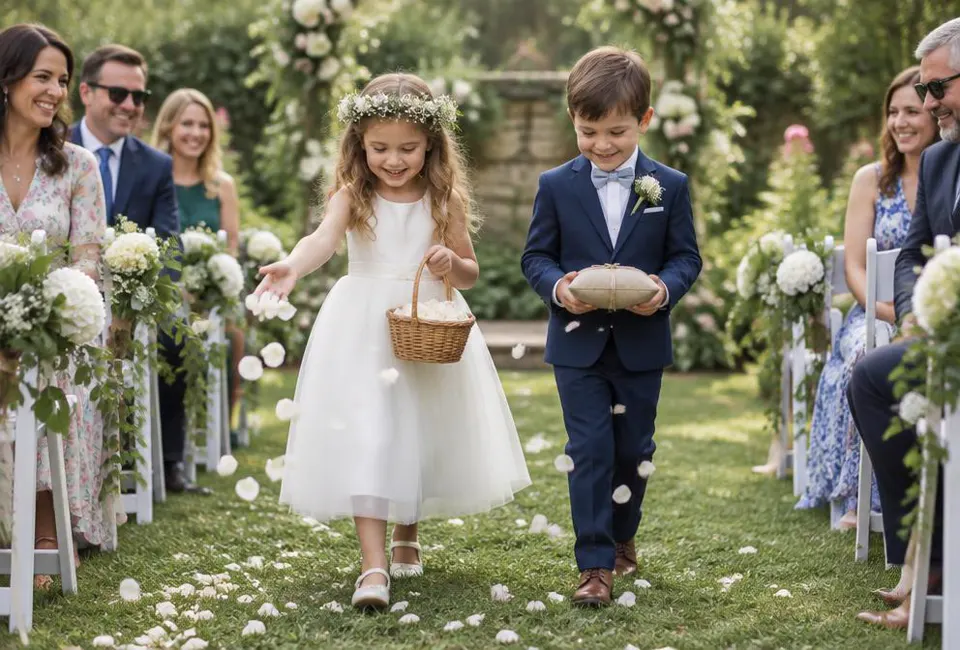
When selecting children for roles such as junior bridesmaids or ring bearers, couples must evaluate the child's temperament rather than just their family connection. While a three year old flower girl offers an adorable processional moment, their capacity to follow complex instructions is limited compared to a ten year old junior usher. For example, Elena and Marcus decided to include their four nephews. Instead of giving each a specific task, they assigned the older two as 'protectors' of the younger ones. This created a peer support system that reduced stage fright. Roles should be clearly defined and rehearsed during the welcome dinner to ensure every child feels confident in their physical path toward the altar.
Strategic Assignments and Age Considerations
| Age Range | Recommended Role | Primary Responsibility | Supervision Need |
|---|---|---|---|
| 2 to 4 Years | Flower Girl / Page | Walking the aisle | High: Needs adult at front |
| 5 to 8 Years | Ring Bearer / Sign Carrier | Delivery of items | Moderate: Needs clear cues |
| 9 to 12 Years | Junior Attendant | Ushering or reading | Low: Independent execution |
| 13+ Years | Full Attendant | Standard bridal party | None: Treated as adult |
A common mistake involves expecting young children to stand at the altar for the duration of the service. Even the most well behaved child will likely begin fidgeting after ten minutes of standing still. To keep the focus on the couple, children under the age of eight should have a designated 'exit strategy' immediately following their walk. Sarah and David implemented a rule where their ring bearer handed the box to the Best Man and then immediately sat in the front row with his grandparents. This prevents the distraction of restless children behind the couple during the exchange of rings and the first kiss, which are the most photographed moments.
The Meltdown Mitigation Plan
- The Parental Anchor: Station the child's parent or a familiar adult in the third or fourth row on the aisle to act as a visual target.
- The Bribe System: Use a 'treasure at the end' approach where a small, quiet toy or snack is waiting in the pew.
- The Buddy System: Pair a toddler with an older child or a sibling to hold hands during the processional.
- The Immediate Exit: If a child begins to cry or shout, the designated guardian should escort them to a prearranged quiet zone instantly.
- The Dummy Ring Policy: Never give the actual wedding bands to a child under ten: use decorative replicas instead.
- The Pre-Processional Burn: Ensure children have a chance to run or move vigorously thirty minutes before the ceremony begins.
Effective children at weddings etiquette also dictates how the couple handles the unexpected. If a flower girl refuses to walk at the last second, the wedding coordinator should be instructed to let her bypass the aisle rather than forcing the moment. In a scenario involving Leo and Chloe, their three year old nephew sat down halfway through the aisle. Because they had pre briefed the ushers, a designated family member simply scooped him up and finished the walk without breaking the ceremony flow. Preparing for these realities ensures that minor disruptions do not become focal points of the day, allowing the couple to remain the center of attention.
Finally, consider the sensory environment of the ceremony venue. Loud organ music or cheering crowds can be overwhelming for young children. If your budget aligns with the US average of about $33,000 (The Knot Real Weddings Study 2025) or the UK average of £20,600 (Bridebook 2024), you might allocate a small portion to a professional 'ceremony handler' specifically for the wedding party children. This individual ensures they are fed, pottied, and calm before the music starts. For couples in Australia spending around A$35,315 (Easy Weddings 2025), this role is often handled by a trusted non family member to allow parents to focus on the ceremony itself.
Ceremony Readiness Checklist
- Confirm every child has attended the rehearsal at the actual venue.
- Verify that all children have used the restroom 15 minutes before start.
- Designate an 'Exit Row' seat for parents of performing children.
- Prepare 'Quiet Kits' with stickers or pipe cleaners for the pews.
- Check that shoes are comfortable and broken in to prevent tripping.
- Assign one adult who is not in the wedding party as the primary point of contact for the kids.
- Brief the photographer on which children might need quick candid shots before they get restless.
- Ensure all flower petals or props are approved by the venue coordinator.
Reception Amenities: Food, Fun, and Safety
When guests bring their families, the reception strategy must transition from formal elegance to practical functionality. Successful children at weddings etiquette relies on proactively managing their physical needs and physical boundaries to ensure the party remains safe and enjoyable for all ages.
Strategic Catering for Younger Guests
Meal timing and composition are critical for maintaining a peaceful environment. While many venues default to pasta or chicken nuggets, these high carbohydrate options often lead to sugar crashes and irritability. Consider the example of Elena and Marco, who worked with their caterer to serve a protein rich menu featuring grilled chicken strips, hummus with vegetable sticks, and cheese cubes. By prioritizing high protein and low sugar options, they avoided the mid evening energy spikes that lead to disruptive behavior. It is also beneficial to serve children as soon as they are seated, rather than waiting for the formal multi course service to begin for adults.
The placement of the children's dining area is just as important as the food itself. A common mistake is grouping all kids in a separate room without supervision or placing them too far from their parents. A more effective approach is to locate the kids' tables near the perimeter of the room but within a clear line of sight of their guardians. This allows parents to enjoy their own meals while monitoring their children. Additionally, ensure that waitstaff are briefed on the importance of clearing glass and sharp cutlery quickly from these tables to prevent accidents during the meal service.
| Feature | Standard Approach | Strategic Approach | Benefit |
|---|---|---|---|
| Sugar Content | High (Juice, Cake) | Low (Water, Fruit) | Prevents hyperactivity |
| Protein Ratio | Low (Breaded items) | High (Grilled meats) | Sustained energy |
| Service Speed | With main course | Immediate arrival | Reduces restlessness |
| Safety Zone | Near dance floor | Protected corner | Prevents collisions |
| Supervision | None | Designated sitter | Peace of mind |
Spatial Safety and Floor Plan Logic
The physical layout of the reception hall presents hidden hazards that require careful planning. High chairs should never be placed at the edge of the dance floor or in high traffic areas where servers carry heavy trays. Instead, tuck these chairs into stable corners or between two adult chairs to create a buffer. Take the case of Sarah and Liam, who used a floor plan software to ensure their tiered wedding cake was placed on a sturdy table against a wall rather than in the center of the room. This prevented curious toddlers from accidentally bumping the display during the cocktail hour.
Beyond furniture placement, consider the lighting and wiring of the venue. Tape down all loose cables near the DJ booth and photo booths to prevent tripping hazards for running children. If the venue has water features, stairs, or open balconies, these areas should be clearly marked as off limits or staffed by professional childcare providers. Ensuring a safe environment is not just about the children: it protects the couple from the stress of potential accidents. A well planned space allows parents to relax, knowing their children are in a zone designed for their limited spatial awareness.
The Reception Safety and Comfort Checklist
- Position high chairs away from the dance floor and server entrance paths.
- Ensure the cake table is stable and positioned away from running lanes.
- Select a menu with at least 40 percent protein content for children.
- Replace glass cups with shatterproof options at the children's table.
- Verify that all decorative candles are out of reach of small hands.
- Tape down every visible electrical cord in the reception space.
- Designate a quiet zone with soft mats for overstimulated toddlers.
- Schedule the children's meal to arrive 15 minutes before the adults.
- Check that all tablecloths at kids' tables are not long enough to be pulled down.
Finally, the entertainment provided at the table can serve as a safety tool. Providing mess free activities like sticker books or customized coloring pages keeps children seated and occupied during the long speeches. Avoid toys with small parts that could be choking hazards or loud whistles that could interrupt the toasts. By combining a safe physical environment with engaging, quiet activities, you create a harmonious atmosphere. This comprehensive approach to children at weddings etiquette ensures that the youngest guests are satisfied and safe while the adults celebrate the milestone without constant interruption or safety concerns.
Common Mistakes to Avoid Worldwide
Navigating children at weddings etiquette requires a balance of firm decision-making and empathetic logistics to avoid common global pitfalls. By sidestepping these frequent errors, couples can maintain their vision while ensuring guests feel respected and supported.
One of the most frequent mistakes is inconsistency in rule application, which often leads to hurt feelings among international guests. For example, if Elena and Marcus decide to allow only their nieces but then permit a close friend to bring an infant, they risk alienating family members who paid for childcare. To maintain integrity in your children at weddings etiquette, you must apply your age limits or family-only rules universally. Making exceptions based on favoritism rather than clear logic, such as a nursing infant rule, creates social friction that can overshadow the celebration.
Logistical oversights regarding furniture and timing also create significant stress for parents traveling across borders. Many couples fail to confirm high chair availability with the venue, assuming these items are standard. In reality, a lack of appropriate seating forces parents to hold a child during the entire meal, preventing them from enjoying the event. Furthermore, failing to provide at least three to four months of lead time for destination weddings is a major error. Parents need this window to vet local childcare services or arrange for grandparents to travel, especially when coordinating across different time zones.
Managing Expectations and Infrastructure
Budgeting for these details is essential, as the average wedding cost in the US is about $33,000 according to The Knot Real Weddings Study 2025. In Australia, costs average about A$35,315 per Easy Weddings 2025, while UK couples spend between £20,600 according to Bridebook 2024 and £23,000 according to Which? 2024. Canadian weddings average about C$30,000 per RBC. When these budgets do not account for child-friendly amenities or the necessary communication tools, the guest experience suffers. Neglecting to mention child-free status on the save the date, not just the invitation, is a common oversight that limits a guest's ability to plan their finances and travel.
Finally, ignoring the sensory needs of children during long ceremonies is a recipe for disruption. Couples often forget that international ceremonies can last significantly longer than a standard twenty minute service. Failing to provide a designated quiet zone or an exit strategy for parents with crying infants can lead to preventable interruptions. By planning for a dedicated breakout space and communicating its location early, you empower parents to manage their children effectively without feeling like they are intruding on your special moment or ruining the professional videography.
Final Success Checklist for Wedding Children Policy
- Confirm the exact count of high chairs and booster seats with the venue manager.
- Include a 'Childcare' tab on the wedding website with local agency links.
- Ensure the 'Save the Date' cards clearly state if the event is adults-only.
- Designate a specific room at the venue for nursing or quiet time.
- Verify that the catering team has a kid-friendly meal option that arrives early.
- Check that your guest list follows a consistent logic for all family branches.
- Provide a list of nearby playgrounds or parks for guests arriving days early.
- Brief the ushers on how to discreetly assist parents who need to exit a ceremony.
- Review the seating chart to place families near exits and restrooms.